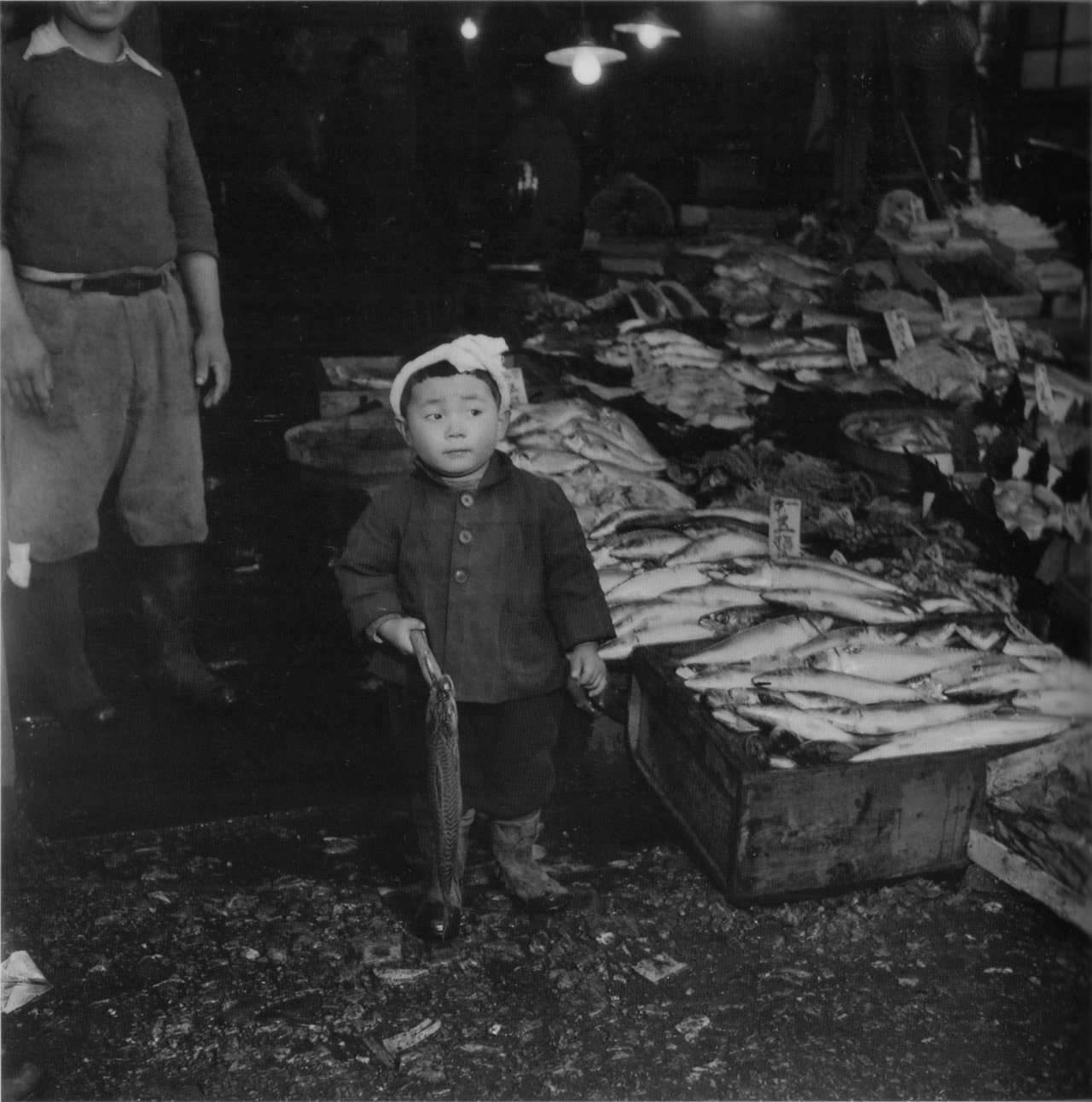
Photo: Nagano Shigeichi, Tsukiji, Tokyo, 1949, public domain, via Wikimedia Commons
Three hundred and sixty. For twenty-two years, from April 1949 to August 1971, that was how many yen one American dollar bought, and nobody had to look it up. Exporters priced on it, importers planned around it, and the few Japanese who could travel abroad budgeted on it.
This week the yen slipped past 160 to the dollar, close to its weakest level since the mid-1980s, and the finance ministry in Tokyo said again that it was ready to respond. Every story about the yen's slide quotes 160 as a "line". It is worth remembering that the yen once had a line that did not move at all, and that the most popular explanation for where it came from is almost certainly wrong.
Too many yen, too many rates
In early 1949, nearly four years into the American occupation, Japan did not really have an exchange rate. It had dozens. Exporters were paid at whatever rate the authorities set for their particular product; according to the Japanese finance ministry's own official history, export rates in January 1949 ran from 160 yen to the dollar for some goods to 600 for others. Textiles alone had three. Imports had a rate of their own. Inflation was running wild. Prices had more than doubled in 1948, and the government was covering its deficits with subsidies and loans from a reconstruction bank that printed money in all but name.
Washington wanted it stopped. The occupation was expensive, and with the Cold War hardening, a Japan that could pay its own way had become a strategic aim in Washington as well as a saving.
The banker from Detroit
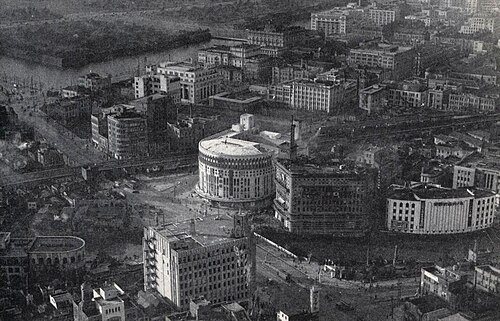
Aerial view of the Ginza district of central Tokyo in 1950, with a large round theatre building at the centre. U.S. Navy photo, public domain, via Wikimedia Commons
The man sent to stop it was Joseph Dodge, president of the Detroit Bank, who had already helped plan the currency reform in occupied Germany. He arrived in Tokyo in February 1949. His programme, which the Japanese press called the Dodge Line, demanded a balanced budget, an end to the subsidies, the closing of the reconstruction bank's lending, and a single exchange rate for everything.
The occupation authorities looked at several figures, including 300 and 400, before settling on 360 in March. The order went out in a memorandum dated 23 April 1949 and the rate took effect two days later, on 25 April. The multiple rates disappeared overnight.
The cure hurt. Firms that had lived on subsidies went under, there were mass layoffs, and the recession that followed was nicknamed the Dodge squeeze. What ended it was not Dodge at all but the Korean War, which began in June 1950 and turned Japan into the supply base for the American army. With the yen pinned at a rate that made Japanese goods cheap, exports climbed for the next two decades.
Why 360, then
Ask in Japan why the number was 360 and you may well hear the circle story. The character for yen, 円, also means a circle or something round. A circle has 360 degrees. So, the story goes, some American official with a sense of humour, or of order, picked 360.
I have looked for a document that says this and have never seen one. The finance ministry's history describes occupation officials weighing several figures, 300 and 400 among them, and says nothing about circles. The circle explanation seems to have attached itself afterwards, because it is neat and because 360 is such a satisfying number to have stumbled into. That does not prove nobody in the room made the joke. I just don't think the joke chose the number.
The end of the circle
The rate held through Britain's devaluation of the pound in September 1949, through the Korean War boom and through Japan's whole high-growth era. It ended because of a decision made in Washington, not Tokyo. On 15 August 1971 Richard Nixon suspended the dollar's convertibility into gold. Most foreign exchange markets shut; Tokyo stayed open for about two weeks and the Bank of Japan bought dollars at the old rate until it gave up and let the yen float at the end of the month. That December the Smithsonian agreement reset the rate at 308. By early 1973 the fixed system was gone for good.
The next big move was also made abroad. In September 1985 the finance ministers of the five largest economies met at the Plaza Hotel in New York and agreed to push the dollar down. The yen, at roughly 240 to the dollar that month, was trading in the 150s within about a year, and Japanese exporters who had grown up on 360 complained loudly about what they called the strong yen.
Since then the yen has been everywhere: under 80 to the dollar in 2011, past 160 this week. My guess is that the circle legend survives because twenty-two years of a number that never moved felt like nature to the people who lived through it, and nobody likes to hear that nature was set by memorandum.
Enjoyed this story?Get a new one every day on social.