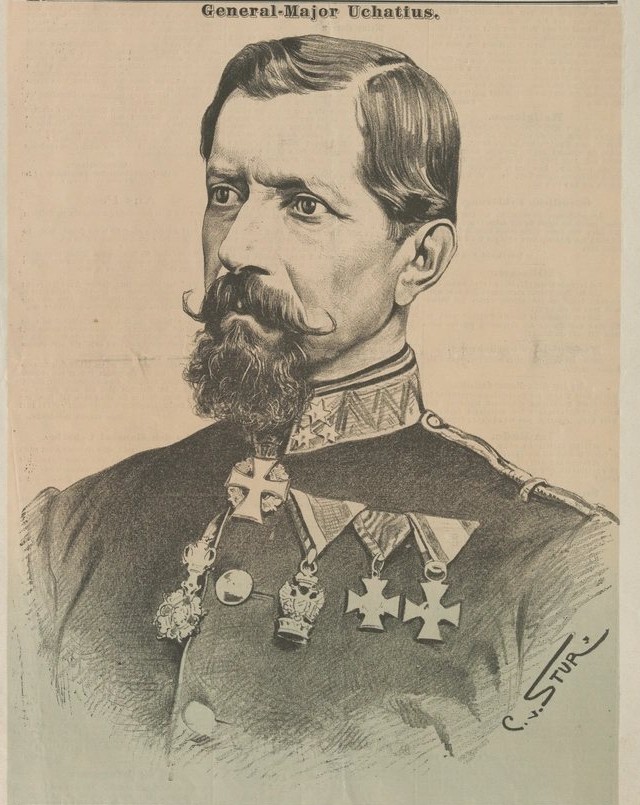
Illustration: Carl von Stur, Der Floh (Vienna), 1875, CC0, via rawpixel
On 15 July 1849, off the lagoon of Venice, Austrian artillerymen on the deck of a steamer filled two small balloons, hung a shrapnel bomb under each, set a fuse and let them go. A contemporary account says they drifted about four miles towards the city and went off roughly 23 minutes later. Nobody on board could steer them after release. The officer who set the fuse had to guess the wind speed and hope he had guessed right.
That is as good a candidate as any for the first weapon in history that nobody was controlling at the moment it struck. It is on my mind because this week, in Geneva, the states that belong to the Convention on Certain Conventional Weapons have opened their seventh review conference, and the main argument is about weapons that pick and attack targets without a person deciding.
A city that would not surrender
Venice had thrown out its Austrian garrison in March 1848 and declared itself the Republic of San Marco. By the summer of 1849 the rest of the revolutions of that year had mostly collapsed, and the Austrian army was besieging the city across the lagoon. Hunger and cholera were doing a lot of the work. The trouble for the besiegers was distance: much of Venice was beyond the reach of their guns.
An artillery officer named Franz von Uchatius suggested going over the top. Small balloons would carry bombs above the city and drop them on a timer. Since the wind in the lagoon usually blew off the sea, the balloons were inflated and launched from a ship, a steamer usually named as the Vulcano, so that the breeze would carry them inland.
How many, and did it work
Here the sources stop agreeing with each other. One British report, based on a letter from Uchatius himself printed in an Austrian military paper, suggests only two balloon bombs went up in the July trial. Other writers put the total over the siege at about two hundred, and some histories date the big attack to late August. The historian Lee Kennett, who looked harder at this than most people, said two hundred was the largest figure he had seen and that he was not sure of the real total. I am not sure either.
What nobody seems to claim is that the balloons did much damage. Some reportedly burst over the city, some dropped harmlessly into the lagoon, and at least some were blown back over the Austrian lines when the wind changed, which is the sort of detail that tends to get repeated because it is funny. The London Morning Chronicle, on the other hand, reported "extreme terror" among the inhabitants, citing the captain of a British brig in the area.
Venice surrendered on 22 August 1849. Ordinary artillery, by then firing on the city by the hundreds of shells a day, and the cholera had more to do with it than anything that came down from the sky.
Fifty years later, at The Hague
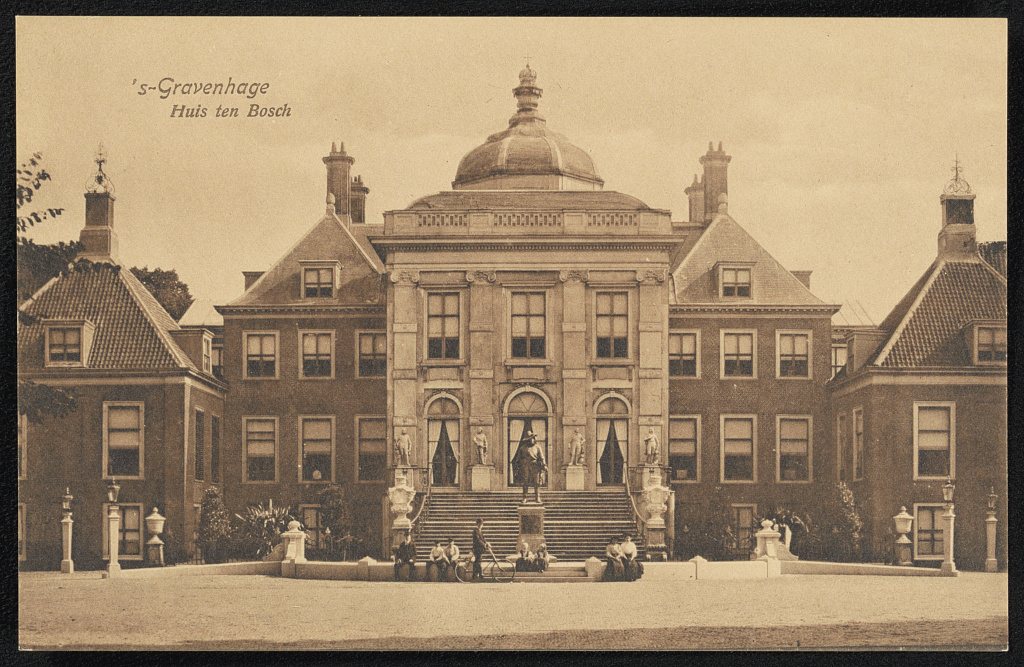
Huis ten Bosch, The Hague, on a postcard of about 1905 to 1930. Library of Congress, no known restrictions
In 1898 Tsar Nicholas II invited the world's governments to a conference on limiting armaments, and in the summer of 1899 delegates from 26 states met at The Hague, in the royal palace of Huis ten Bosch on the edge of the city. Most of what they produced dealt with the laws of land war and with arbitration between states. But they also signed three short declarations aimed at specific weapons. Two of them, against projectiles spreading asphyxiating gas and against bullets that expand in the body, were open-ended.
The third prohibited, for a term of five years, "the launching of projectiles and explosives from balloons, or by other new methods of similar nature."
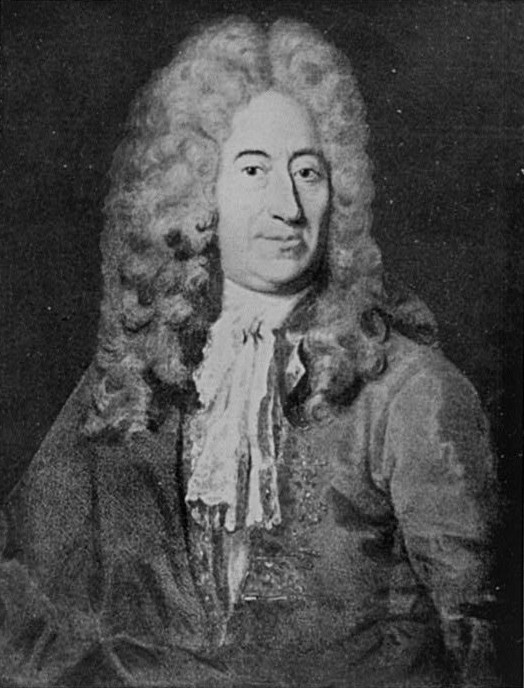
The five-year limit came largely from the American delegate on the subject, Captain William Crozier, an army ordnance officer. His argument, as recorded in the delegation's report, was that balloons could not be used "with any accuracy" and so endangered people who were not fighting. If the technology improved, he suggested, aerial bombing might become more precise, and then perhaps more humane than shelling a city from a distance. Historians disagree on how much he wanted a permanent ban and was outvoted, and how much he wanted the time limit all along. Either way the declaration came into force in 1900 and quietly expired in 1905.
The ban that ran out
The second Hague conference in 1907 renewed it, this time until a third peace conference should meet. Only 27 of the 44 states present signed. Germany, France, Russia, Italy and Japan, which is to say most of the countries likely to build air forces, did not. The third conference was planned for around 1915 and never happened.
In November 1911, during Italy's war with the Ottoman Empire in Libya, an Italian pilot dropped grenades from an aeroplane onto Ottoman positions. Italy had not signed the 1907 declaration. Three years after that, everyone was bombing everyone.
Technically the United States, which signed the 1907 declaration, has never formally withdrawn from it. The Pentagon's law of war manual lists it among historical documents rather than treaties in force, and lawyers describe it as fallen into disuse.
Geneva this week
The Geneva conference opened on 16 November. The UN Secretary-General, António Guterres, told delegates "the nature of warfare is changing" and urged them to negotiate a legally binding instrument with "clear prohibitions and restrictions." The UN human rights chief, Volker Türk, put it more simply: "A machine must never have the power to decide whether a human being survives or dies." There is no agreement yet on whether any new rules should be binding, and some of the largest military powers, the United States and Russia among them according to reports from the talks, prefer voluntary guidelines.
Crozier's argument from 1899 is being made again, nearly word for word, by people who say autonomous systems could one day be more precise than a frightened soldier. Maybe they will be. I would only point out that the last time the world agreed to wait and see whether a new weapon would become more accurate, the waiting period was five years, and the weapon won.
Enjoyed this story?Get a new one every day on social.