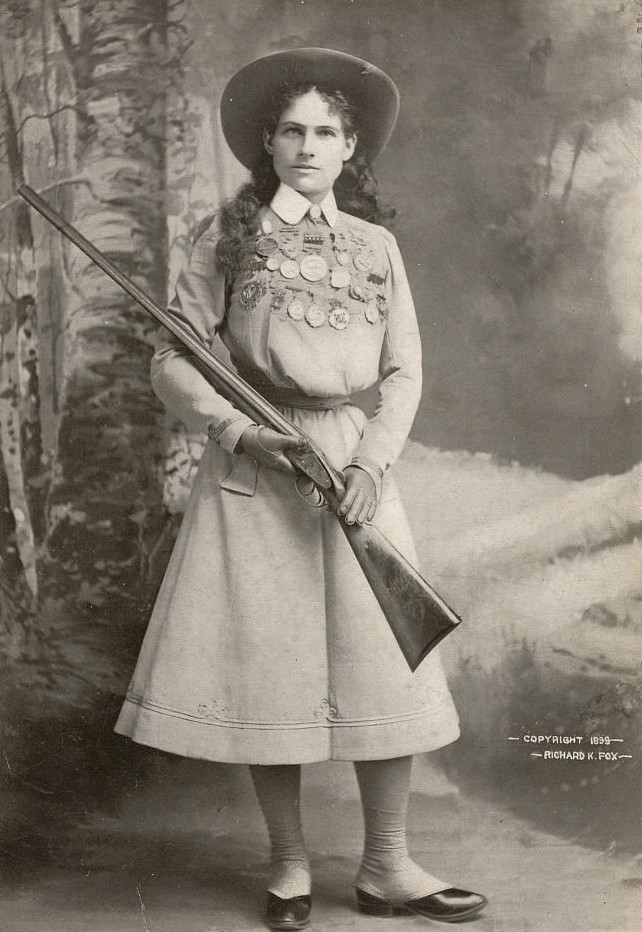
Photo: Annie Oakley, copyright Richard K. Fox, 1899, Library of Congress, no known restrictions
"Famous Woman Crack Shot ... Steals to Secure Cocaine."
That headline ran on 11 August 1903 in two of William Randolph Hearst's Chicago newspapers, two days before Annie Oakley's forty-third birthday. The papers said she had stolen a man's trousers to pay for the drug, that she was facing 45 days in jail, and that she looked close to 40 with her beauty gone. Other papers picked the story up by wire. Some of them identified her as Buffalo Bill's daughter-in-law, which she was not either.
Oakley was nowhere near Chicago. She had left Buffalo Bill's Wild West in 1901 after a train wreck that left her temporarily paralysed and took five spinal operations to mend, and she was living quietly on the New Jersey shore. She had never touched cocaine. The woman in the Chicago lock-up was a burlesque performer who worked under the name "Any Oakley" and whose real name turned up later as Maude Fontanella (the spelling varies by source).
She died 100 years ago today, in Greenville, Ohio, at 66. Most obituaries of her life start with the rifle, and fair enough. I would start with the trousers.
The girl from Darke County
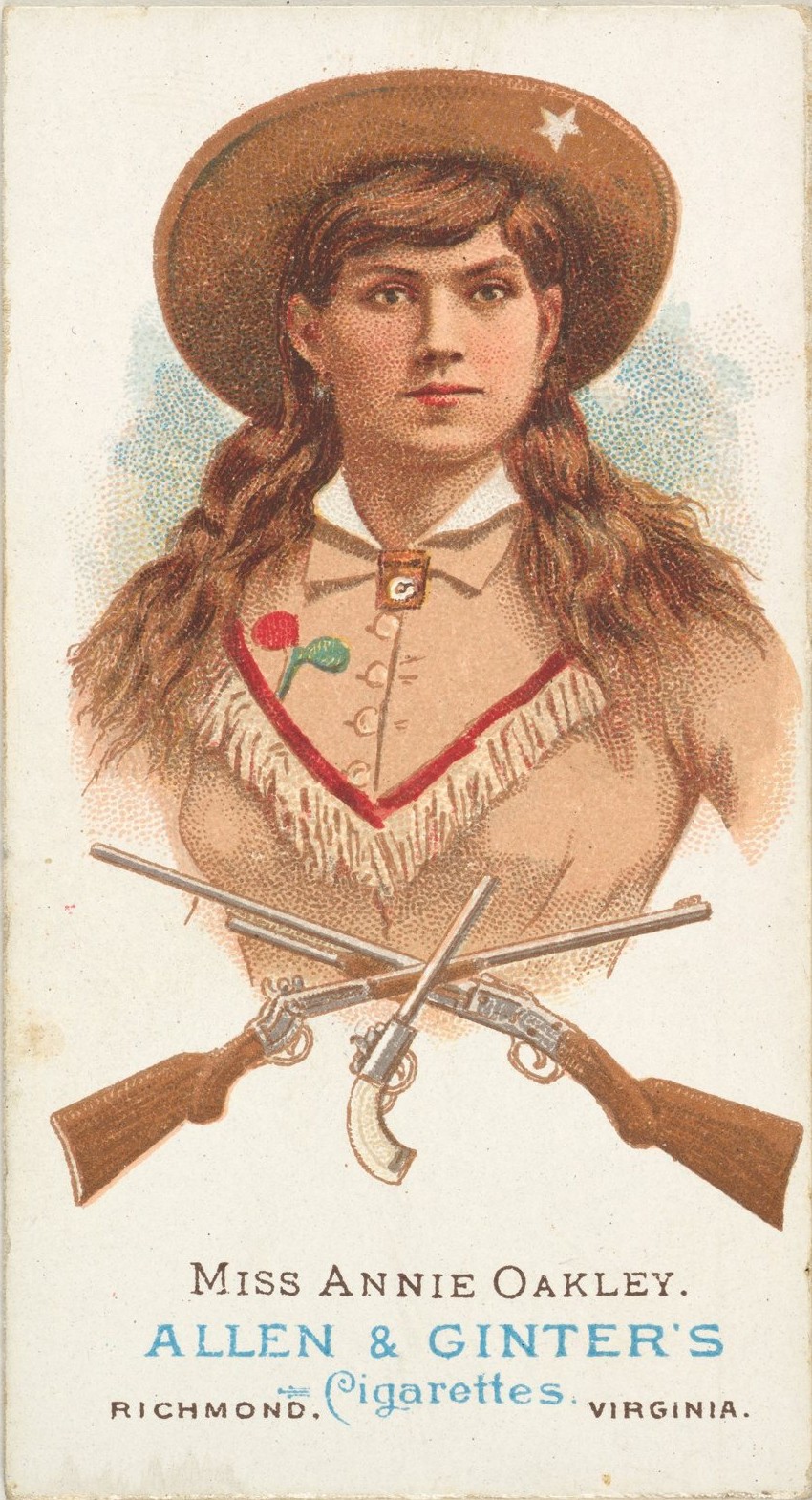
Trade card: Allen & Ginter, Miss Annie Oakley, Rifle Shooter, World's Champions series, 1887, The Metropolitan Museum of Art, CC0
She was born Phoebe Ann in a log cabin in Darke County, Ohio, on 13 August 1860. Her surname is its own small dispute: biographers usually write Moses, her father's headstone says Mosey, and she reportedly insisted on Mozee. Her father died when she was six, and she was sent to work for a foster family she later remembered as cruel. She learned to shoot to put food on the table, and the game she sold paid off the mortgage on her mother's farm.
The story of how she met Frank Butler is a good one, and the date is the only trouble with it. Butler was a touring marksman who bet $100 that he could beat any local shot, and a young woman from the back country turned up and beat him on the last bird. The legend says Thanksgiving Day 1875 in Cincinnati. Her biographer Shirl Kasper put it in spring 1881, near Greenville. They married, he took over the managing, and in 1885 she joined Buffalo Bill. In 1887 she met Queen Victoria in England.
What she did about the headline
Many papers printed corrections as soon as she wrote to them. That would have been enough for most people, and it was not enough for her. Between 1904 and 1910 she sued 55 newspapers for libel, which the Smithsonian calls the largest action of its kind in history.
Hearst, who could have settled for very little in 1903, sent investigators to Ohio to dig up something he could use. They came back with nothing. His lawyers argued that she wanted publicity, and that her stage act was immodest. She went to court and sat through it, and by all accounts she never lost her composure on the stand.
She won or settled 54 of the 55. She won $27,500 against Hearst's Chicago papers. Estimates of what she collected altogether run so wide (from $250,000 to $800,000) that I do not trust either end, and the usual verdict is that she lost money after lawyers and travel. If so, she knew it was coming. I suspect that was the point: a performer who wore long skirts on principle was never going to let "cocaine" stand next to her name for the sake of a good balance sheet.
The libel law she would meet today
She had one advantage that a celebrity would not have now. In 1903 she broadly had to show that the story was false and had done her harm. Since New York Times v. Sullivan in 1964 and the cases that followed it, a public figure in the United States has to prove the paper knew the story was false or recklessly disregarded the truth. The court has been asked several times to revisit that rule, and this June it declined to hear Alan Dershowitz's bid to revive his $300 million suit against CNN.
Chicago's reporters in 1903 got their woman wrong through laziness, by the look of it, and a lazy mistake might not meet the modern test. I think Oakley's case, on those facts, would be hard to win today.
Eighteen days
She went on working for years. A car crash in late 1922 left her in a steel brace on her right leg, and she still came back to perform after more than a year of recovery. The theatre business, meanwhile, had started calling free tickets "Annie Oakleys", because the holes punched in them looked like the playing cards she shot through.
She died of pernicious anaemia on 3 November 1926. Frank Butler reportedly stopped eating, and he died in Michigan 18 days later. His death certificate said senility. Their remains were buried together at Brock Cemetery near Greenville on 25 November, which was Thanksgiving Day.
Enjoyed this story?Get a new one every day on social.