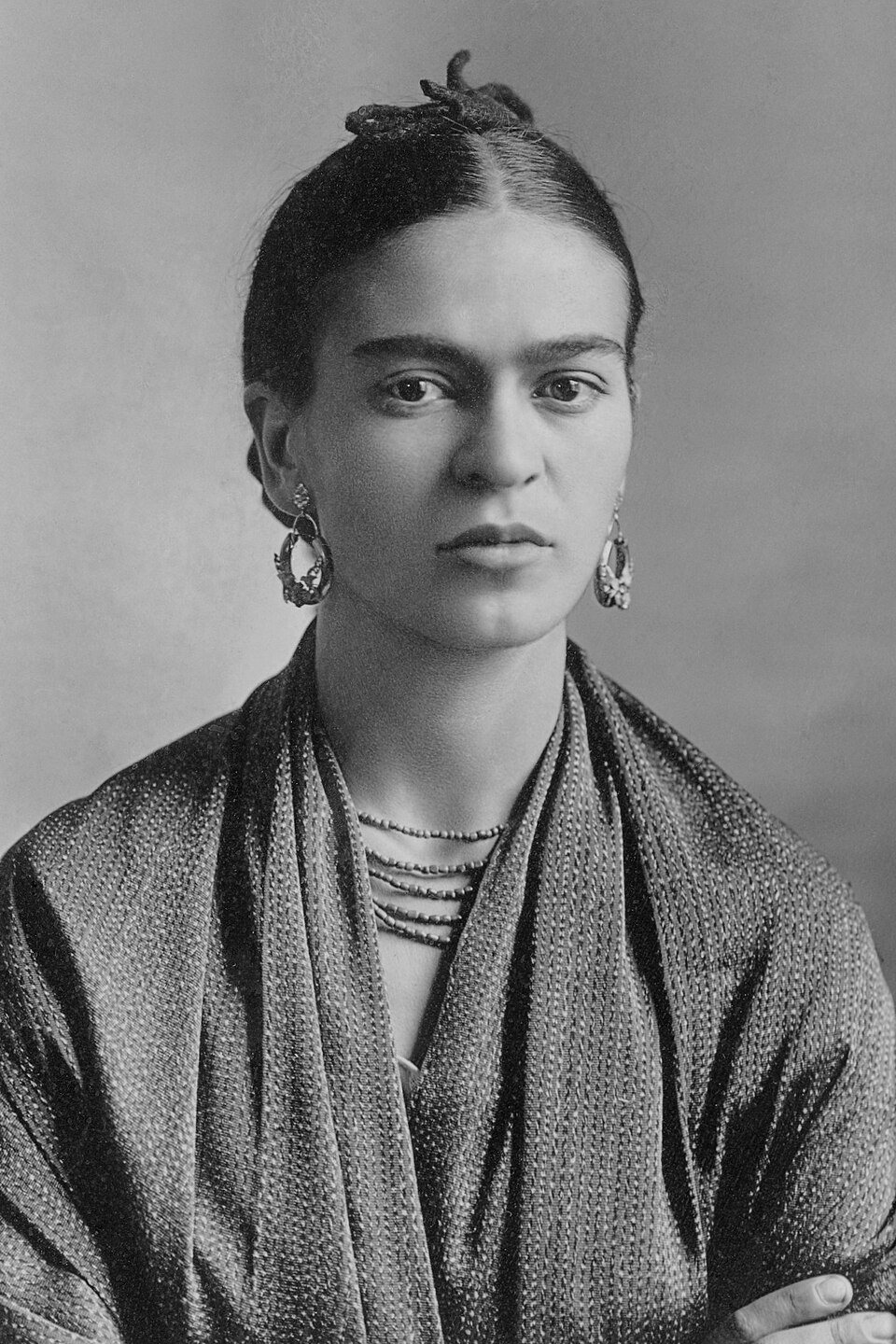
Photo: Guillermo Kahlo, public domain, via Wikimedia Commons
Hours before bidding was due to start in New York on Tuesday, Christie's withdrew a small 1952 painting by Frida Kahlo from its sale. It shows a white dove in a tree heavy with fruit, a smiling sun, the moon and two slices of watermelon, and it was expected to fetch up to $3.5 million. Mexico had asked for the sale to wait until the painting's ownership history was documented. Christie's said it had withdrawn the lot, with the seller's agreement, for further research.
The painting is called Congreso de los pueblos por la paz, Congress of the Peoples for Peace. It sold at Sotheby's in 2020 for $2.66 million and nobody objected then. What has changed is a question about dates, and the date that matters most is 1984.
A dove for Vienna
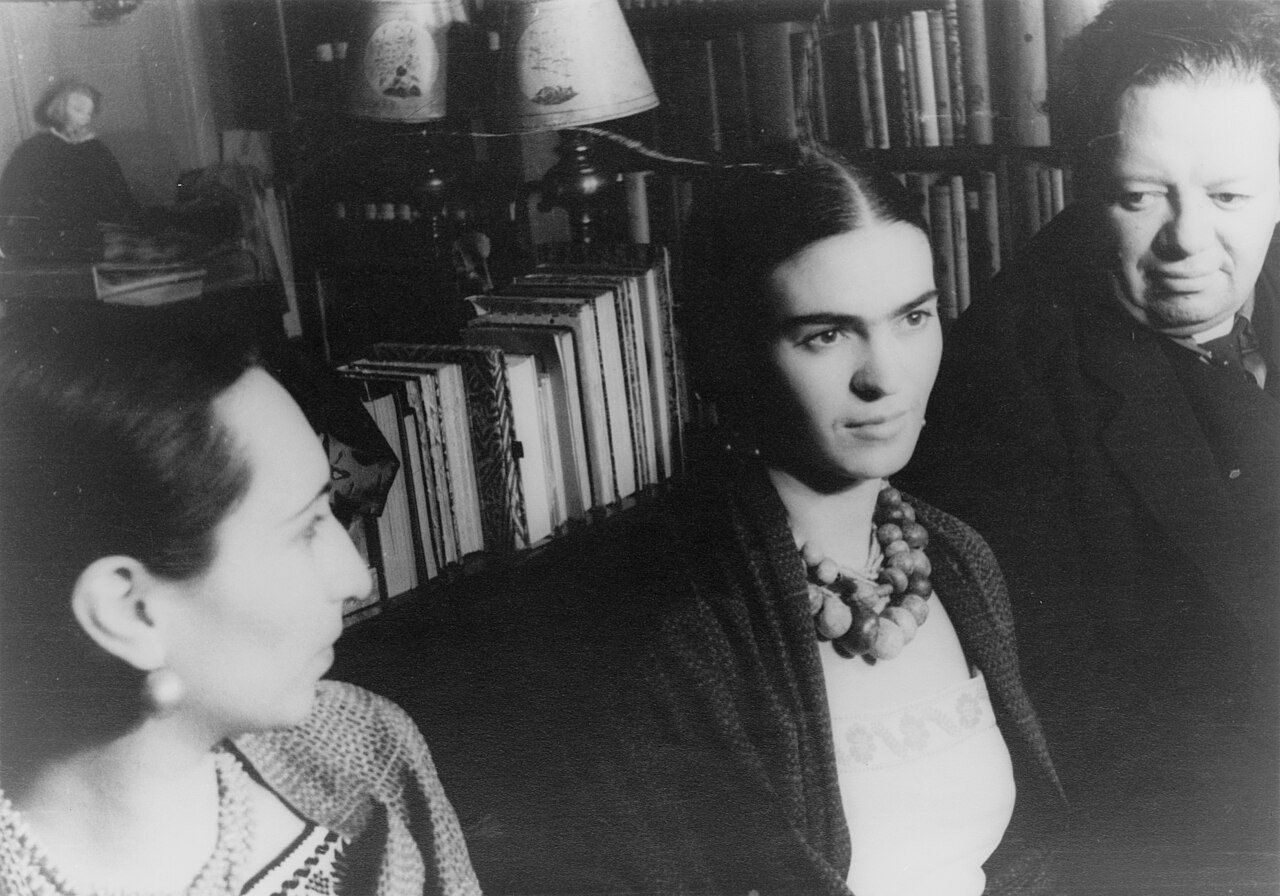
Lucienne Bloch, Frida Kahlo and Diego Rivera, photographed by Carl Van Vechten in 1932. Public domain, via Wikimedia Commons
Kahlo painted it in October 1952, when she was 45 and very ill. She had spent most of 1950 in a Mexico City hospital after a series of operations on her spine, and by 1952 she painted largely from her bed or a wheelchair. She was also, by then, a devoted member of the Mexican Communist Party, and the peace movement backed by the Soviet bloc was one of her causes.
The World Peace Council held a Congress of the Peoples for Peace in Vienna that December. According to the Associated Press, citing the memoirs of Emma Hurtado and the historian Raquel Tibol, Kahlo donated the picture to the congress and sent it with her husband, Diego Rivera. It is a poster-like little thing with a political message, nowhere near her great self-portraits, and I like it more than I expected to, mostly for the watermelons, which she came back to in her last still lifes.
She had her first solo exhibition in Mexico in April 1953, and arrived at the gallery by ambulance, to be carried to her own four-poster bed set up in the middle of the room. She died in July 1954, in the Blue House in Coyoacán where she was born.
How Kahlo became expensive
For two decades after her death Kahlo was known mainly as Rivera's wife. That changed in a rush. A large retrospective at the Palacio de Bellas Artes in Mexico City in the late 1970s, an exhibition at the Whitechapel Gallery in London in 1982 that paired her with the photographer Tina Modotti, and Hayden Herrera's biography in 1983 turned her into an international figure, adopted by feminist critics and, soon after, by the art market.
Mexico moved before the prices did. In 1984 the government declared her work an artistic monument of the nation. In practice the decree meant that Kahlo paintings in Mexico at that moment could no longer be exported permanently. They could travel on loan, but they had to come home. Works already abroad were not covered. Six years later Sotheby's sold Diego y yo for about $1.4 million, the first Latin American work to pass a million at auction. In 2021 the same painting made $34.9 million, and last year El sueño (La cama) set her record at $54.7 million.
The question about dates
That is why Mexico's first response to the Christie's sale was relaxed. The National Institute of Fine Arts and Literature said, according to Mexico News Daily, that Kahlo had donated the painting and that it had left the country before the 1984 decree, more than three decades before, on the AP's account. If it went to Vienna in 1952, the decree simply does not reach it.
Then a campaign group called Defendamos la Colección Gelman said the painting appears in an inventory Rivera compiled for the trust that runs the Blue House, and that it was removed without authorisation. If that is right, it was still in Mexico long after 1952 and the whole story changes. The institute has since asked Christie's for records of who owned it and when it left. The Frida Kahlo Museum says Mexican authorities are investigating, working with the Diego Rivera and Frida Kahlo Museums Trust, which the Bank of Mexico administers. I have not seen the inventory, and I suspect very few people outside the trust have.
There is a bigger argument behind this one. The Gelman collection, built by the film producer Jacques Gelman and his wife Natasha and including 18 Kahlo works, is now in Spain, managed by Banco Santander. Mexico calls that temporary. President Claudia Sheinbaum has said she wants tougher rules on exporting heritage art.
A house that kept its secrets
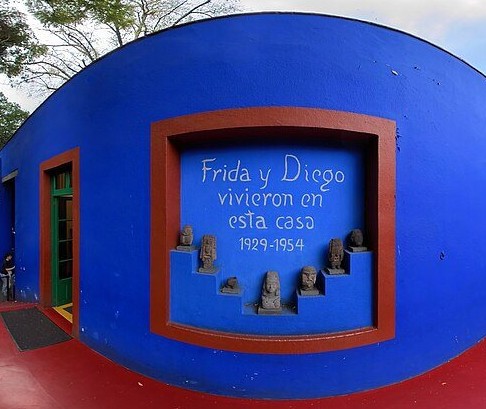
The courtyard wall of the Blue House in Coyoacán, painted with the words "Frida y Diego vivieron en esta casa 1929-1954". Photo: Fuzheado, CC0, via Wikimedia Commons
Rivera outlived Kahlo by three years. Before he died in 1957 he placed the Blue House and his Anahuacalli museum in a trust run by the Bank of Mexico, and the Blue House opened as the Frida Kahlo Museum in 1958. He is said to have asked that some of her rooms and belongings stay sealed for years after his death. Dolores Olmedo, his patron and the trust's long-time chair, kept them closed until she died in 2002. When the bathroom and storerooms were finally opened, they held thousands of letters, photographs and drawings, and many of her dresses, which no researcher had seen.
Today the house is a cobalt-blue block on a corner in Coyoacán, with a red-floored courtyard full of plants and pre-Hispanic stone figures, and a queue of visitors along the outside wall most mornings. On the courtyard wall, in white letters, it says that Frida and Diego lived in this house from 1929 to 1954.
Enjoyed this story?Get a new one every day on social.