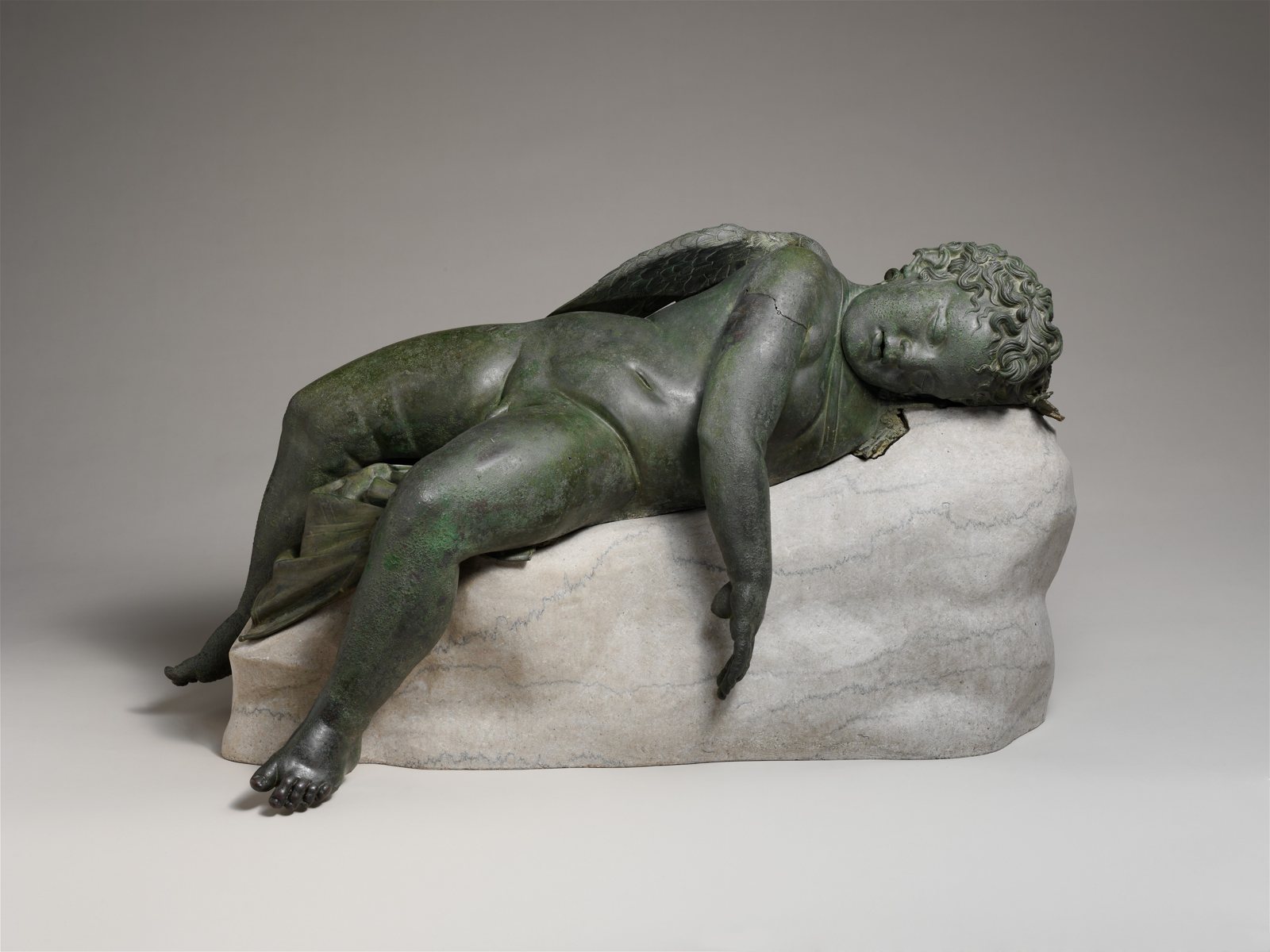
Photo: Bronze statue of Eros sleeping, 3rd to 2nd century BC, The Metropolitan Museum of Art, CC0
In the spring of 1900 two boats from the island of Symi, working their way home from the sponge grounds off North Africa, ran into a gale between Crete and the Peloponnese and sheltered in the lee of Antikythera, a rock with a few hundred people on it. The captain, Dimitrios Kontos, decided that if they had to wait out the weather they might as well look for sponges. One of his divers, Elias Stadiatis, went down in the canvas suit and copper helmet of the trade, about 45 metres, and came back up in a hurry. He said the bottom was covered with dead people, naked, and horses, and that one of them had reached up at him.
Kontos went down himself and came back with a bronze arm.
A salvage run by the navy
What Stadiatis had seen was the cargo of a Roman-era merchant ship that had gone down against the cliff some time in the first century BC: marble and bronze statues, some of them lying in the sand with the hands and faces that the diver had taken for bodies. Kontos reported the find to the authorities in Athens that autumn, with the arm as evidence, and the Greek government, which had almost no money and no divers of its own, hired the sponge crew and sent a navy transport to help.
The work ran from November 1900 to September 1901 and was done the way sponge diving was done, which is to say badly for the men: a few minutes at a time at 45 or 50 metres, with no understanding of decompression. One diver, Giorgos Kritikos, died of the bends, and two were paralysed. What they brought up filled the National Archaeological Museum in Athens: a life-size bronze of a young man now called the Antikythera Youth, marble figures scoured on the side that had lain exposed, glass bowls, pottery, a bronze head of a philosopher with a wild beard, and a quantity of corroded lumps that went into the store rooms to be looked at later.
17 May 1902
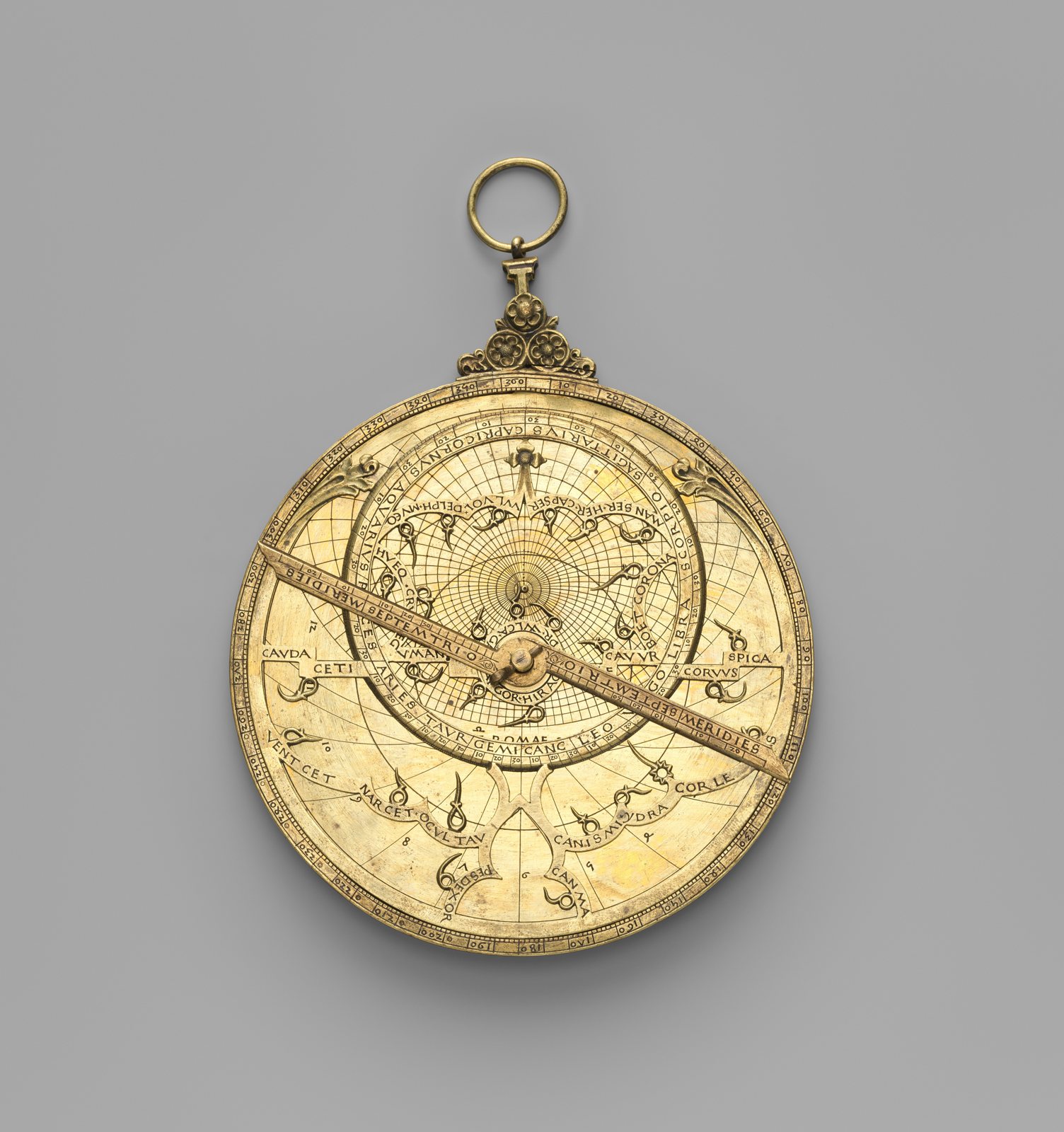
An astrolabe of 1462 by Regiomontanus: the instrument some scholars first took the fragments for. It has no gears. The Metropolitan Museum of Art, CC0
The lumps were looked at later. On 17 May 1902 the archaeologist Valerios Stais, going through the material, noticed that one piece of greenish bronze, about the size of a thick book and split into several pieces, had a gear wheel in it. A toothed wheel, with the teeth cut precisely and a good deal of Greek lettering on the surface around it.
The first reaction, which I have some sympathy with, was that it could not be from the wreck. Geared mechanisms of that quality belonged to clockmakers, and clockmakers belonged to the fourteenth century and later. Some scholars suggested it had fallen off a passing ship in modern times and landed among the statues by chance. Others thought it was an astrolabe, which at least had the virtue of being an ancient Greek instrument, even if astrolabes have no gears. The fragments were argued over for a few years and then more or less left alone for half a century.
The physicist with the X-rays
The man who did most to change that was Derek de Solla Price, a British historian of science at Yale, who became interested in the fragments in the 1950s and in 1971 persuaded the museum to let a Greek radiographer, Charalambos Karakalos, X-ray them. The plates showed what the corrosion hid: not one gear but dozens, stacked on shafts, with tooth counts that Karakalos could estimate from the images. Price published his reconstruction in 1974 under the title Gears from the Greeks and argued that the device was a calendar computer that modelled the movements of the sun and moon.
Price got some of it wrong, and Michael Wright, a curator at London's Science Museum who built working models in his own workshop, spent the 1990s and 2000s correcting him. Then in 2005 a team of British and Greek researchers, with an eight-tonne CT scanner shipped to Athens for the purpose, imaged the fragments in three dimensions. The scans doubled the amount of readable text, from about a thousand characters to more than three thousand, and settled the gear counts.
What it did
The present understanding, which I would not call final, is that the mechanism was a box about the size of a shoebox with a dial on the front and two on the back, driven by a hand crank on the side. Turn the crank and the front dial showed the sun and moon in the zodiac, with a small rotating ball for the moon's phase, and probably pointers for the five planets then known. The back dials were spirals. One ran through the nineteen-year cycle after which the lunar months and the solar year line up again, and the other through the eighteen-year cycle on which eclipses repeat, with glyphs marking which months would have one, at what hour, and whether of the sun or the moon. A small subsidiary dial, identified in 2008, counted off the four-year cycle of the Panhellenic games, with the Olympics on it.
The gearing even handles the fact that the moon speeds up and slows down in its orbit, with a pin-and-slot device that nobody expected to see for another thousand years. There are at least thirty gears surviving in the 82 fragments, and the text on the covers is in effect an instruction manual. It was made some time between about 200 and 60 BC, probably in Rhodes or Corinth, by someone who knew the astronomy of Hipparchus. We do not know who.
Nothing like it for a thousand years
The thing that makes the mechanism strange, rather than just impressive, is the silence around it. Cicero mentions a device by Archimedes, and another by his own teacher Posidonius in Rhodes, that showed the motions of the heavens; those are the only ancient references and they are vague. After the Antikythera device nothing with comparable gearing survives, or is described, until the astronomical clocks of medieval Islam and Europe. Either the Greeks made very few of these and we happened to find the one that sank, or they made many and bronze is simply too easy to melt down. The second is more likely, and it is still a thin story for a technology that vanished.
Back to the wreck
The site itself kept giving. Jacques Cousteau worked it in 1976 and brought up coins that date the sinking to between 76 and 67 BC. A Greek-led project has been excavating it since 2012, and in 2016 found a skeleton, a young man the team called Pamphilos, which is a rare thing on an ancient wreck because the fish usually get there first. In 2022 divers lifted a marble head of Hercules that fits a headless body raised in 1901. Last summer, between May and June 2025, a Swiss-led team under the Greek antiquities service brought up a section of the hull itself, three elm and oak planks still fixed to a frame, and the base of another marble statue with a left leg attached. The hull piece is thinner than expected and its first dating makes it older than the cargo, so it may be a repair or a second, smaller vessel.
The mechanism has its own corner of the National Archaeological Museum in Athens, in a case near the X-rays and the reconstructions, and it is smaller than most visitors expect. My own view, having stood in front of it twice, is that the most unsettling fact is not the gears but the shelf: it waited ten months in a store room in a museum full of archaeologists, and the only reason we have it is that one of them picked up the wrong lump.
Enjoyed this story?Get a new one every day on social.