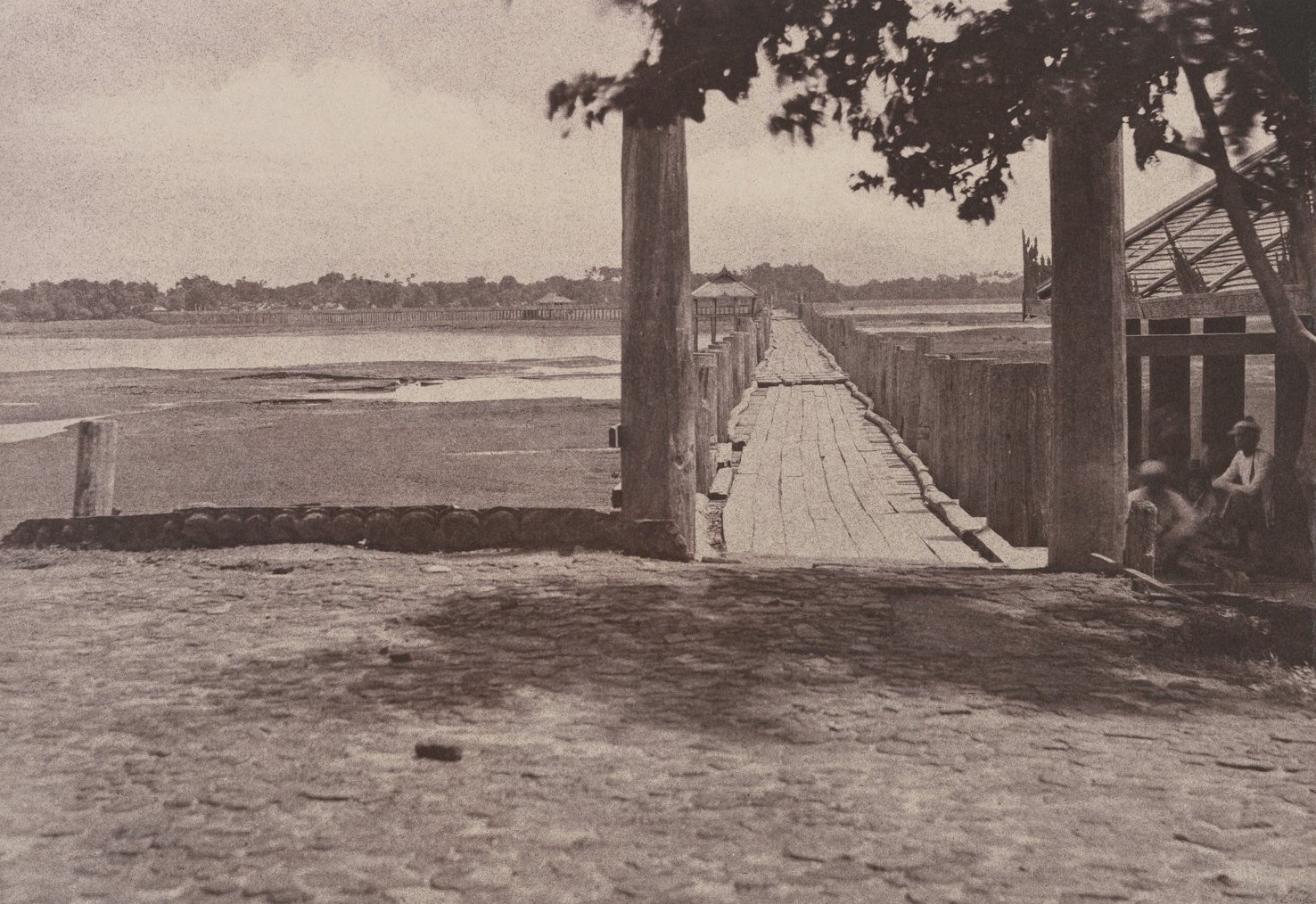
Linnaeus Tripe, Amerapoora: Wooden Bridge, 1855. The Metropolitan Museum of Art, CC0
"The first is that spoken by the Mohammedans, who have been long settled in Arakan, and who call themselves Rooinga, or natives of Arakan."
That sentence was written by Francis Buchanan, a Scottish surgeon who travelled to the Burmese court with a British embassy in 1795, and it was printed in 1799 in Asiatic Researches, the journal of the Asiatic Society in Calcutta. It sits in a dry word list of languages spoken in the Burmese empire. It is also one of the most argued-over sentences in the history of Southeast Asia, and it will be in the background on Thursday when the International Court of Justice in The Hague gives its judgment in the case The Gambia brought against Myanmar in 2019 under the 1948 Genocide Convention.
The court is deciding what happened in 2016 and 2017, not what happened in the 18th century. But almost every argument about the Rohingya turns, sooner or later, on one historical question: who belonged in Arakan, and since when.
A kingdom that faced the Bay of Bengal
Arakan (now Rakhine State) is a long strip of coast cut off from the Irrawaddy valley by the Arakan Yoma mountains. For most of its history it looked west, toward Bengal, more than east toward the Burmese kings at Ava.
The kingdom that mattered here was centred on Mrauk U, founded around 1430 by a king usually called Min Saw Mon (also Narameikhla). He had spent years in exile at the court of the Bengal sultanate and came home with Bengali help. For a time afterwards the Buddhist kings of Arakan used Muslim titles alongside their own names and struck coins with Persian inscriptions. That is not evidence of anyone's ancestry, but it does show a court that took its cues from Bengal as much as from Burma.
Mrauk U grew rich on rice, trade and, less pleasantly, on slaving raids into Bengal carried out with Portuguese freebooters. Dutch merchants kept a trading post there in the 17th century. In 1660 the Mughal prince Shah Shuja, beaten in a war of succession by his brother Aurangzeb, fled to Arakan, and within a year he and most of his household had been killed. The Mughals took Chittagong from Arakan in 1666.
The conquest of 1784
The end came from the east. King Bodawpaya of Burma sent an army across the mountains at the end of 1784, led by his son, and Arakan, weakened by years of court feuding, fell within weeks. Its last king was taken away as a prisoner.
The Burmese also took the Mahamuni, a large bronze Buddha that the Arakanese regarded as the protector of their kingdom. It was hauled over the mountains in 1785 to Bodawpaya's new capital at Amarapura, near today's Mandalay. (The cover photograph, taken by Linnaeus Tripe in 1855, shows the long wooden bridge across the lake there.) I find this the detail that makes the conquest real. Moving the image to the Burmese capital told every Arakanese who now owned the place.
Burmese rule in Arakan was harsh. Forced labour for Bodawpaya's building projects and for his wars led to revolts, and the revolts led to more reprisals.
Refugees across the Naf
People did what people on that coast had always done in a crisis. They crossed the Naf River into Chittagong, which by then was run by the British East India Company. Both Buddhists and Muslims went. A Company letter of 1801 spoke of twenty to thirty thousand people who had "claimed the protection of the Company," and that was only the people the Company counted.
In 1799 the Company sent Captain Hiram Cox, who had served as its envoy to the Burmese court, to settle the refugees on land in the south of the Chittagong district. He made real progress, by the accounts we have, and then died the same year, still in his thirties. A market town that grew up near the settlements was named after him: Cox's Bazar.
What Buchanan wrote down
Buchanan's word list comes from exactly these years. He went to the Burmese court in 1795 with an embassy led by Michael Symes, and three years later he toured the Chittagong frontier where the refugees were living. His journals have a line that matters as much as the published one: he was told that the Bengali name for Arakan was "Ro.oinga."
So the word existed, in some form, within about fifteen years of the conquest. What it meant to the people who used it, and how many of them there were, his notes do not say. Buchanan was collecting vocabulary, and nobody should try to read a census into his notes.
The war the border caused
The refugee problem did not stay a local one. Arakanese rebels used Company territory as a base for raids, Burmese commanders crossed the frontier after them, and the two sides argued for twenty years about who was sheltering whom. Those border quarrels were among the causes of the First Anglo-Burmese War, which began in 1824. The Treaty of Yandabo in 1826 handed Arakan to the British.
Under British rule, labourers and traders moved freely between Bengal and Arakan for a century, because both were now part of British India. This is where the historical argument gets bitter. Myanmar's governments have long held that most Muslims in Rakhine descend from colonial-era migrants. Rohingya historians point to Mrauk U, to Buchanan's word list and to older Muslim communities on the coast. Historians outside the dispute mostly agree that both things are true in some proportion, and disagree, sometimes sharply, about which proportion. I do not think anyone can settle it from the sources that survive.
What is not in dispute is that Myanmar's 1982 citizenship law left the Rohingya off its list of recognised national races, which made most of them stateless in the country where they were born.
The Hague and the hill camps
The Gambia filed its case in November 2019, acting with the backing of the Organisation of Islamic Cooperation. Myanmar's position is that its forces were responding to attacks by Arakan Rohingya Salvation Army fighters in 2017 and that there is no proof of intent to destroy the Rohingya as a group, which is what genocide requires in law. The judgment is final and cannot be appealed, though the court has no police of its own to enforce it.
The Mahamuni is still in Mandalay, in a temple built for it after a fire in the 19th century. Every morning before dawn monks wash its face, and men press so much gold leaf onto its body that the figure has gone lumpy under the layers. Cox's Bazar is now a beach resort, with hotels along one of the longest unbroken sand beaches in the world. A short drive south, on the cleared hillsides of Ukhia and Teknaf, are the camps where about 1.2 million Rohingya live in bamboo and tarpaulin shelters, a few kilometres from the river their predecessors crossed in 1785.
Enjoyed this story?Get a new one every day on social.