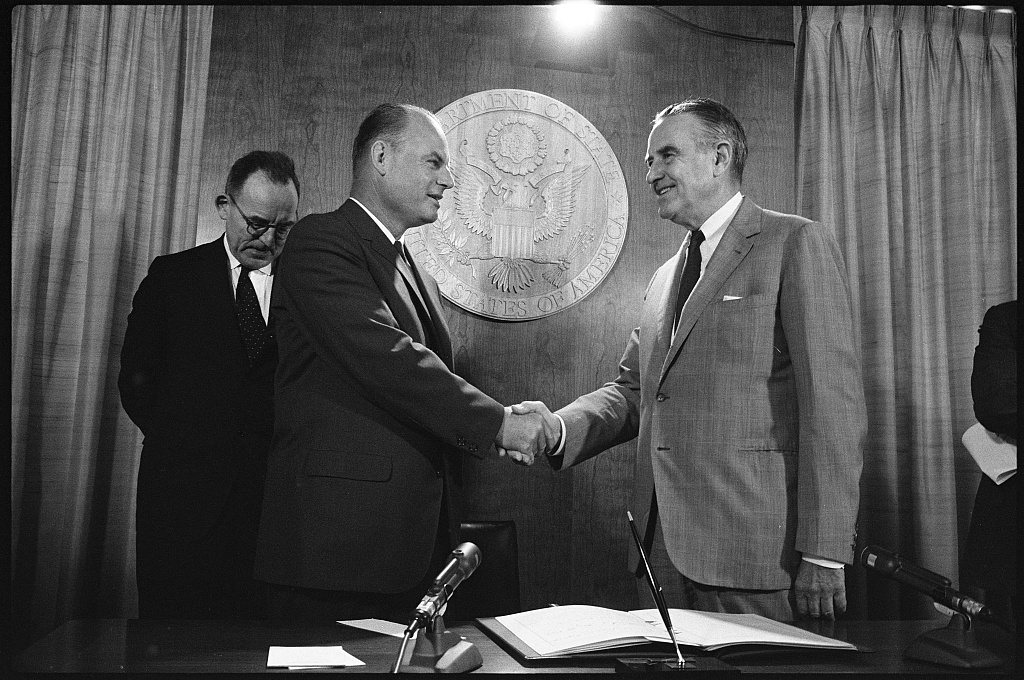
Averell Harriman (right) at a signing of the Limited Test Ban Treaty, Washington, August 1963. Photo: Marion S. Trikosko, Library of Congress, no known restrictions
"A big fraud to fool the people of the world." That was how the government of the People's Republic of China described the Partial Test Ban Treaty in a statement issued on 31 July 1963, less than a week after American, British and Soviet negotiators had initialled it in Moscow. The Chinese statement went on to propose something far grander: a conference of every government on earth to ban nuclear weapons completely and destroy the ones that already existed. China had no bomb of its own at the time. Fifteen months later it did.
That old argument is back on the table this week. On Thursday, on the sidelines of the APEC meeting in Shenzhen, Donald Trump is due to sit down with Xi Jinping and Vladimir Putin in what the White House calls an unprecedented three-way meeting. Trump says he wants a nuclear deal that includes China. The last treaty limiting American and Russian arsenals, New START, expired in February, and Trump turned down Moscow's offer to extend it for a year. A senior administration official has already told reporters: "We do not expect to get to any kind of agreement."
Ten days in Moscow
The 1963 treaty came together quickly by Cold War standards. Averell Harriman for the United States, Lord Hailsham for Britain and Andrei Gromyko for the Soviet Union opened talks in Moscow on 15 July and had a text by the 25th. It banned nuclear tests in the atmosphere, in outer space and under water, and left underground testing alone, which is why it is called partial. Dean Rusk, Lord Home and Gromyko signed it in the Kremlin on 5 August, and it came into force that October.
The Cuban missile crisis, nine months earlier, did most of the persuading. So did the fallout. Atmospheric tests had been scattering radioactive strontium across the northern hemisphere for years, and a citizens' committee in St Louis had been collecting children's baby teeth to measure how much of it was ending up in their bones. Kennedy, Khrushchev and Macmillan each had reasons to want a win, and this one was available.
Why Beijing was furious
Mao had been dismissive about the bomb for years, at least in public. In August 1946 he told the American journalist Anna Louise Strong that the atom bomb was "a paper tiger" that American reactionaries used to scare people. Privately his government wanted one badly, and for China the 1963 treaty looked like a door closing. The country's leaders read it as a deal between the two superpowers to keep the club small, and they had a particular grievance with one of the founding members.
In October 1957 Moscow had signed an agreement promising Beijing help with nuclear weapons, including, by most accounts, a sample bomb. In June 1959, with relations between Mao and Khrushchev going sour, the Soviet leadership wrote to say the sample would not be coming. By the summer of 1960 Soviet advisers had been pulled out of China altogether, many taking their blueprints with them. Chinese scientists carried on alone, and they named their first device 596, after the year and month of that letter. (It is a petty name, and I mean that as a compliment.)
So when Moscow signed a treaty with Washington and London in 1963 and invited the rest of the world to join, Beijing heard the Soviet Union locking the door it had already refused to open. France, which was also building a bomb, declined to sign for similar reasons.
A tower at Lop Nur
On 16 October 1964 China detonated device 596 on a tower at the Lop Nur test site in Xinjiang. The yield was roughly 20 kilotons, in the same range as the bomb dropped on Nagasaki. The timing was remarkable for other reasons too: Khrushchev had been removed from power two days earlier, and Britain had gone to the polls the day before.
The Chinese statement that day contained the line that still anchors the country's nuclear policy. China, it said, "will never at any time or under any circumstances be the first to use nuclear weapons." It repeated the call for a world summit on total abolition. It also explained that China was testing precisely to break the monopoly of the nuclear powers, which is the kind of reasoning that has never convinced anyone who already had a bomb.
A small arsenal, by choice
For decades China kept its stockpile modest. Western estimates put it in the low hundreds for most of the Cold War, a fraction of the tens of thousands held by the two superpowers. (Beijing has never published a figure, so every number in this paragraph is somebody's estimate, including the ones I use below.) That gap gave Beijing its standard answer whenever arms control came up: the United States and Russia, with by far the biggest arsenals, should cut first and talk to each other.
China did eventually sign up to some of the architecture. It joined the Non-Proliferation Treaty in 1992. It signed the Comprehensive Nuclear-Test-Ban Treaty in 1996, a few weeks after its last test, though like the United States it has never ratified it. It never signed the 1963 partial ban.
What has changed since
The modest-arsenal argument is harder to make now. The Stockholm International Peace Research Institute's 2026 yearbook estimates that China has around 620 warheads and is expanding its arsenal faster than any other country. The United States and Russia still hold the overwhelming majority of the world's stockpile, roughly 83 per cent between them by SIPRI's count, but the distance is closing from one side.
Beijing's position on the talks themselves has not moved much. According to reporting ahead of the summit, Chinese officials have rebuffed attempts to discuss nuclear weapons in a three-way format and are irritated that Washington wants to put them on the agenda of a meeting China meant to be about trade.
Shenzhen, then and now
In 1964 Shenzhen was a small market town across the river from Hong Kong, notable mainly as the place where trains from the British colony stopped and passengers walked over the border. It became a special economic zone in 1980 and is now one of the largest cities in China.
The Chinese government's 1963 demand, for every nuclear power to sit down together and agree to get rid of the lot, has never been met, and nobody expects it to be met on Thursday. My own view is that whatever gets said in Shenzhen will matter less than whether anyone in the room still accepts the old Chinese argument, that the two largest arsenals must shrink before the third one stops growing.
Enjoyed this story?Get a new one every day on social.