Photo: 瑞丽江的河水, CC BY-SA 4.0, via Wikimedia Commons
At 4:39 on the morning of 11 April this year, according to an indictment unsealed in Manhattan this week, a man cut through the perimeter at Shannon Airport in County Clare and made for a US Air National Guard C-130H parked on a taxiway. Prosecutors say he broke the lock on the rear crew door, hung the crew's hammocks over the windows and barricaded himself in. Over the next five hours, they allege, he cut wire bundles and hydraulic lines, crimped a liquid oxygen line, smashed cockpit gauges and packed the door tracks with ball bearings set in epoxy. Shortly before ten he is said to have climbed out through a roof hatch and taken an axe to the outside of the aircraft.
The plane was worth about $60 million, and prosecutors say it will never fly again. The accused, Daithí O'Corrain, a 48-year-old Irishman, is charged in New York with destroying US government property, which carries up to ten years, but he is not in American custody. Gardaí arrested him on the day and he already faces trespass and criminal damage charges in Ireland. His supporters call him a peace activist acting against the American war with Iran and US support for Israel. He has said nothing in public.
What caught my eye in the American filings was a small line: he had allegedly tried to get in touch with someone involved in an earlier breach at the same airport. There have been plenty of those. The most famous two happened within a week of each other in 2003, and the way the Irish courts dealt with them is the part of this story the US Attorney's office may not enjoy reading.
A refuelling stop in a neutral country
Shannon was built as a refuelling stop for transatlantic flights in the days when planes needed one. American military and military-chartered flights have used it to refuel for decades, and traffic rose sharply after 2001. Ireland is militarily neutral, and the arrangement has always been a political sore. The government's position, then and now, is that US aircraft land under conditions, including limits on carrying weapons without permission, and that no operations are launched from Irish soil. Critics say refuelling troops on their way to a war is taking part in it.
In the winter of 2002 to 2003, with the invasion of Iraq plainly coming, some protesters decided that letters to the Taoiseach were not enough.
The axe in January
On 29 January 2003 Mary Kelly, an anti-war campaigner from County Galway, got onto the airfield and attacked a US Navy aircraft with an axe. It had stopped to refuel on its way to Sicily, carrying spare parts. The damage was put at about €1.1 million.
She was tried at Ennis Circuit Court in 2004, represented herself, and argued she had a lawful excuse: she was trying to stop the plane going on toward Iraq, where innocent people would be killed. The jury convicted her and the judge gave her a two-year suspended sentence. That might have been the end of it, except that in February 2011 the Court of Criminal Appeal quashed the conviction. The judges found that the law on lawful excuse had never been explained clearly to her or to the jury. Neither the trial judge nor the prosecution, they said, had properly grasped how a 1997 amendment had changed the test, which now turned on whether the defendant believed the damage was reasonable in the circumstances. The court declined to order a retrial and added, with some feeling, that lawmakers should draft provisions an ordinary person could understand.
Five Catholic Workers and a hangar door
Five days after Kelly, in the early hours of 3 February 2003, five members of the Catholic Worker movement went into a hangar at Shannon and damaged a US Navy C-40 transport plane with hammers. They were Deirdre Clancy, Nuin Dunlop, Karen Fallon, Damien Moran and Ciaron O'Reilly, and they called themselves the Pitstop Ploughshares, after Isaiah's line about beating swords into ploughshares. The name was a deliberate nod to the Plowshares Eight, who had walked into a General Electric plant in King of Prussia, Pennsylvania, in 1980 and hammered on nuclear warhead nose cones.
The charges put the damage at €100 for the hangar door and $2.5 million for the plane. The five spent between four and eleven weeks in Limerick Prison on remand.
Three trials in Dublin
Their case is close to a comedy of procedure. The first trial, in the Dublin Circuit Criminal Court in March 2005, collapsed on its sixth day when the judge declared a mistrial over remarks he had made about a defence witness. The second, in October that year, ended when Judge Donagh MacDonagh agreed to step aside after the defence pointed out that he had attended George W. Bush's inauguration in 2001 and had met Bush when he was governor of Texas. The jury was discharged on 7 November 2005.
The third trial opened on 10 July 2006 before Judge Miriam Reynolds, and she allowed the lawful excuse defence to go to the jury. After twelve days of evidence and argument, seven women and five men deliberated for four and a half hours and acquitted all five on both counts on 25 July. The defendants' case was that they had acted to protect lives and property in Iraq and in Ireland, and the jury accepted that their belief was reasonable.
(The American government was not a party to any of this, and I have never found a public US comment on the verdict. I suspect there was a fair amount of private comment.)
Why the New York indictment is different
The 2003 defendants were tried only in Ireland, by Irish juries, under an Irish law that allows a defendant to argue that what they damaged was damaged for a good reason. A federal indictment in Manhattan is a different animal. American federal judges have been famously reluctant to let protesters argue necessity in front of a jury, and the prosecutors have framed the case as an attack on national security. FBI New York's chief said flatly that "this was not an act of spontaneous vandalism."
Whether O'Corrain ever stands in a US courtroom is another matter. He is in Ireland, charged in Ireland, and I would be surprised to see Dublin hand him over while its own case is still open. The protests have not stopped either. Two men who wrote on a US Navy plane in 2017 were cleared of criminal damage in 2023, and earlier this month the Supreme Court in Dublin overturned the trespass conviction of one of them, Dan Dowling. Several other cases had been waiting on that ruling.
The airport today
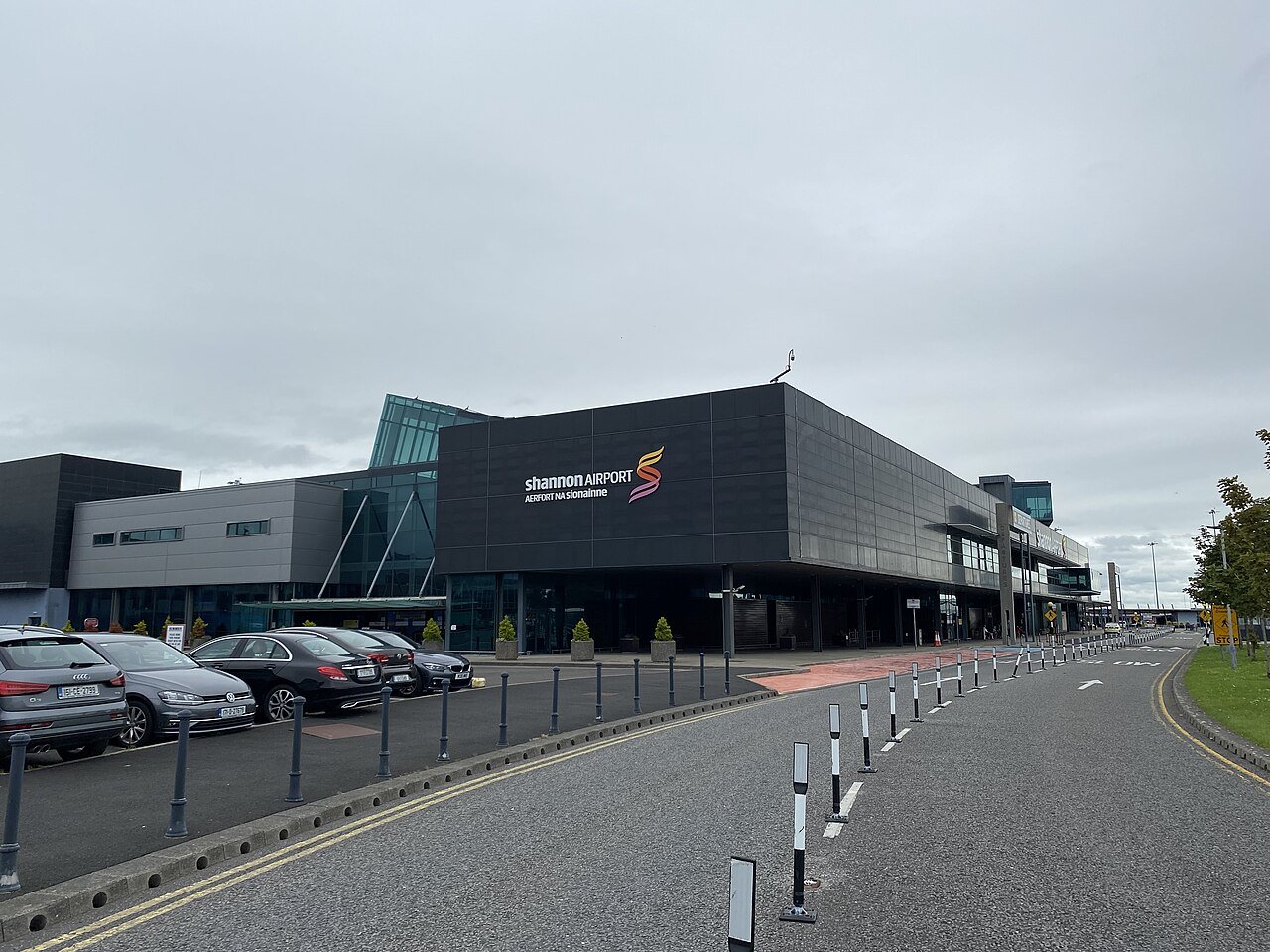
Shannon today is a quiet regional airport for most of the day, a long low terminal looking out over the Shannon estuary, with the duty-free shop that claims to be the world's first. On a good day you can watch a transatlantic airliner and a grey military transport sit on the same apron, with the estuary flat and brown behind them.
Enjoyed this story?Get a new one every day on social.