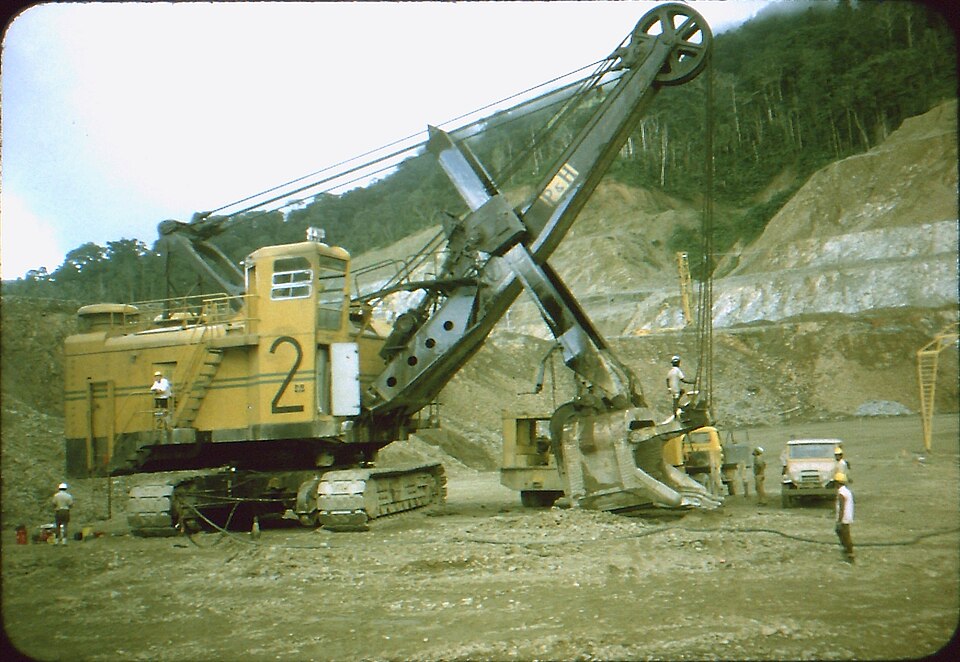
Photo: Robert Owen Winkler, c. 1971, public domain, via Wikimedia Commons
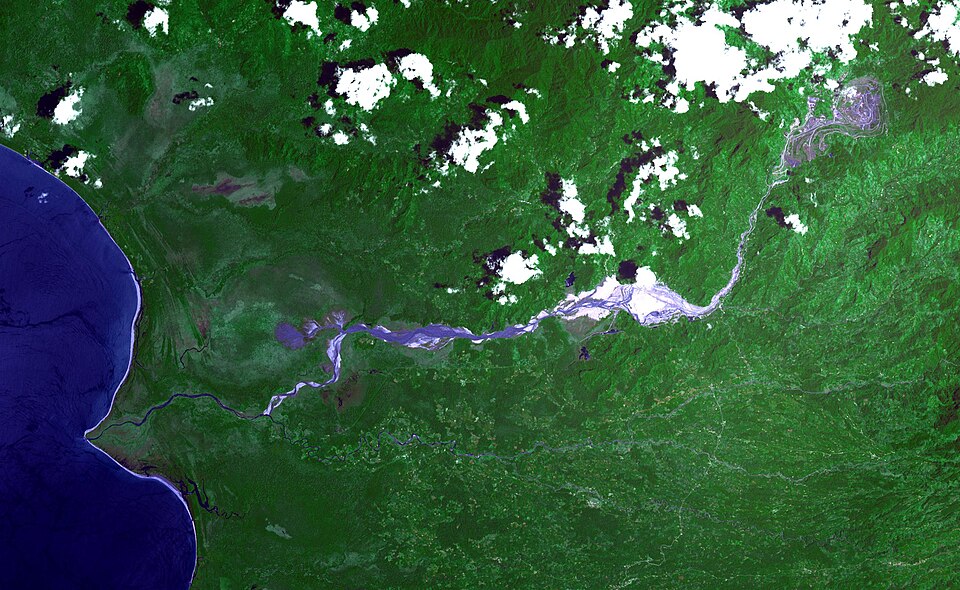
More than a billion tonnes. That is the usual estimate of the waste rock and tailings that the Panguna copper mine, in the mountains of Bougainville, sent into the Jaba and Kawerong rivers between 1972 and 1989. From space you can still see the result, a pale grey braid of sediment running from the pit all the way down the valley to the sea.
This week Rio Tinto, which owned most of the mine for its whole working life, committed US$250 million (about A$371 million) to a fund to deal with the damage. The agreement was reached with Bougainville Copper Limited, the Autonomous Bougainville Government and community leaders, among them the lead complainant, Theonila Roka-Matbob. It follows a complaint brought by local residents and an independent assessment, paid for by Rio Tinto from 2021, which found that people's rights to water, education and culture had been violated at some sites and that parts of the old pit, levees and buildings were at extreme risk of collapse. Rio Tinto handed its shares to the Papua New Guinea and Bougainville governments in 2016.
The mine has not produced anything since May 15, 1989. What shut it was a war, and the first blows of that war landed on the mine's own power lines.
An Australian deal for an island that wasn't asked
Satellite image of the Panguna pit (upper right) and the pale tailings in the Jaba River valley running to the coast. Image: NASA/METI/AIST/Japan Space Systems and the U.S./Japan ASTER Science Team, public domain, via Wikimedia Commons
Bougainville sits at the northern end of the Solomon Islands chain and is, culturally and geographically, much closer to the Solomons than to the rest of Papua New Guinea. It ended up inside PNG because of how Germany and Britain divided the region in 1899 and because Australia then ran it as part of its New Guinea territory after the First World War.
In the 1960s geologists from Conzinc Riotinto of Australia (CRA) found an enormous low-grade copper and gold deposit at Panguna, in the Crown Prince Range. In 1967 the Australian colonial administration signed the Bougainville Copper Agreement with the company. Bougainville Copper Limited, about 56 percent owned by CRA, built the mine, a port at Loloho and the town of Arawa.
The people whose land it was had not been asked in any meaningful sense. In 1969, as land was being taken for the town, women lay down in front of bulldozers and villagers clashed with riot police. None of it stopped the project.
The money went to Port Moresby
When the mine opened in 1972 it was one of the largest open-cut copper mines in the world. For the young state of Papua New Guinea, which became independent in 1975, it was most of the economy. In its best years Panguna earned more than 45 percent of the country's export revenue, and the company's taxes paid for something like a sixth of the national budget.
Landowners received a very small slice. Figures vary with how you count, but the royalties and compensation reaching Bougainvilleans amounted to roughly 0.5 to 1.25 percent of the mine's profits. Meanwhile the tailings choked the Jaba valley, people downstream said the fish had gone from the river, and a growing workforce from other parts of PNG settled around Arawa, which caused its own friction.
Bougainville had already tried to leave once. On September 1, 1975, two weeks before PNG's independence, local leaders including John Momis and Leo Hannett declared a Republic of the North Solomons. It lasted until a compromise in 1976 made Bougainville a province with some self-government.
Francis Ona's ultimatum
The man who stopped the mine was one of its own employees. Francis Ona was a surveyor at Panguna, from a Nasioi family in the area. In 1988 he left the company and, through a new Panguna landowners' association, presented a list of demands that included compensation of 10 billion kina, an amount larger than anything the company or the state could pay. I think he knew that.
When the demands were rejected, the sabotage began, in late 1988. Ona's followers used explosives taken from the mine's own magazines to bring down the power pylons that fed it. Riot police and then soldiers were sent in, and their heavy-handed response turned a landowners' dispute into an island rebellion under the name of the Bougainville Revolutionary Army. The mine stopped on May 15, 1989, and by early 1990 the company's staff had pulled out entirely.
A blockade, then mercenaries
In May 1990 the PNG government withdrew its forces and imposed a blockade of the island, cutting off medicine and supplies. Ona's side declared independence that same month. Many of the deaths in the following years came not from fighting but from illness and lack of medicine behind the blockade, and from fighting between Bougainvilleans themselves. Estimates of the total run from about 10,000 to 20,000, and nobody has a precise figure.
The strangest episode came in 1997, when Prime Minister Julius Chan's government contracted Sandline International, a private military company based in London, to retake the mine. The commander of PNG's own army, Jerry Singirok, refused to go along, publicly demanded Chan's resignation, and the mercenaries were detained and flown out. Chan stood aside within days. Truce talks mediated by New Zealand followed that year, and a peace agreement signed at Arawa on August 30, 2001, promised Bougainville autonomy and a referendum on independence.
The vote, and the pit
Ona never joined the peace process. He died of malaria in July 2005. The referendum was held at the end of 2019, and about 97.7 percent of those who voted chose independence. The result is not binding on its own; it needs ratification by PNG's parliament, and that vote has been delayed repeatedly this year amid arguments over how large a majority it needs.
The fund announced this week is meant for the rivers, the delta and the communities around the mine, port and town. Whether Panguna ever reopens is a separate decision, which the agreement leaves to the Bougainville government and its people, and some of them would like the revenue for a new state. My own view is that nobody should talk about reopening the pit until the levees the assessment flagged as dangerous have been made safe.
Enjoyed this story?Get a new one every day on social.