Photo: Maksym Kozlenko, CC BY-SA 4.0, via Wikimedia Commons
The UN climate conference that opened in Antalya on 9 November will spend the next eleven days arguing over who pays for what, and for how long. Antalya has heard that kind of argument before. Antalya was founded in the second century BC by a king of Pergamon, and the dynasty he belonged to is remembered mostly for the way it ended: with a will, read out in 133 BC, that handed an entire kingdom to the Roman Republic.
Turkey holds the presidency of COP31, with Murat Kurum, its environment minister, in the chair, and Australia's Chris Bowen leading the formal negotiations. The delegates are meeting at the Antalya Expo Center, well outside the old town. Most of them, I suspect, will see the ancient city only from a hotel bus.
A brother who gave the throne back
The founder was Attalus II, called Philadelphus, "the one who loves his brother". It was not an empty title. In 172 BC his elder brother, King Eumenes II, was ambushed on the road near Delphi and reported dead. Attalus took the crown and married the widowed queen, Stratonice. Then Eumenes turned up alive. According to the ancient accounts, Attalus handed back the crown without a fuss, and Eumenes, rather remarkably, never held it against him.
Attalus finally became king in his own right in 159 BC, and somewhere in the two decades that followed he founded a harbour town on the coast of Pamphylia and named it after himself: Attaleia. The geographer Strabo is our main source for the founding. Over many centuries and several languages Attaleia became Adalia and then Antalya.
Pergamon's kings and the Roman habit
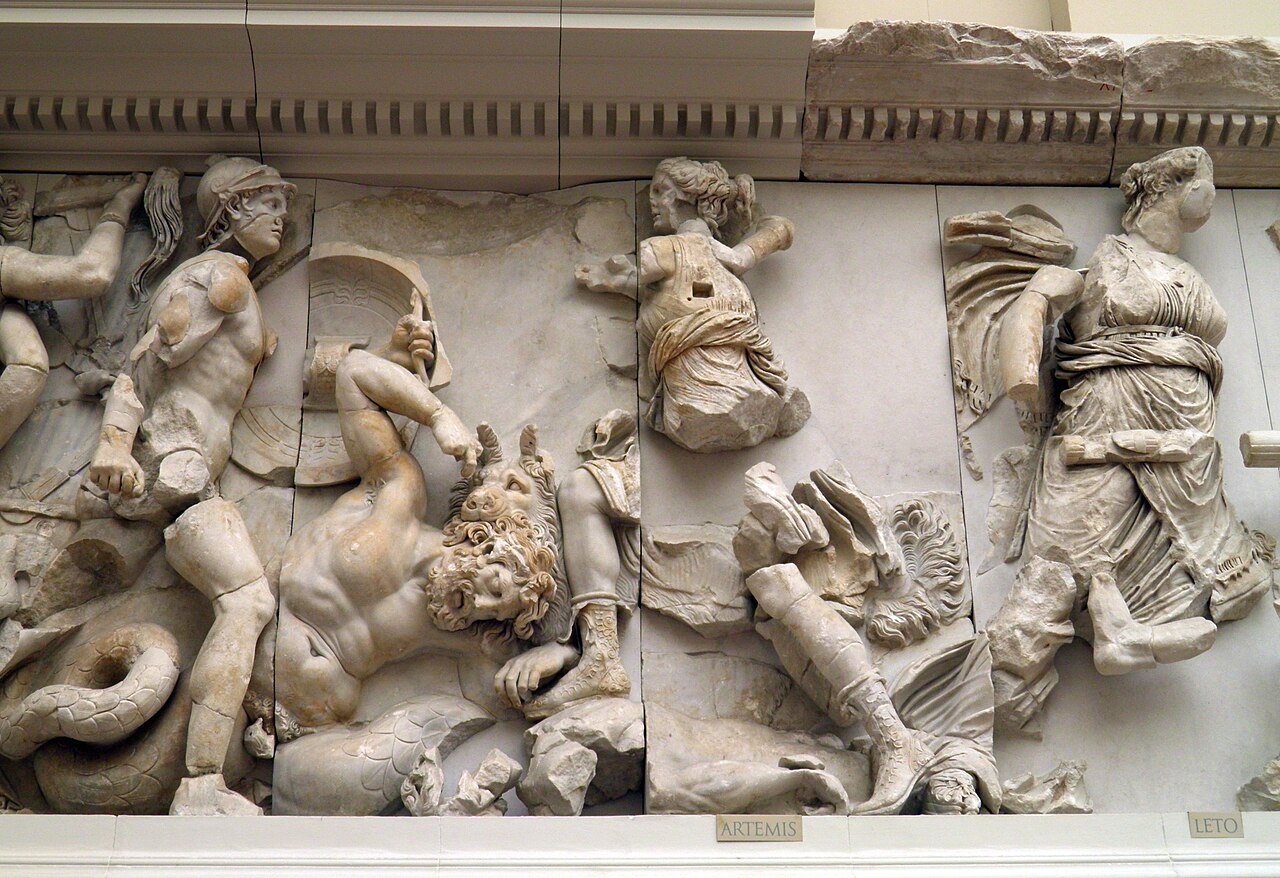
Artemis and Leto on the east frieze of the Pergamon Altar. Photo: Carole Raddato, CC BY-SA 2.0, via Wikimedia Commons
The Attalids were newcomers. Their kingdom, centred on the hill city of Pergamon in western Anatolia, had been carved out of the wreck of Alexander's empire, and it survived by being useful to Rome. Attalid kings fought on Rome's side against Macedon and against the Seleucids, and were rewarded with territory. They spent the money on Pergamon: a great library, a theatre cut into an absurdly steep slope, and the Great Altar, whose frieze of gods fighting giants now sits in a museum in Berlin.
Being Rome's friend had a cost. The Senate watched the Attalids closely, and Eumenes II found that a client king who becomes too successful starts to look like a problem. By the time Attalus II died in 138 BC, at around eighty, the kingdom's freedom of action was already narrow.
The king who preferred his garden
His successor, Attalus III, was Eumenes's son, and he is one of the oddest monarchs of the Hellenistic world. The Roman historian Justin, writing much later, describes a ruler who killed several of his relatives and courtiers, then withdrew from public life, dressed in mourning and devoted himself to gardening. He is said to have grown poisonous plants such as hellebore and hemlock and studied them, and to have worked in bronze and wax. He wrote on agriculture, and later Roman writers on farming cited him as an authority.
How much of this is true is hard to say. Justin was not a friendly witness, and an eccentric, cruel recluse is exactly the sort of king Roman readers expected to find in the East. What is not in doubt is the date of his death, 133 BC, after just five years on the throne, and that he had no son.
The will and the scramble
When the will was opened, it named the Roman people as heir. The idea was not brand new: Ptolemy VIII had made a similar will in 155 BC, leaving Cyrene to Rome if he died without children, but he went on to outlive it by decades. Attalus III was the first king whose will of this kind actually took effect. An inscription from Pergamon, a decree passed by the city soon afterwards, refers to the king's will and to the city's own freedom, which suggests the document made some provision for Pergamon itself rather than simply handing over every acre. The full text of the will does not survive.
Rome did not exactly rush to accept. The bequest arrived in the middle of a political crisis in the city. Tiberius Gracchus, the tribune pushing a land reform bill, proposed using the Attalid treasure to equip the poor citizens who would receive land, and to let the people rather than the Senate decide what to do with the cities of the kingdom. That was one of the moves that made the senators decide he had gone too far. He was killed later that year.
In Anatolia, meanwhile, a man named Aristonicus, who claimed to be a son of Eumenes II, rejected the will and fought for the throne. He drew support from slaves and the poor and called his followers Heliopolitai, citizens of the Sun. It took Rome until 129 BC to defeat him, and only then did it organise the core of the kingdom as the province of Asia.
Attaleia after the Attalids
Attaleia's place in all this is murky. It sat on the edge of the kingdom, on a coast where piracy was a business, and the sources do not say clearly whether it passed to Rome with the rest. It shows up again in the 70s BC, when the Roman commander Publius Servilius Vatia campaigned along that coast against the pirates, and Cicero later lists the lands of Attaleia among the territory Servilius brought under Roman control. By the time the Apostle Paul and Barnabas sailed from "Attalia", as the Book of Acts calls it, it was an ordinary Roman port.
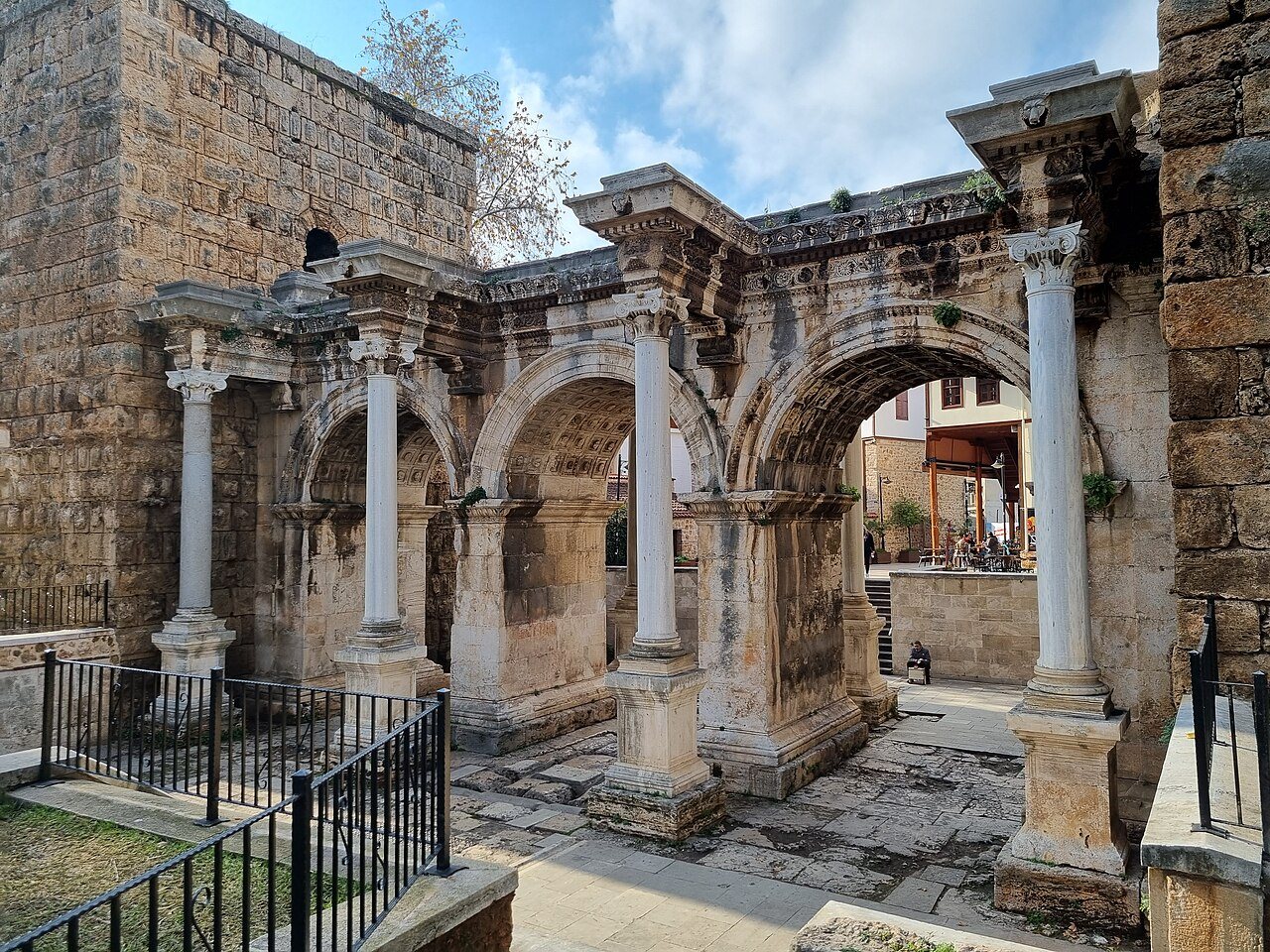
Ordinary enough, anyway, to earn an imperial visit. The emperor Hadrian came through around AD 130, and the city put up a triple arch for him in white marble. It still stands at the edge of the old town, its paving worn into deep grooves by centuries of cart wheels, and it is the one ancient monument in Antalya almost every visitor walks through. (If you go, look down rather than up. The ruts tell you more about the city than the carving does.)
The question nobody has settled
So why did Attalus III do it? The historians disagree, and have done for a long time. One view is that it was a hard-headed calculation: a king with no heir, a neighbour that would take the kingdom anyway, and a will that at least protected the Greek cities from being sacked in the process. Another is that it was a last act of spite against his own relatives and courtiers, who would have fought over the throne. A third, which some ancient writers hinted at and which cannot be proved either way, is that the Romans had a hand in drafting it.
The Pergamon inscription leans towards the first explanation without quite confirming it. Until the will itself turns up, the man who gardened with hemlock keeps his reasons to himself.
Enjoyed this story?Get a new one every day on social.