Photo: U.S. Army Corps of Engineers Norfolk District, public domain, via Wikimedia Commons
Inside the nozzle of a Patriot interceptor's rocket motor there are layers of charred cloth, and the cloth started life as rayon. The Wall Street Journal reported last week that this fabric has become one of the narrowest points in the Pentagon's effort to build more PAC-3 MSE missiles, and the trade press has been repeating the story since. It is not the rayon in a summer shirt. It is a grade spun to aerospace specifications, carbonized, soaked in resin and wrapped around the throat of the nozzle, where it is meant to burn away slowly while the exhaust tears past.
According to the Journal's reporting, as relayed by the Jerusalem Post and Interfax-Ukraine, the chain runs like this: thread from a factory in the Czech Republic, carbonized into fabric by ArianeGroup in France, coated by Park Aerospace in Kansas, then layered into nozzles by L3Harris for Lockheed Martin's Patriot line. ArianeGroup has said its supply is limited. Park has pledged $5 million toward a new French production line due around 2028 and a further $25 million toward a plant in the United States that is roughly three and a half years away. "Nobody wants to wait 3½ years," Park's chief executive, Brian Shore, told the paper.
The United States has been in this spot before, in 1989, and that time the problem was one factory on the Shenandoah River.
The biggest rayon plant in the world
The American Viscose Corporation opened its plant at Front Royal, Virginia, in 1940. Rayon, made by dissolving wood cellulose and squeezing it through spinnerets into an acid bath (so it comes from trees, which surprises people who assume it is a plastic), was a war material almost from the start: parachutes, and the cord inside the tires of aircraft and jeeps. At its peak the plant employed about 2,500 people, was the largest employer in Warren County, and was described as the largest producer of rayon anywhere. Its buildings covered roughly a tenth of the town, which meant that for most of a working family's life in Front Royal the factory was simply the place where people went in the morning.
Viscose rayon is a chemical business, and a dirty one. The process uses carbon disulfide, sulfuric acid and zinc, and Front Royal smelled of it (residents describe a sulfurous stink that came and went with the wind). FMC Corporation owned the plant for a time and sold it in 1976 to a new company, Avtex Fibers.
A shuttle part with one supplier
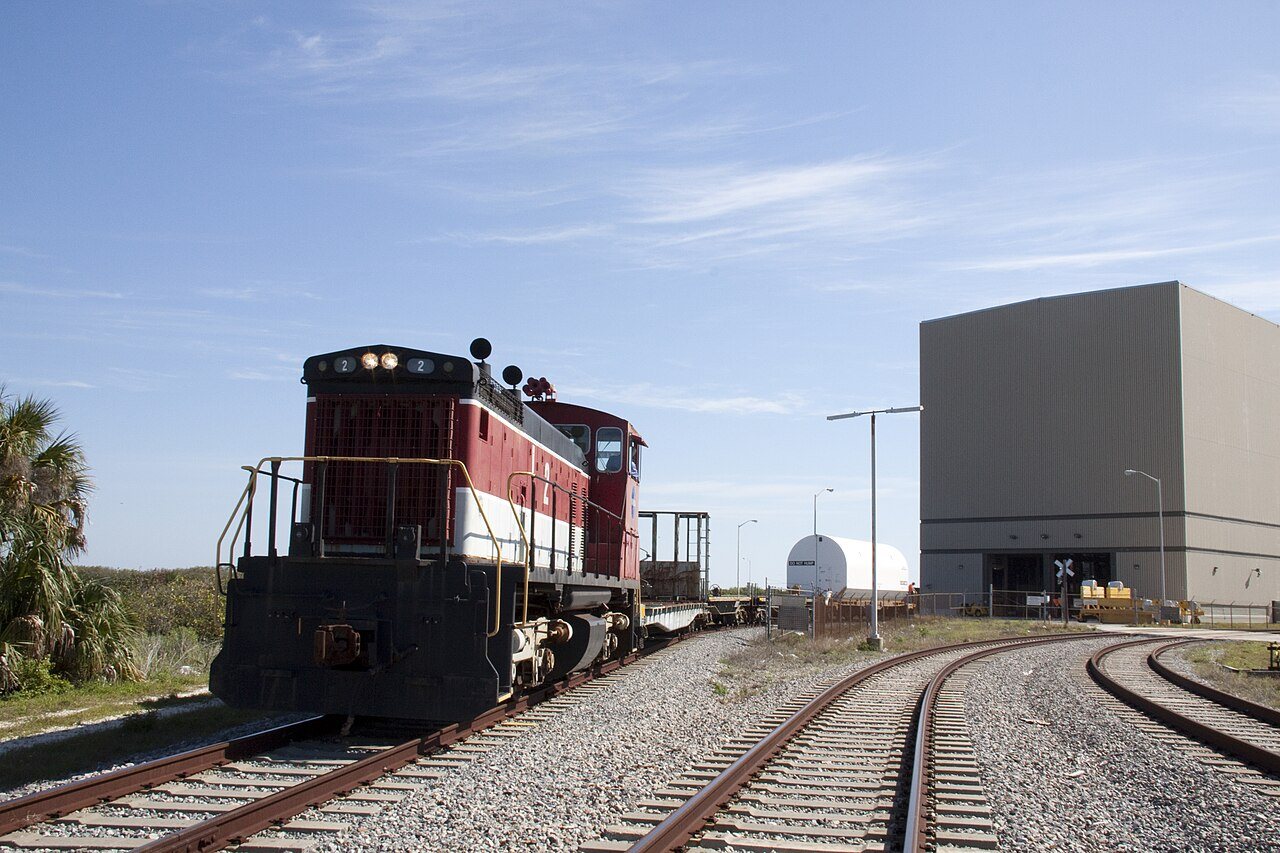
A nozzle exit cone for a space shuttle solid rocket booster arrives at Kennedy Space Center by rail
By the 1980s most of the American rayon industry had gone. Avtex survived partly because of a small, specialized product: rayon yarn qualified for carbon cloth phenolic, the ablative lining used in the nozzles of the space shuttle's solid rocket boosters and in military rocket motors. The catch is qualification. A nozzle liner has to char at a predictable rate under conditions that cannot be tested casually, so once a fiber from one plant is approved, a fiber from another plant is not a substitute until it has been through the whole process again. Avtex was, in effect, a sole source, and nobody in Washington seems to have thought much about it while the plant was running.
Two thousand violations
The plant also polluted on an industrial scale. A Wikipedia summary of its record counts more than 2,000 environmental violations over five years, including releases of PCBs into the Shenandoah. Heavy-metal sludge leaked through fissures in the limestone under the site into the river, and fish became unsafe to eat. The federal Superfund program took control of the 430-acre site in 1986, while the factory was still operating.
The company closed its rayon operations in 1988 for economic reasons, then started them up again briefly to make fiber for the aerospace industry, because there was nowhere else to get it (I find that detail more telling than anything in the court files). Virginia kept pressing. Attorney General Mary Sue Terry fought the company in court over its discharges, the state Water Control Board revoked its discharge permit, and in the autumn of 1989 the plant shut for good. When Avtex filed for bankruptcy in February 1990, the Associated Press called it "the single largest corporate polluter in the state" and a "defunct military contractor." Court papers listed debts of about $63.9 million. The machinery for making rayon yarn was valued at $2 million.
What NASA did next
The shuttle did not stop flying. How much Avtex yarn the program had on its shelves when the gates closed is something I have never seen a reliable public figure for. The longer answer was another mill: by the 1990s the booster nozzles were being made with rayon from North American Rayon Corporation in Tennessee, and less than a decade later the same thing happened again. According to a 2000 paper by engineers at Thiokol, the booster's builder, North American Rayon stopped making aerospace-grade rayon in September 1997. NASA kept a stockpile meant to last until the summer of 2005 and started a formal program in 1998 to find a replacement, screening a dozen rayon and lyocell fibers from three vendors. Half of them were dropped in the first round, partly over "future availability concerns."
So the people who flew the shuttle spent the final two decades of the program buying a fabric that the clothing business no longer wanted to make, from whichever factory still made it, and stockpiling against the day it closed. The current Patriot reporting reads almost line for line like that history. Enka, a German rayon maker, faces possible closure as fashion demand falls, and American contractors and the Pentagon have reportedly committed to buy more than 470,000 pounds over two years to keep it open a little longer, even though its rayon is not yet qualified for the PAC-3 MSE.
Royal Phoenix
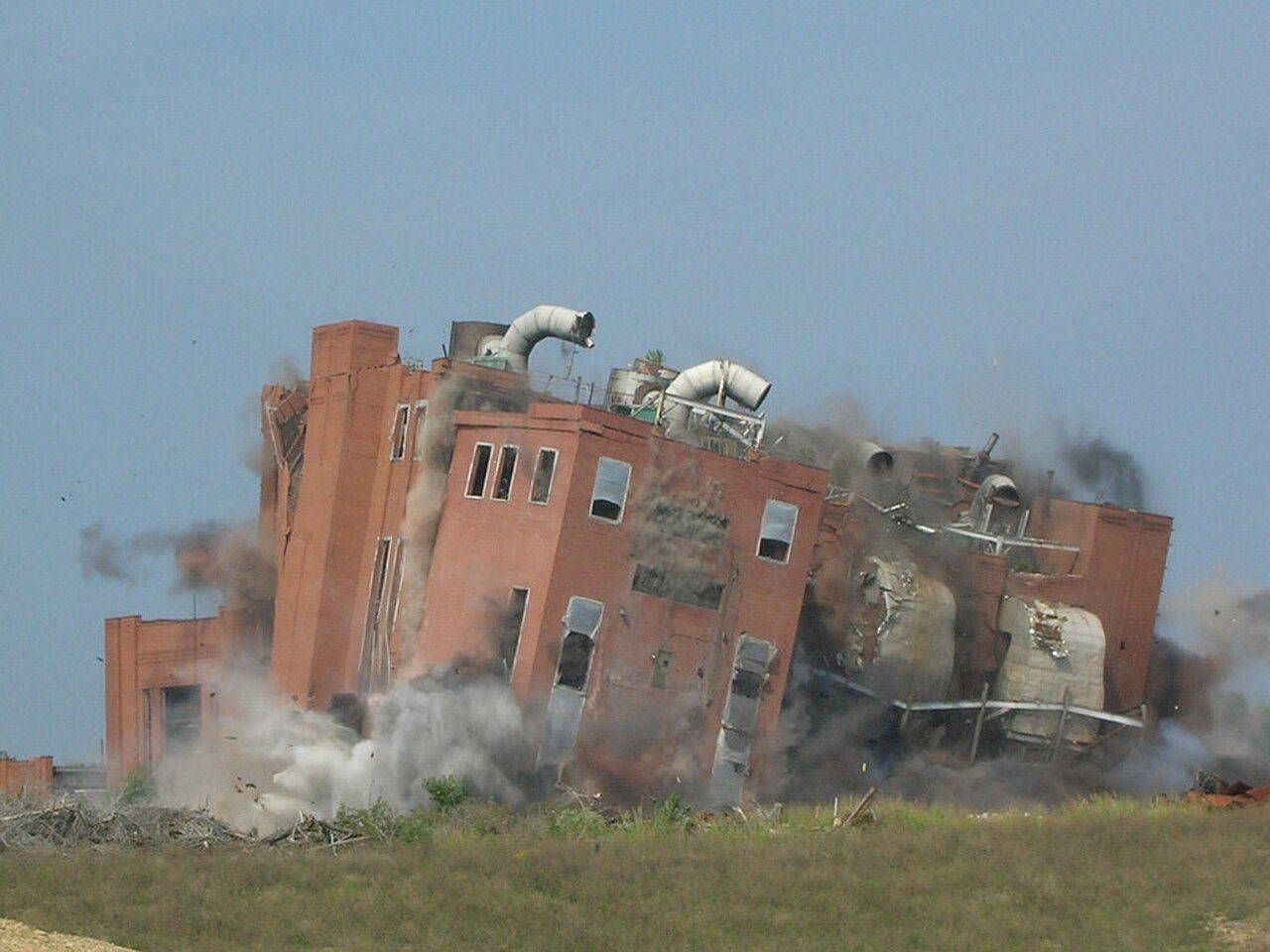
Avtex's buildings came down in stages. Its boiler house was demolished in 2005, the moment in the photograph above, and the cleanup by the federal government and FMC went on for years after that. The site has since been renamed Royal Phoenix. A magazine profile in 2015 described a soccer complex on 35 acres, a business park planned on part of the land and about 240 acres set aside as a nature conservancy along the river. The Art Deco office building, the one piece of the plant that looked as if it had been designed by someone who cared, held a 151-seat theater.
Enjoyed this story?Get a new one every day on social.