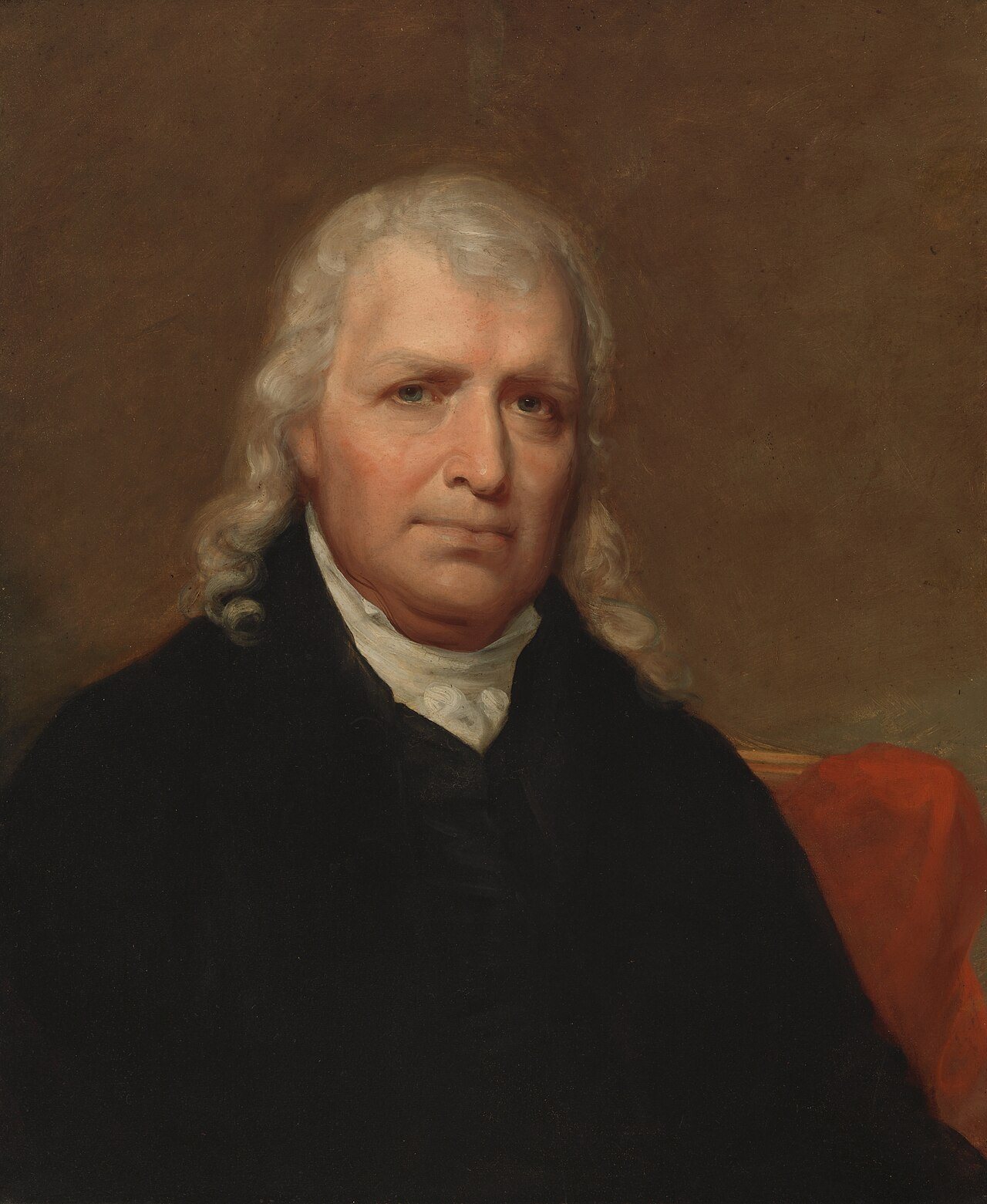
Samuel Chase by John Wesley Jarvis, National Portrait Gallery, public domain, via Wikimedia Commons
South Korea's Democratic Party said on Friday that impeaching Chief Justice Cho Hee-dae is now official party policy, and that it is starting the procedure. The opposition People Power Party called it a national tragedy. The anger behind the move has been building for months over a run of court decisions the ruling party disliked, including the appeals court acquittal of Seoul mayor Oh Se-hoon, and Cho's term runs out next June anyway.
The United States tried the same thing once at the very top of its judiciary, in 1804, against a Supreme Court justice whose real offence was that the party in power could not stand him. How that ended still governs how American judges are treated.
A signer of the Declaration in a judge's robe
Samuel Chase was a Maryland lawyer who had signed the Declaration of Independence in 1776. George Washington put him on the Supreme Court in 1796. He was clever, loud and a committed Federalist, and he did not keep his politics in his chambers.
In those years Supreme Court justices also rode circuit, sitting as trial judges around the country. That is where Chase made his enemies. In 1800 he presided over the treason trial of John Fries, a Pennsylvania auctioneer who had led an armed protest against a federal property tax. Chase handed down his view of the law in writing before the defence had argued it, and Fries's lawyers walked out in protest. Fries was convicted and sentenced to hang. President John Adams pardoned him.
The same year Chase tried James Callender, a pamphleteer charged under the Sedition Act for attacking Adams in print. Jeffersonian accounts of the trial describe a judge who badgered defence counsel and plainly wanted a conviction. Callender got nine months in jail. (Two years later, out of jail and feeling unpaid by his old patrons, he turned on Jefferson and published the Sally Hemings story, so nobody in this affair comes out of it clean.)
The grand jury speech in Baltimore
Thomas Jefferson's party won the presidency and Congress in 1800, and in 1802 it repealed the Federalists' Judiciary Act of 1801, abolishing a batch of new judgeships. Chase took that personally.
In May 1803, addressing a grand jury in Baltimore, he attacked the repeal, criticised Maryland's move toward universal white male suffrage and warned that the country was sliding toward what he called mobocracy. A judge was telling citizens summoned for jury duty that the elected government was wrecking the Constitution.
Jefferson read the reports and wrote to a Maryland congressman, Joseph Nicholson, asking whether such an attack on the Constitution ought to go unpunished. Then, characteristically, he added that he would leave the matter to others and keep his own name out of it.
Eight articles and a vote in the House
The House took the hint. On 12 March 1804 it voted 73 to 32 to impeach Chase, and eventually approved eight articles. Six dealt with his conduct at the Fries and Callender trials. The eighth was about the Baltimore speech.
The lead manager for the prosecution was John Randolph of Roanoke, a Virginian of great eloquence and very little patience, who was better at insulting witnesses than at organising evidence, which turned out to matter a good deal.
A trial run by a man charged with murder
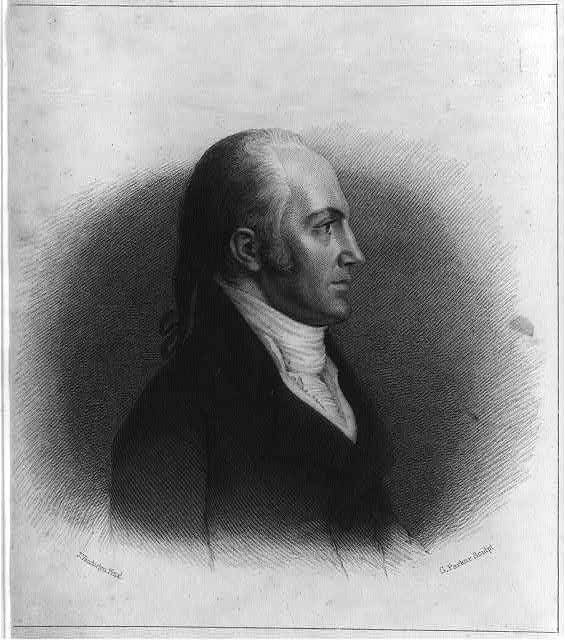
Aaron Burr, engraved portrait in profile. Library of Congress, no known restrictions
The Senate trial opened in February 1805. The presiding officer was the vice president, Aaron Burr, who the previous July had shot Alexander Hamilton dead in a duel at Weehawken. He had been indicted in New York and New Jersey and was avoiding both states. In Washington he was still in charge of the Senate, and he had the chamber fitted out like a courtroom for the occasion.
Chase's defence team was strong. Its best-known member, Luther Martin, a former Maryland attorney general famous for both his legal memory and his drinking, argued that a judge could only be impeached for an indictable crime, not for being rude, partisan or wrong. Randolph's side argued that impeachment was a political remedy and could reach misconduct that broke no statute.
Everything turned on that point. If the Senate convicted Chase for his opinions and his manners on the bench, every judge in the country would know that the majority in Congress could remove him for the same.
Nineteen votes, not twenty-three
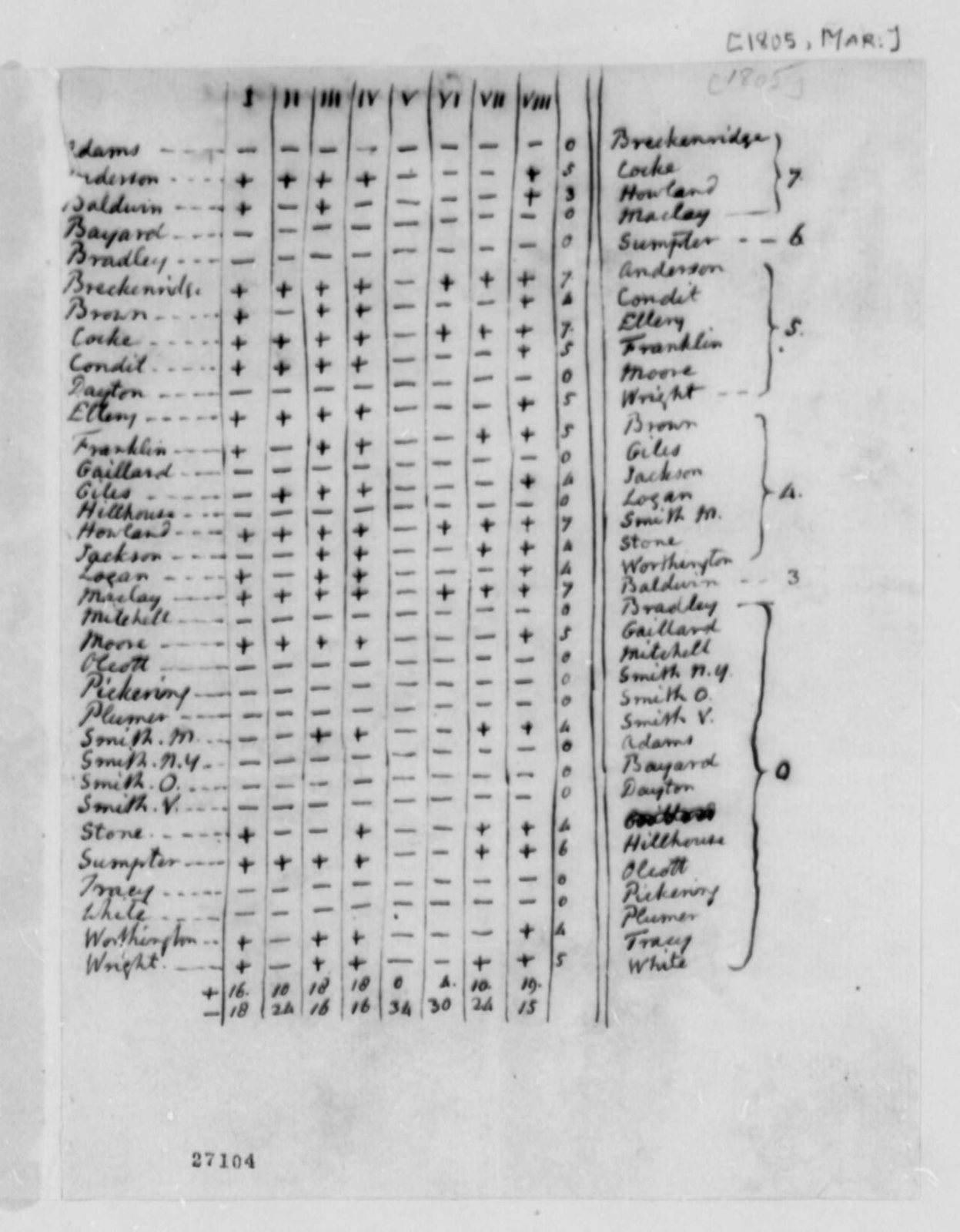
Handwritten tally of the Senate votes on the eight articles against Samuel Chase, 1805, from Thomas Jefferson's papers. United States Senate, public domain, via Wikimedia Commons
The Senate voted on 1 March 1805. There were 34 senators, so conviction on any article needed 23. Jefferson's party held a comfortable majority, and it still could not get there.
The closest vote came on the Baltimore speech: 19 guilty, 15 not guilty. On the trial-conduct articles the numbers were lower, and on some of them the prosecution was nowhere close. A number of Republican senators simply would not vote to remove a judge over what he had said and how he had said it.
Randolph was furious. He proposed a constitutional amendment letting the president remove federal judges at the request of both houses of Congress. It went nowhere. Chase went back to the Supreme Court and sat there until he died in 1811, by most accounts somewhat quieter on the bench than before.
What the Chase verdict settled
No Supreme Court justice has been impeached since. The House has impeached a number of lower federal judges over the years, but for bribery, perjury, tax evasion and similar crimes, not for their rulings. Chief Justice William Rehnquist, who wrote a whole book on the Chase trial (Grand Inquests, 1992), argued that the acquittal did as much as anything to secure the independence of federal judges. I think he was right, though he did have a professional interest in the conclusion.
South Korea's system is different in its mechanics. A majority of the National Assembly can impeach a judge, and the case then goes to the Constitutional Court, where six of nine justices must agree to remove. The country has done it to a judge only once, in 2021, when the Assembly impeached Lim Seong-geun, a senior judge accused of meddling in trials; the Constitutional Court dismissed the case because his term had already ended by the time it ruled.
Whether the Democratic Party has the votes, and whether the Constitutional Court would go along, is unknown. In 1805 the outcome did not depend on the arithmetic of party seats. It depended on a handful of senators in the majority deciding, when it came to a vote, that a judge who ruled the wrong way had not committed a high crime.
My own view is that the senators of 1805 who voted to acquit a judge they disliked did more for American courts than any judge of their generation.
Enjoyed this story?Get a new one every day on social.