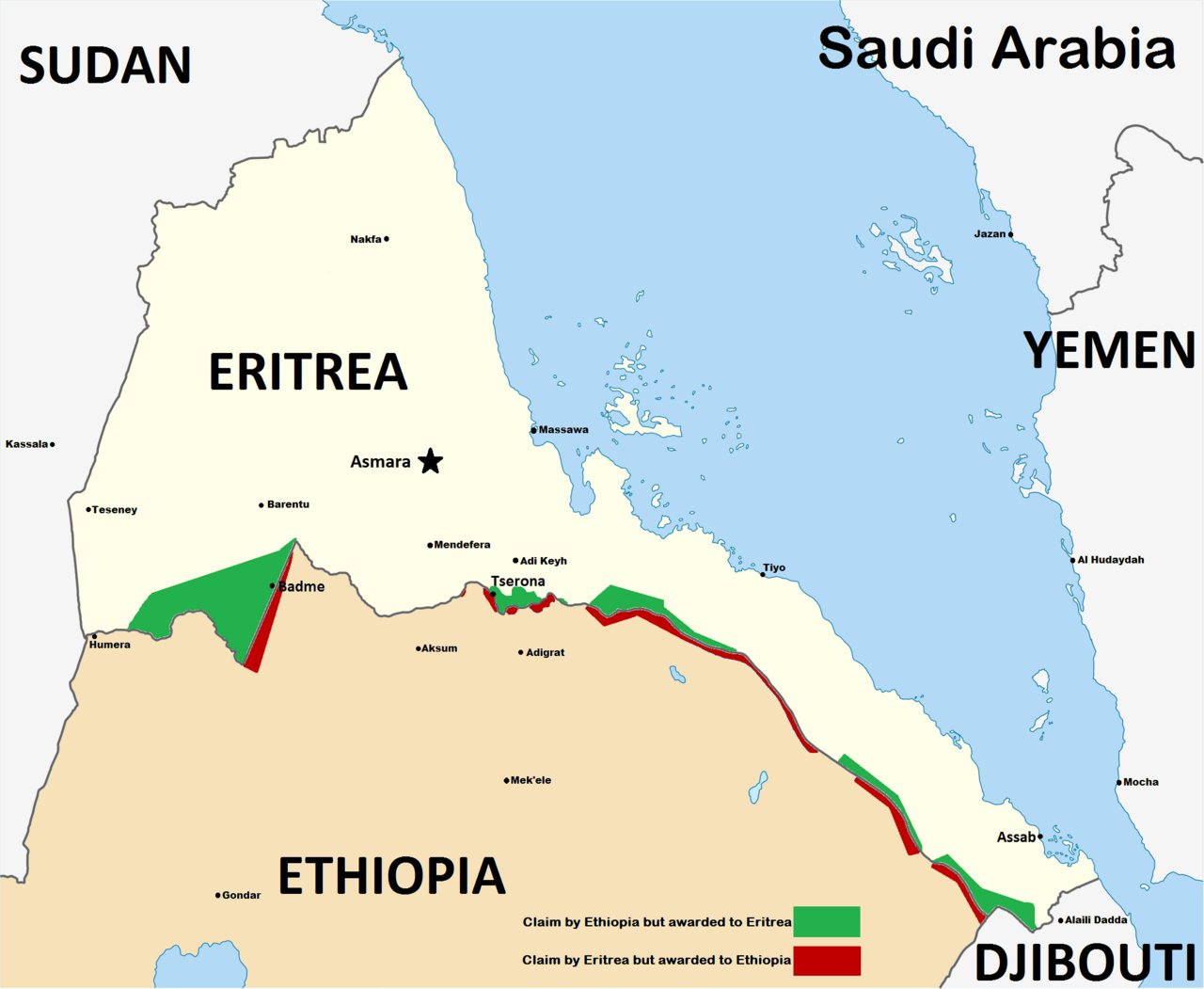
Map: Skilla1st, CC BY-SA 3.0, via Wikimedia Commons
"The parties agree that the delimitation and demarcation determinations of the Commission shall be final and binding." That sentence is Article 4, paragraph 15 of the agreement Ethiopia and Eritrea signed in Algiers on 12 December 2000, at the end of a war that had killed tens of thousands of people over a stretch of dry, thinly farmed border country. The paragraph goes on: "Each party shall respect the border so determined."
Twenty-six years later the border has still not been marked on the ground, and the town at the centre of the argument is being shelled again. According to the conflict monitor ACLED, quoted by Reuters this week, Ethiopian drones struck what were likely Eritrean positions near Badme on 12 November, Eritrean guns fired back, and the two armies clashed on the Ethiopian side of the line the next day. Reuters could not confirm the skirmishes itself. Eritrea's information minister dismissed the reports as propaganda, and Ethiopia did not comment.
A line drawn between two rivers
The border that Ethiopia and Eritrea dispute was not drawn by either of them. It comes from three treaties between Emperor Menelik II and Italy, which had made Eritrea its colony in 1890: one in 1900, an annex in 1902 and another in 1908. The Algiers agreement names all three as the basis for any ruling.
For the western stretch, where Badme is, the 1902 annex is the one that matters. It was signed in Addis Ababa on 15 May 1902 (a British envoy put his name to it too, because Sudan was involved) and it describes the frontier in terms of rivers: from the Setit, along a tributary called the Maieteb, across to the Mareb at the point where the Mai Ambessa joins it. The idea was to put the Kunama people on the Italian side. Nobody walked the line and put stones on it, and for most of the next century nobody needed to. Eritrea was an Italian colony, then a British-run territory, then, from 1962, a province of Ethiopia. A border inside one country is an administrative detail.
That changed in 1993, when Eritrea voted for independence after a thirty-year war. The two new governments, led by former allies Isaias Afwerki in Asmara and Meles Zenawi in Addis Ababa, got along well enough at first to leave the details for later.
Six days in May 1998
Later arrived on 6 May 1998. A small armed clash near Badme, between Eritrean soldiers and Ethiopian militia and police, reportedly killed several Eritrean officers. Who fired first is still argued about. Six days later Eritrean troops with armour moved into Badme and the surrounding plain, which Ethiopia had been administering, and Ethiopia's parliament declared it an act of aggression.
What followed looked, to many outside observers, absurd. Two of the poorest countries on earth went to war over a small farming town with no oil and no port. People reached for the line usually credited to Jorge Luis Borges about the Falklands, two bald men fighting over a comb. (Borges did not invent it, as it happens; versions of the image go back to the Roman fabulist Phaedrus.) I have never found the comparison helpful. Badme mattered because each government had told its own people the land was theirs, and neither could be seen to give it up.
Trenches and Operation Sunset
The fighting was closer to 1916 than to anything else in modern Africa: dug-in infantry, artillery duels and mass frontal assaults across open ground. In February 1999 Ethiopia launched an offensive it called Operation Sunset, broke through the Eritrean trenches and took Badme back within a few days. In May 2000 a second, larger Ethiopian push went deep into western Eritrea and took the town of Barentu before a ceasefire was agreed in June.
The dead are usually put at around 70,000, and some estimates run to 100,000. Tens of thousands of people of Eritrean origin were expelled from Ethiopia during the war, and Eritrea expelled Ethiopians in turn. A United Nations peacekeeping mission patrolled a buffer zone from 2000 until 2008.
The ruling in The Hague
The Algiers agreement handed the border to a five-member commission sitting in The Hague. It reported on 13 April 2002. Both governments claimed victory on the day, which tells you something about how carefully the maps had been read, but within months it was clear that the commission had placed Badme on the Eritrean side.
Ethiopia refused to accept it. In September 2003 Meles wrote to the UN Security Council calling the decision "a blatant miscarriage of justice" and warning that it was "a recipe for continued instability, and even recurring wars." The commission eventually gave up trying to put pillars in the ground and in 2007 declared the border demarcated on paper, by coordinates. For sixteen years the two armies faced each other across it in a state the region called "no war, no peace".
The handshake that did not move a soldier
In June 2018 Ethiopia's ruling coalition, newly led by Abiy Ahmed, announced that it would fully accept the Algiers agreement and the commission's ruling. A month later Abiy flew to Asmara, embraced Isaias, and the two signed a declaration ending the state of war. Phone lines between the countries opened for the first time in two decades. Abiy won the Nobel Peace Prize in 2019, largely for this.
Badme stayed where it was, under Ethiopian administration. The town lies in Tigray, and the Tigrayan leaders who ran the region had fought the 1998 war and showed no sign of handing it over. Within two years Ethiopia and Eritrea were fighting together against those same Tigrayan forces, in a war from 2020 to 2022 that killed far more people than the border war had. That alliance has since fallen apart. Fighting between the federal government and Tigrayan rebels resumed in September, witnesses reported Eritrean troops inside Tigray in October (Eritrea denies it), and Abiy's repeated talk of Ethiopia needing access to the sea is read in Asmara as a threat.
The International Crisis Group's Magnus Taylor told Reuters that fighting near the border could draw Eritrea further in on the Tigrayan side, which "could trigger a direct conflict" between the two states. According to ACLED, the clash on 13 November took place on the Ethiopian side of the line those 2007 coordinates describe.
Enjoyed this story?Get a new one every day on social.