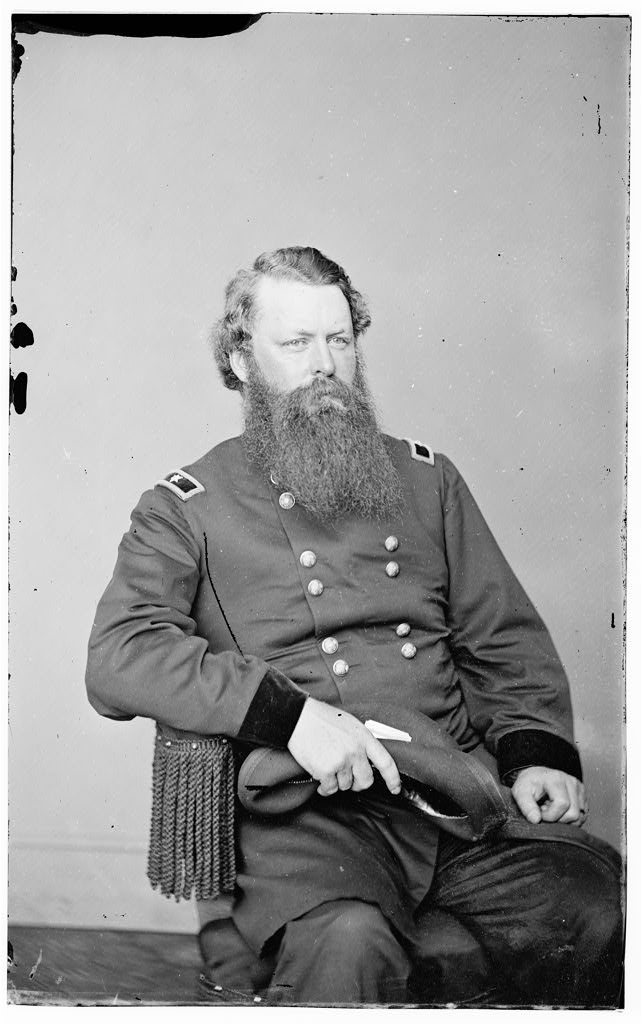
Brady's National Photographic Portrait Galleries, between 1860 and 1865, Library of Congress Prints & Photographs Division, no known restrictions
Since Tuesday the question I have been asked most is a simple one: has Congress ever actually impeached the person running the Pentagon? There was no Pentagon in 1876, and the job was called secretary of war. But yes. His name was William Worth Belknap, and his case is stranger than the short answer.
The question is live because Representative Thomas Massie, a Kentucky Republican, says he will force a House vote on articles of impeachment against Defense Secretary Pete Hegseth when Congress returns next week. Republicans who lost badly in the midterms blame Hegseth for the war with Iran, and several GOP sources told CNN they expect the measure to pass. Hegseth, in a video outside the Pentagon on Thursday, called them "sham articles of impeachment against yours truly". President Trump says he is keeping him.
A trading post at Fort Sill
Belknap was a lawyer from Iowa who had ended the Civil War as a Union general, and Ulysses S. Grant made him secretary of war in 1869. The job paid $8,000 a year. Washington in the Grant years was expensive, and Belknap's household lived as if it paid a good deal more.
The arrangement that ruined him was small and grubby. Army posts on the frontier had a licensed trader, a sutler who sold goods to soldiers and civilians, and the secretary of war controlled the licences. In 1870 a New York contractor named Caleb Marsh, a friend of Belknap's second wife, Carrie, was promised the post at Fort Sill in what is now Oklahoma. The man already running it, John Evans, did not want to leave. So a deal was struck: Evans kept the store and paid Marsh $12,000 a year, and Marsh sent half of it on to the Belknap household.
Carrie Belknap died at the end of 1870. The payments did not stop. For a while they were said to be for her infant son, who did not live long, and after that they simply went to Belknap. In 1873 he married Carrie's sister, Amanda, known to everyone as Puss, and the money kept arriving every quarter. By 1876, according to the later accounting, Belknap had received more than $20,000.
Leap day testimony
The story broke in the New York Herald early in 1876, and the newly Democratic House sent it to a committee chaired by Hiester Clymer of Pennsylvania. On 29 February (a leap year, which feels about right for a man whose luck ran out on a date that barely exists) Marsh testified under oath and described the arrangement.
Belknap knew what came next. On the morning of 2 March he went to the White House and handed Grant his resignation. Grant, who liked him and by most accounts did not grasp how serious the matter was, accepted it on the spot. Two senators, Oliver Morton of Indiana and Lot Morrill of Vermont, are said to have urged him not to, but by then it was done.
Impeached that afternoon
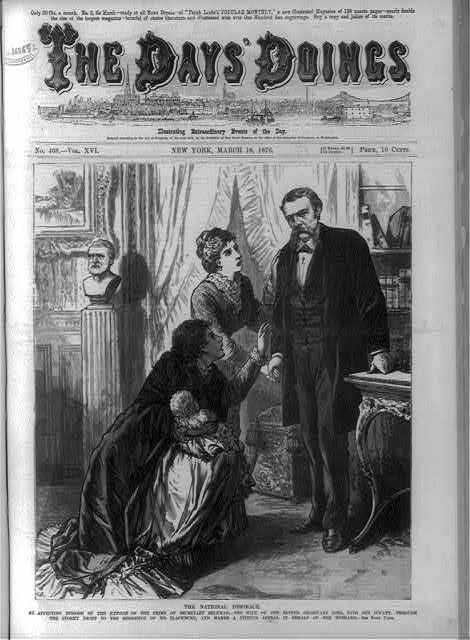
The National Disgrace, front page of The Days' Doings, New York, 18 March 1876, an illustrated weekly's melodramatic take on the Belknap scandal. Library of Congress, no known restrictions
If the resignation was meant to stop the House, it did not. That same afternoon the House voted to impeach him anyway, with no member voting against. The Democrats were in no mood to let a Grant cabinet officer slip out of the building, and plenty of Republicans saw no reason to defend him.
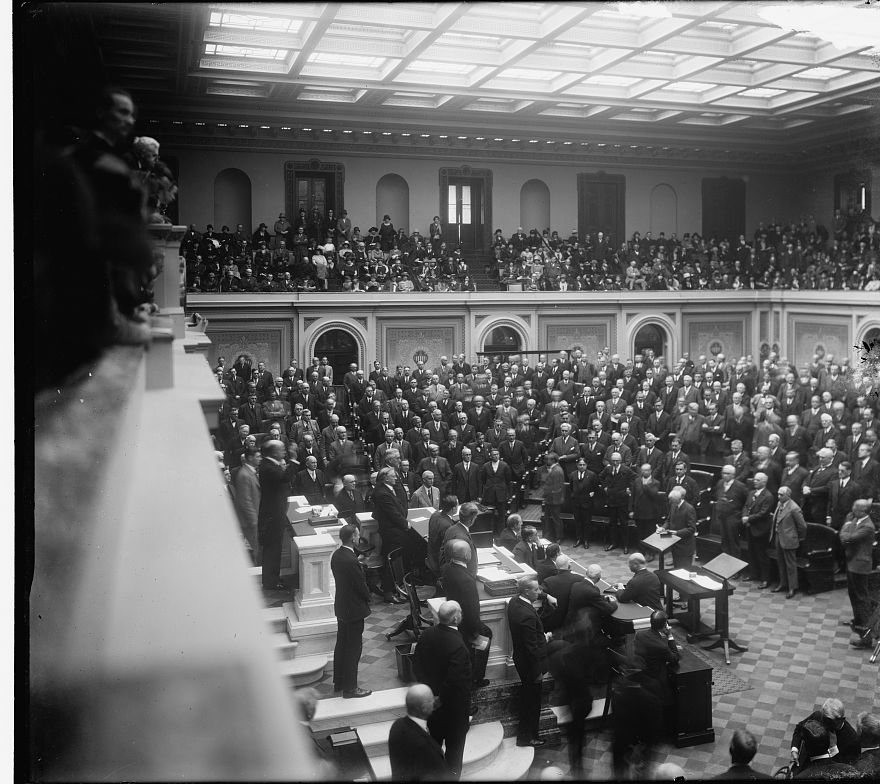
The trouble was the Constitution. It allows impeachment of "the President, Vice President and all civil Officers of the United States", and by the time the vote was taken Belknap was none of those. His lawyers, among them the former postmaster general Montgomery Blair and the former attorney general Jeremiah Black, argued that a private citizen could not be impeached at all. The House managers answered that the penalty in the Constitution includes disqualification from holding any office in future, and that a man could not escape it by resigning an hour ahead of the vote.
The Senate argues with itself
The trial opened on 5 April 1876, and the Senate spent weeks on the jurisdiction question before it heard a word of evidence. On 15 May it voted 37 to 29 that it could try him. That margin mattered more than anyone admitted at the time, because conviction needs two-thirds of the senators present, and 29 senators had just said on the record that the whole proceeding was improper.
The evidence itself was never really in doubt. The verdicts came on 1 August, and every article drew a majority for guilty. None reached two-thirds; the best showing was 37 to 25. Most of the senators who voted to acquit said afterwards that they did so because they believed the Senate had no jurisdiction, not because they thought Belknap was innocent. It was a party vote with a constitutional argument draped over it. I don't think that is too unkind.
What happened to Belknap
He was never convicted of anything. A criminal prosecution was talked about and quietly dropped. Belknap stayed in Washington, practised law, and died there in October 1890. He is buried at Arlington National Cemetery, as a general of the Union army.
His case did not vanish either. The 37 to 29 vote became the precedent for trying an official who has already left, and it was quoted constantly in 2021, when the Senate tried Donald Trump after he had left the White House. For almost 150 years Belknap was also the only cabinet secretary ever impeached. Alejandro Mayorkas, the homeland security secretary, became the second in February 2024, by a single vote, 214 to 213. The Senate dismissed those articles in April without holding a trial.
The Hegseth arithmetic
Hegseth would be the third. He would also be the first to face it while still in the job and with the president firmly behind him, which is a different situation from Belknap's, who was gone before lunch. The department he runs has, since 2025, been using the old name Department of War again as a secondary title, so on paper, at least, the two men held the same job.
Nothing guarantees a vote passes. If it does, the articles would go to a Senate that changes hands in January, when the Democrats take control after this week's results, and the jurisdiction fight of 1876 would not come up at all as long as Hegseth stays put. Belknap, the only man who ever tried resigning his way out of an impeachment, got four months of Senate trial for his trouble, and at the end of it no punishment at all.
Enjoyed this story?Get a new one every day on social.