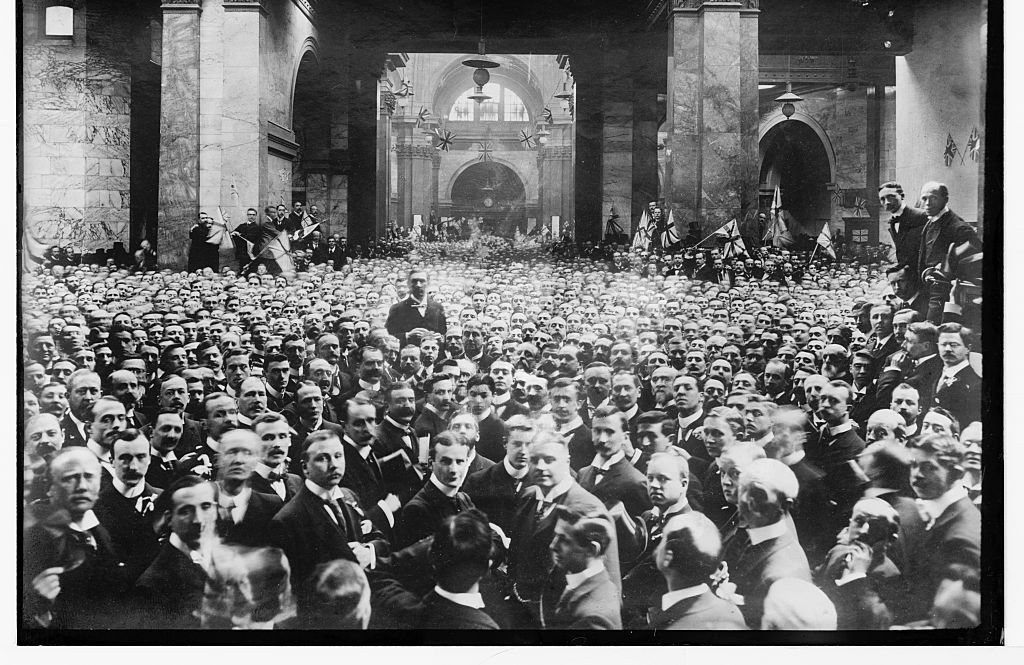
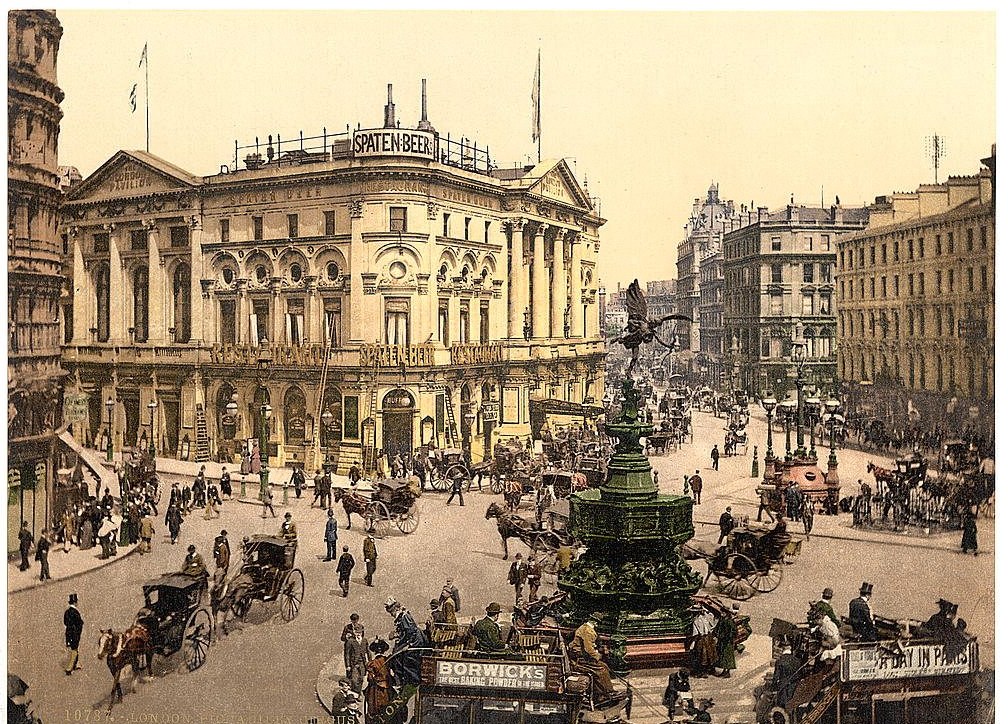
Photo: Bain News Service, between 1910 and 1920, Library of Congress Prints & Photographs Division, no known restrictions
At a little after eight on the morning of Monday 27 October 1986, in the hexagonal dealing room of the Stock Exchange tower on Threadneedle Street, a few hundred men in dark suits stood at their pitches and waited for prices to appear on the new screens. They appeared, then stopped. The quotation system that was meant to replace two centuries of shouting had, by most accounts, buckled under the load in its first hour, and for a while that morning the most modern share market in Europe was staring at frozen numbers. A broker who was there later remembered the floor itself as the strangest part: "There was a complete hush, it was extraordinary."
The hush was the point. The screens were fixed by lunchtime, and within a few weeks most of the people standing on the floor had gone upstairs, to desks with telephones, and never came back down. The day had a nickname before it happened, borrowed from cosmology, and it stuck: Big Bang.
A club with rules that broke the law
The London Stock Exchange before that Monday was a private club, and a well-run one, but its rules would have landed any other British trade in court. Members were divided into two castes that were not allowed to mix. Jobbers stood on the floor and dealt in shares for their own account; brokers took orders from the public and walked over to the jobbers to fill them. A broker could not deal, a jobber could not take clients, and every broker charged the same fixed minimum commission, set by the Exchange. Firms were partnerships, and outsiders could own only a small slice of them.
The motto over the door was Dictum Meum Pactum, my word is my bond, and the senior partners of Mullens & Co., the firm that acted as broker to the government, still wore top hats to work. By the early 1980s New York's exchange was roughly six times London's size, and London's own investors were going round it: exchange controls had been abolished in 1979, so a British pension fund could buy foreign shares through an American house in New York at a negotiated commission rather than through a London broker at a fixed one. New York had scrapped fixed commissions on 1 May 1975, a date Wall Street called May Day, and London's brokers had watched the business drift away ever since.
A deal in a government office, 1983
The Exchange did not reform itself out of foresight. It reformed because the Office of Fair Trading had referred its rulebook to the Restrictive Practices Court in 1979, and by 1983 the case was heading for a hearing the Exchange expected to lose. After the Conservatives won that June's election, the Exchange's chairman, Nicholas Goodison, went to the new trade and industry secretary, Cecil Parkinson, with an offer: drop the case, and the Exchange would abolish fixed commissions itself, by the end of 1986, and open its doors to outside capital.
Parkinson agreed, the case was dropped, and the Exchange had three years to dismantle a system it had spent 170 years building. The date it chose was 27 October. (Parkinson resigned from the government three months after the deal, over a personal scandal, and is remembered for almost everything except this. Politics is not fair about these things.)
Everybody buys everybody
Once it was clear that outsiders would be allowed to own member firms outright, which the Exchange permitted from March 1986, the City held the biggest sale in its history. Nearly every old broking and jobbing partnership was bought, and the buyers were banks. Barclays took the jobber Wedd Durlacher and the broker de Zoete & Bevan and bolted them together as BZW. S.G. Warburg bought the jobber Akroyd & Smithers, the broker Rowe & Pitman and Mullens, top hats included. Midland Bank, Citicorp and Union Bank of Switzerland each bought a broker or two. Merrill Lynch, Goldman Sachs, Salomon Brothers and Morgan Stanley, which had been operating in London on the edges, hired in bulk and moved in.
The partners who sold did extremely well out of it, and a generation of young dealers did nearly as well, because every bank that had bought a firm then had to staff a dealing room, and there were not enough experienced people to go round. Salaries roughly doubled in a couple of years. The phrase "golden hello" entered the language, and so, less kindly, did "yuppie." Within a year, 75 of the Exchange's member firms were foreign-owned. Within a decade only a handful of the old British houses were still independent, among them Cazenove, Schroders, Hambros and Flemings, and most of those have since been bought too.
A crash, a fraud office and a new city
Big Bang had one anniversary before anyone could judge it. On Monday 19 October 1987 the world's share markets fell faster than they ever had, and London's first screen-based crash was an ugly day: market makers were accused, with some justice, of simply not answering their phones. The market survived, which was the real test, and the old floor was not missed. Equities had already left it. The Exchange kept it open a little longer for the traded options business, then shut it.
Two other pieces of furniture arrived in the same two years. The Financial Services Act of 1986 set up a new regulator for investment business, and the Serious Fraud Office was created in 1987, in the wake of a share-support scandal at Guinness that broke within weeks of Big Bang and put several very senior City men in the dock.
The less obvious consequence of putting a market on screens is that you need somewhere to put the screens. A bank that now did broking, dealing and corporate finance under one roof wanted a dealing floor the size of a football pitch, with no columns and room underneath for miles of cable, and the medieval street plan of the City could not supply many of those. So in 1987 the Canadian developers Olympia & York took on a derelict dock three miles east and began building Canary Wharf, on land that had been unloading bananas twenty years earlier. It went bankrupt once on the way, in 1992, but it is there because of what happened on Threadneedle Street in October 1986.
What is left on Threadneedle Street
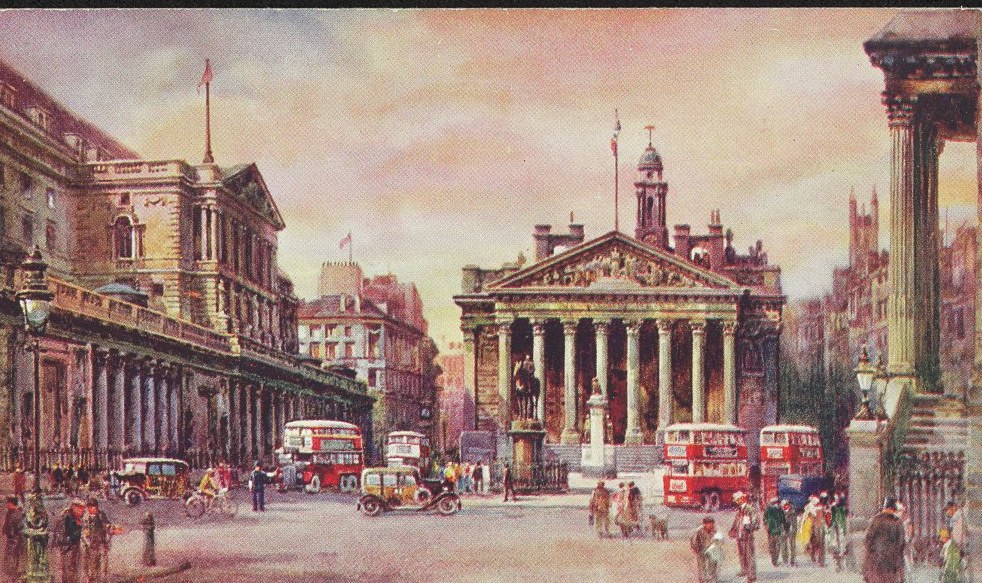
Postcard of the Bank of England and the Royal Exchange, London, in the 1930s; the Stock Exchange stood a few yards away on Threadneedle Street. Postcard, between 1930 and 1940, Library of Congress Prints & Photographs Division, no known restrictions
The 1972 tower where Big Bang happened had a short second act. The IRA bombed its visitors' gallery in July 1990 (nobody was hurt), and the Exchange left for Paternoster Square, beside St Paul's, in 2004. The tower was gutted, reclad in glass and is now an ordinary office block at 125 Old Broad Street. There is no plaque for the hexagon, and no reason a passer-by would know that share prices were once shouted there.
The argument about whether Big Bang was worth it is forty years old and not finished. The case for the prosecution says London gave away its own firms and ended up a branch office of New York. The figures are more mixed. London has had a poor few years for new listings since 2021 and ranks, at best, sixth in the world by the value of the companies quoted on it; it is also still the biggest centre on earth for trading currencies and interest-rate derivatives, financial services employ more than a million people across the country, and it remains, by a long way, the financial capital of Europe. The dealing floors are mostly in Canary Wharf now, with a view back towards the City, and they are still full of screens.
Enjoyed this story?Get a new one every day on social.