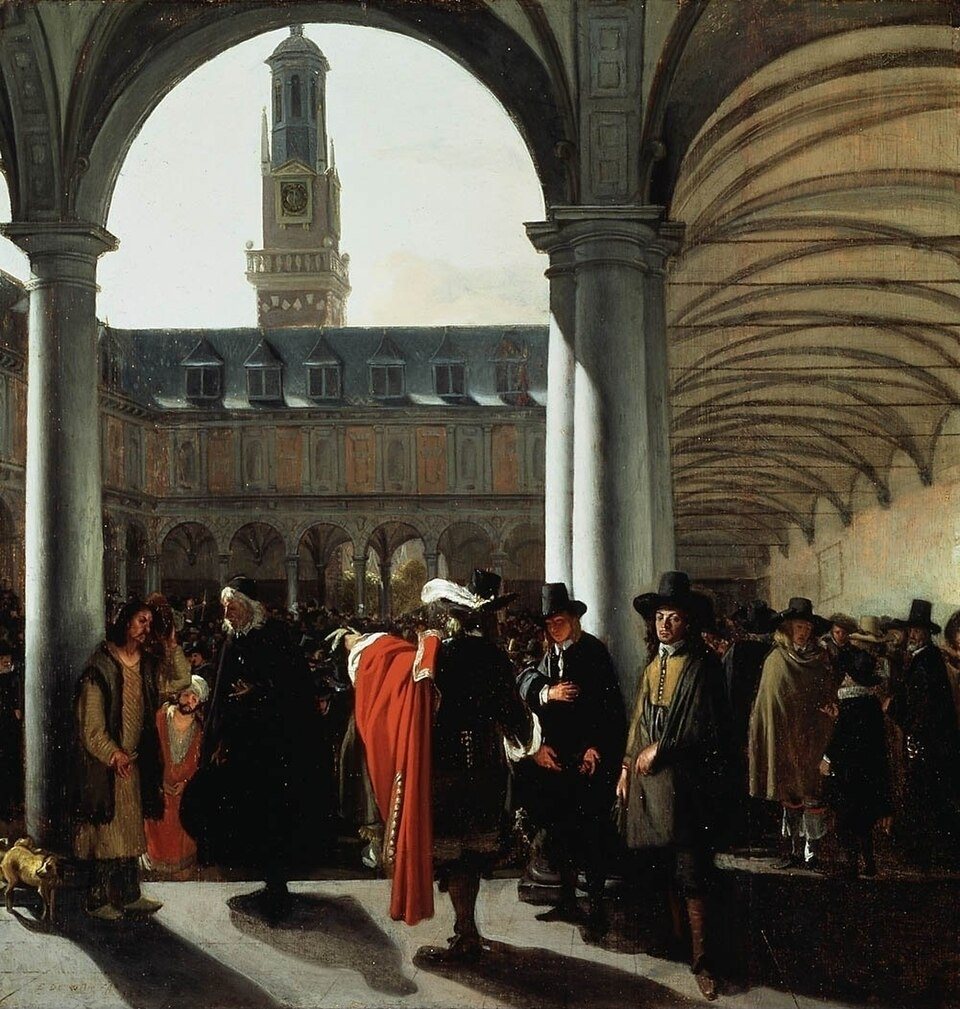
Painting: Emanuel de Witte, The courtyard of the Amsterdam exchange, public domain, via Wikimedia Commons
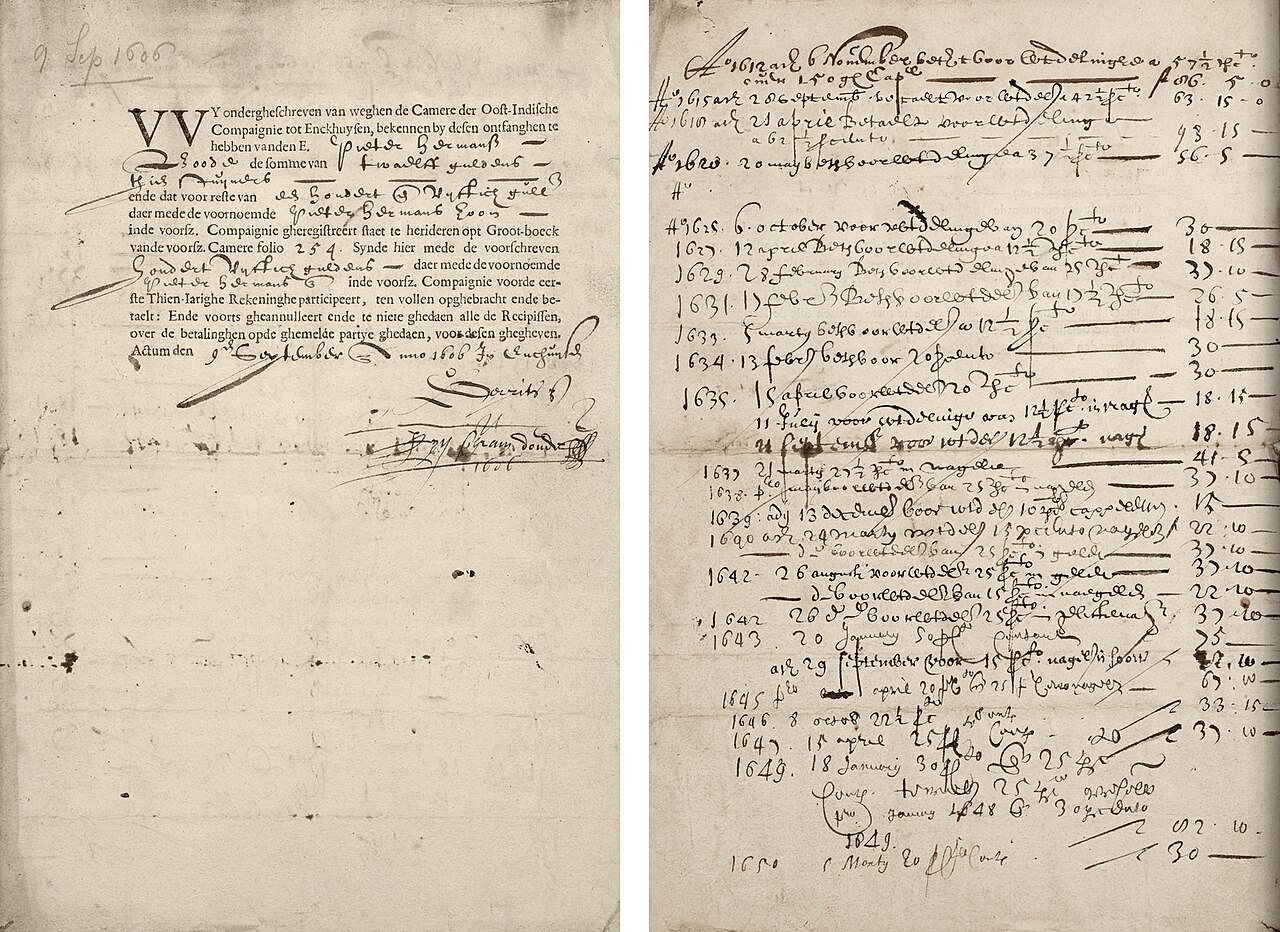
"We, the undersigned, on behalf of the Chamber of the East India Company at Enkhuizen, acknowledge that we have received from the honourable Pieter Harmensz the sum of..." The receipt goes on in a clerk's hand to record that Harmensz had now paid in full for a 150-guilder stake, entered "in the great book of the said Chamber, folio 254". It is dated 9 September 1606. It was found in the town archive of Hoorn in 2010 by a history student, and as far as anyone knows it is the oldest share document in the world.
I thought of it this week because Anthropic, the AI company, has set a price range of $70 to $78 a share and plans to start trading on Nasdaq on 19 November, with about a fifth of the shares reportedly set aside for ordinary retail buyers. Selling a slice of a very large company to the general public is now so routine that we forget somebody had to try it first, and that the first attempt left its buyers with a problem nobody had planned for.
A company anyone could join
The Dutch East India Company, the VOC, was chartered by the States General on 20 March 1602. It merged several rival trading ventures into one body with a monopoly on Dutch trade east of the Cape of Good Hope. What made it unusual was the charter's offer: any inhabitant of the United Provinces could subscribe, in any amount.
Six chambers took money, in Amsterdam, Middelburg, Delft, Rotterdam, Hoorn and Enkhuizen. In Amsterdam the subscription book was kept at the house of Dirck van Os, one of the directors, and people came in to write their names and the sum they promised. The books closed at the start of September 1602 with about 6.4 million guilders pledged, more than half of it in Amsterdam. Enkhuizen, a much smaller town, had 538 subscribers, and many of them were craftsmen and small traders rather than merchants. Nobody paid everything up front. The pledges were called in by instalments over the next few years, which is why Harmensz was still finishing his in 1606.
No certificate, just a line in a ledger
Front and back of the 1606 receipt from the Enkhuizen chamber of the VOC, with dividend payments recorded by hand on the reverse up to 1650. Public domain, via Wikimedia Commons
There were no share certificates in the modern sense. What you owned was a line in the chamber's capital book. Paper like the Harmensz receipt confirmed what you had paid, and the back of his was later used to note the dividends he received, a column of dates running into 1650. To sell, you and the buyer went to the company's office and the bookkeeper moved the entry from your name to theirs.
That last detail matters, because selling turned out to be the only way out.
The ten-year promise
The charter ran for 21 years, but it promised a general accounting after the first ten. The Harmensz receipt even names it: his money took part in "the first ten-year account". Investors seem to have assumed that in 1612 the books would be settled and they could take their capital out if they wished.
It did not happen. The directors were building forts and fleets in Asia and had no intention of handing the money back, and the full accounting was put off. By the time the charter was renewed in 1623 the capital had, in practice, become permanent. (Historians of the company still argue about how deliberate this was. My own reading is that it was more drift than plan, though the drift suited the directors very well.)
There was no dividend at all until 1610, and much of that first one was paid in mace, the spice, rather than cash. If you needed your money before then, you had one option, which was to find someone who would buy your line in the ledger.
A market grows on a bridge
So they did. Shares changed hands on the Nieuwe Brug and along the Warmoesstraat in Amsterdam, in the open air, until the city built a proper exchange on the Rokin, designed by Hendrick de Keyser and opened in 1611. Its courtyard is the one in Emanuel de Witte's painting above, crowded with men in black at the fixed trading hours.
The tricks came quickly too. In 1609 a group led by Isaac Le Maire, a former director who had fallen out with the company, sold shares they did not yet own in the hope of buying them back cheaper. The States General banned the practice the next year, which makes short selling about as old as the stock market and the rules against it only slightly younger.
De Keyser's exchange was pulled down in 1835 because its foundations were failing. The site on the Rokin is ordinary city street now. The Harmensz receipt fared better. After it turned up in the archive it was put on show at the Westfries Museum in Hoorn, a single sheet with forty-four years of dividends written on the back.
Enjoyed this story?Get a new one every day on social.