"Forever" is the word the Treaty of Stolbovo used in 1617, when Russia handed the fortress of Ivangorod and the lands of Ingria to Sweden. Forever lasted 87 years, until Peter the Great's army came back for the place. Nearly every promise made about the Narva River has gone the same way.
Estonia's foreign minister, Margus Tsahkna, said over the weekend that the country's road crossings with Russia at Narva, Koidula and Luhamaa will shut on 1 December. The trigger was a failed arson attack on Saturday on the drone maker Threod Systems, which Estonia's Internal Security Service says was carried out by Latvian residents on the orders of Russia's GRU. It is the second attack on an Estonian defence company since August. Moscow's foreign ministry called the plan "Russophobia." The government has not yet said whether the closure is temporary.
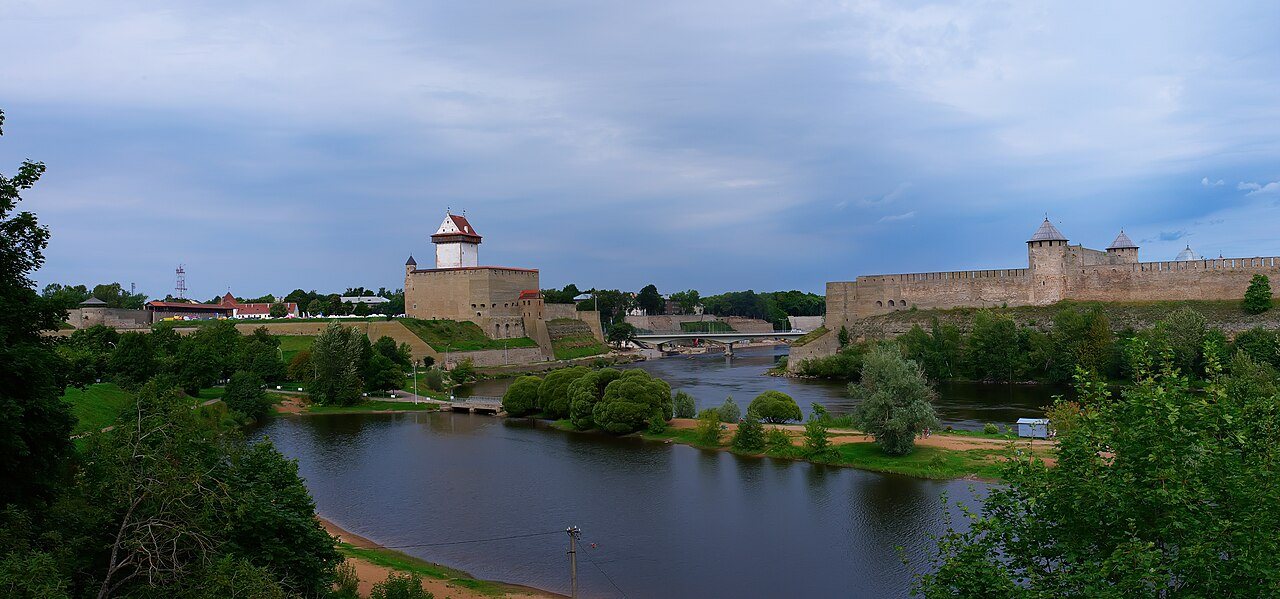
Of the three crossings, Narva is the one with a view. Stand at the bridge and you have a square Western castle with a tall white tower on one bank, and a long grey Russian fortress on the other, close enough that for most of their history each could fire straight into the other.
A Danish castle on the west bank
The western castle is the older of the two. Danish crusaders took northern Estonia in the early thirteenth century, and Narva grew up around a Danish stronghold on the river crossing, the obvious place to tax traffic between the Baltic and Novgorod. In 1346 the Danish crown, short of money and tired of revolts, sold the whole of northern Estonia to the Teutonic Order. The castle passed to the Order's Livonian branch, which gave it the shape it has now, including the tower everyone calls Tall Hermann. (Nobody seems sure which Hermann, if any, it is named after. I have read three explanations and believe none of them.)
Narva did well out of Russian trade, which made it a nuisance to the bigger Livonian towns that wanted that trade for themselves. It also made it a target.
Ivan III builds in a summer
The man who changed the view was Ivan III, grand prince of Moscow. In 1478 he had swallowed the republic of Novgorod, and with Novgorod came its western frontier, the Narva River. In 1492 he ordered a fortress built on a rise called Maiden Hill, directly opposite the Livonian castle. It was a plain square with four towers, and according to the Russian accounts it went up in about two months. He named it after himself: Ivangorod, Ivan's town.
The Livonians are said to have called it a "Trutz-Narva," a spite-Narva, which is about the only honest name a fortress has ever been given. Its purpose was not hidden. It watched the Order's castle, and it gave Moscow a foothold on the river that did not depend on anybody's goodwill.
A Swedish raid and an awkward sale
Ivangorod's first test came quickly, and from a third direction. In August 1496 a Swedish fleet, about seventy ships by one count, came up the Narva estuary, and after a heavy storm the new fortress fell. The Swedes then tried to sell it to the Livonian Order across the river. The Order declined, which is one of those decisions that look wiser the more you think about them, and Russian troops took the place back the same year.
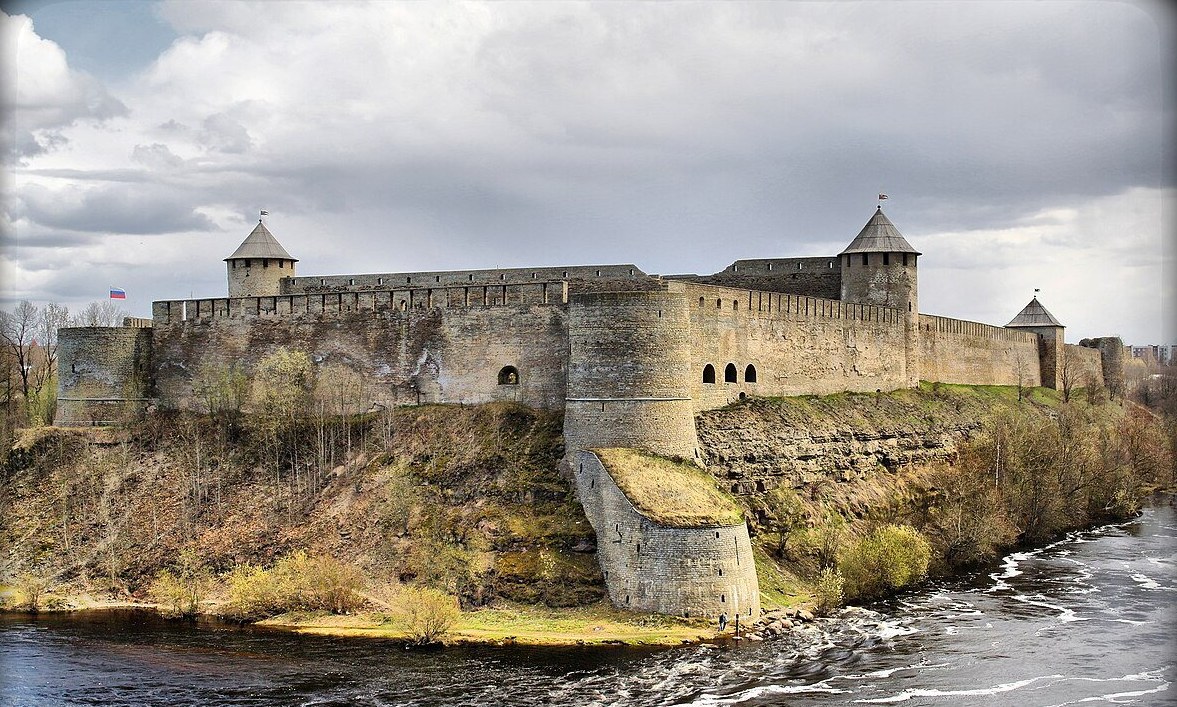
Moscow's answer was to build much bigger. The rebuilt fortress gained a large new enclosure on its eastern side, the Big Boyar Town, with walls around nineteen metres high. Most of what a visitor sees today dates from that rebuilding and the decades after it.
Eighty years of trading places
In 1558 Ivan IV, the one later called the Terrible, started the Livonian War. In April his guns at Ivangorod shelled Narva for days. In May a fire broke out in the town, and Russian troops crossed the river and took it, castle and all. For the first time a bridge joined the two fortresses, built by the side that now held both.
It did not last. Swedish forces took Narva in 1581 and soon afterwards Ivangorod as well. Russia won Ivangorod back under a truce in 1590, lost it again to a Swedish siege that ended in December 1612, and then signed it away at Stolbovo in 1617. For most of the seventeenth century both banks were Swedish, and the river was an internal waterway of the Swedish empire, which must have been a strange feeling for the garrisons on the eastern side, guarding a fortress that faced nothing in particular.
Peter's second try
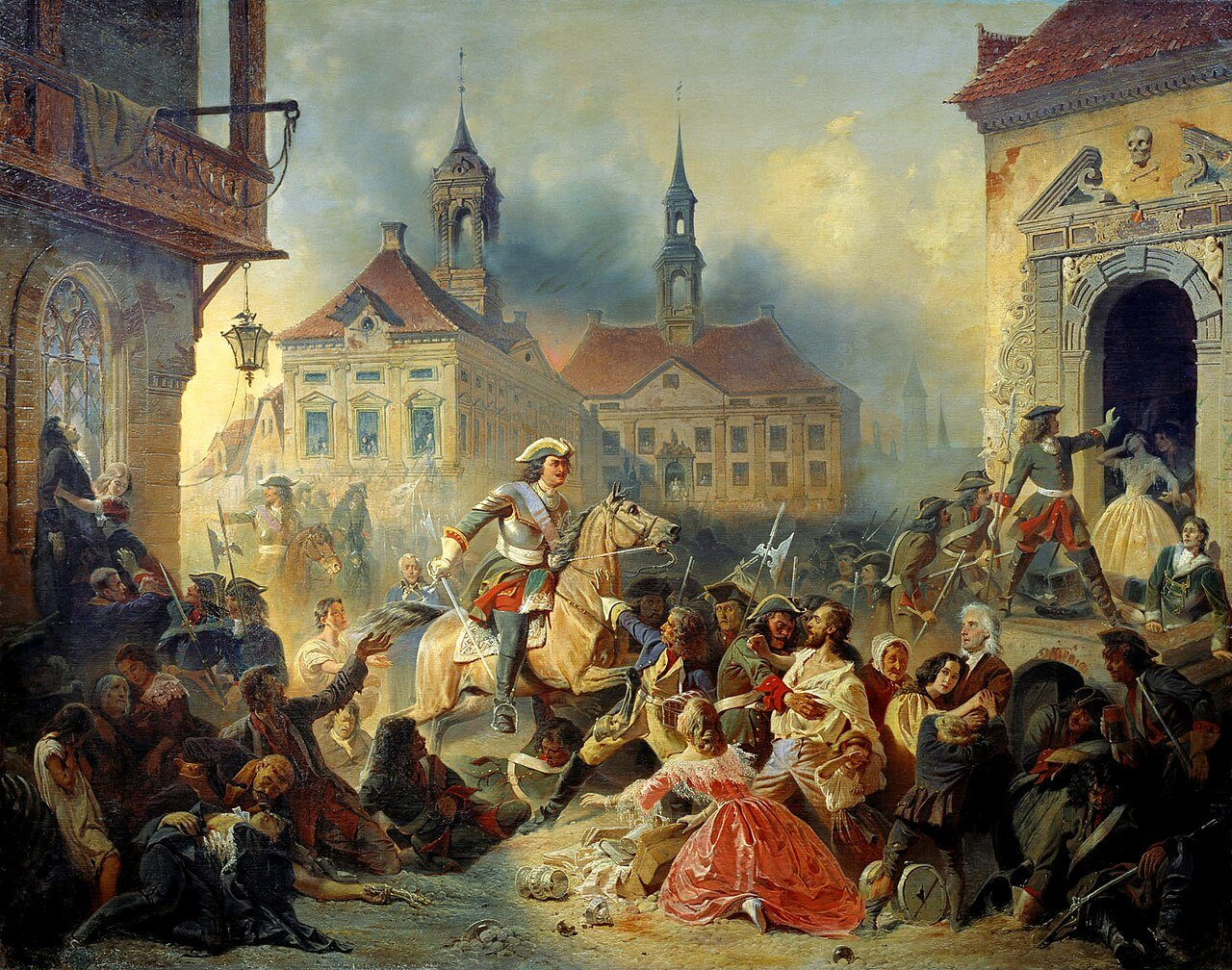
Peter the Great on horseback in a Narva street in 1704, as imagined in Nikolai Sauerweid's painting of 1859. Painting: Nikolai Sauerweid, public domain, via Wikimedia Commons
Peter the Great came for Narva in 1700, at the start of the Great Northern War, and was badly beaten outside its walls by the eighteen-year-old Charles XII. He came back. On 9 August 1704, after a bombardment and a final assault, his troops took Narva. Ivangorod's Swedish garrison surrendered a week later and was allowed to march out with its personal weapons.
A famous Russian story has Peter riding into the sacked town and stopping his own soldiers from plundering it, striking down one of them with his sword. Nikolai Sauerweid painted the scene in 1859. The tale was much repeated in the nineteenth century, when it suited the imperial image very well, and I would treat the details with some caution. The Treaty of Nystad in 1721 made both banks Russian, and for the next two centuries the river separated nothing more than two districts of the same empire.
The river becomes a border again
The walls and towers of Ivangorod Fortress above the Narva River. Photo: Andrey Korchagin, CC BY-SA 2.0, via Wikimedia Commons
That changed with the Russian Revolution. Under the Treaty of Tartu in 1920, the new Estonian republic got Narva and a strip of land east of the river, which put Ivangorod inside Estonia too. The Soviet Union annexed Estonia in 1940. The fighting of 1944 wrecked Narva's baroque old town, which was not rebuilt, and after the war Moscow redrew the internal line so that Ivangorod went to the Russian republic.
Inside the Soviet Union that line hardly mattered. In 1991 it became an international border, running down the middle of the river between the two castles. Narva, rebuilt after the war largely by people brought in from elsewhere in the Soviet Union, is now overwhelmingly Russian-speaking,, and many of its families have relatives in Ivangorod and beyond.
The bridge between the castles
The road bridge at Narva sits almost exactly where the 1558 bridge would have been useful, between the Order's castle and Ivan's fortress. Hermann Castle is a museum now, and so is Ivangorod. Under Tsahkna's plan the road crossing between them closes on 1 December, 534 years after work started on Maiden Hill.
Enjoyed this story?Get a new one every day on social.