Photo: Vice-Presidência da República, CC BY 2.0, via Wikimedia Commons
Brazilians are voting today in a presidential runoff between Luiz Inácio Lula da Silva, who turns 81 on Tuesday and is asking for a fourth term, and Flávio Bolsonaro, a senator whose father is serving a 27-year sentence for plotting a coup. Flávio Bolsonaro led the first round on 4 October, 47 per cent to 45. Whatever happens tonight, it will be the seventh time Lula's name has been on a presidential ballot. The first was in 1989, and I think that one explains a good deal about the six that followed.
It was the first time Brazilians had chosen a president directly since October 1960. In between there had been a military coup, twenty-one years of generals, and a return to civilian rule in 1985 that began with a death.
The president who never took office
The generals had agreed to hand over power through an electoral college, not a popular vote, and in January 1985 that college chose Tancredo Neves, a 74-year-old moderate from Minas Gerais who had spent the dictatorship as a careful opponent. The night before his inauguration he was taken to hospital with abdominal pain. He never took the oath. He died on 21 April after seven operations, and his vice-president, José Sarney, a politician who had supported the military regime until shortly before, became the first civilian president in two decades almost by accident.
Sarney's five years produced a new constitution, in October 1988, and an inflation rate that is hard to describe to anyone who did not live through it. Prices rose by more than 1,000 per cent in 1989. Supermarkets re-priced shelves during the day. The constitution set the first direct presidential election for 15 November 1989, which was also, to the day, the hundredth anniversary of the coup that had abolished the Brazilian monarchy. It also gave the vote, for the first time, to sixteen-year-olds.
Twenty-two candidates and a hunter of maharajas
Twenty-two people ran, still the record. The field included Leonel Brizola, the old left-wing governor who had been exiled in 1964; Mário Covas; Paulo Maluf; Ulysses Guimarães, who had steered the constitution through Congress and got under five per cent for his trouble; and Lula, then 44, a former lathe operator from the car plants of São Bernardo do Campo who had led the metalworkers' strikes of 1978 to 1980 and founded the Workers' Party in 1980.
The man who beat all of them had been polling at about five per cent at the start of the year. Fernando Collor de Mello was the 40-year-old governor of Alagoas, one of Brazil's smallest and poorest states, where he had made his name by publicly going after civil servants on absurd salaries. The magazine Veja called him the "caçador de marajás," the hunter of maharajas, and the name stuck. He was handsome, rich, telegenic and belonged to a party, the PRN, that had been created mostly to run him. He campaigned against corruption and against the political class, which in the second round meant against Lula, and he did it mainly on television.
In the first round Collor took 30.5 per cent. Lula came second with 17.2, about 450,000 votes ahead of Brizola, who then swallowed thirty years of rivalry with the Workers' Party and backed him for the runoff. It was set for 17 December.
Four days that decided it
The runoff was close for most of the month. Then came the final week.
On 11 December, Abílio Diniz, the head of the country's largest supermarket chain, was kidnapped in São Paulo. He was freed by police days before the vote, and the officers reported that his captors, a mixed group of Brazilian, Argentine, Chilean and Canadian militants, had been found with Workers' Party shirts. The party said it had nothing to do with it and nobody has ever shown otherwise, but the pictures ran everywhere on the eve of the vote.
The edit
On 14 December the two men met in the last televised debate. On the evening of 15 December, Globo's main news programme, Jornal Nacional, broadcast a highlights package of it to the largest television audience in the country. The edit used Collor's best moments and Lula's worst. Armando Nogueira, who had run Globo's news division, later said as much in public. Roberto Marinho, who owned Globo, was close to Collor. A study published in 2023 by researchers at Insper in São Paulo estimated that viewers of the edited version swung towards Collor by a margin that would have cost Lula millions of votes.
Collor won on 17 December with 53 per cent to Lula's 47, about four million votes out of seventy million cast. Turnout was 86 per cent. Lula's camp has believed ever since that the last four days decided it. They may be right; a six-point margin is not much against a kidnapping and a news edit, though nobody can run the week again to check.
What the winner did with it
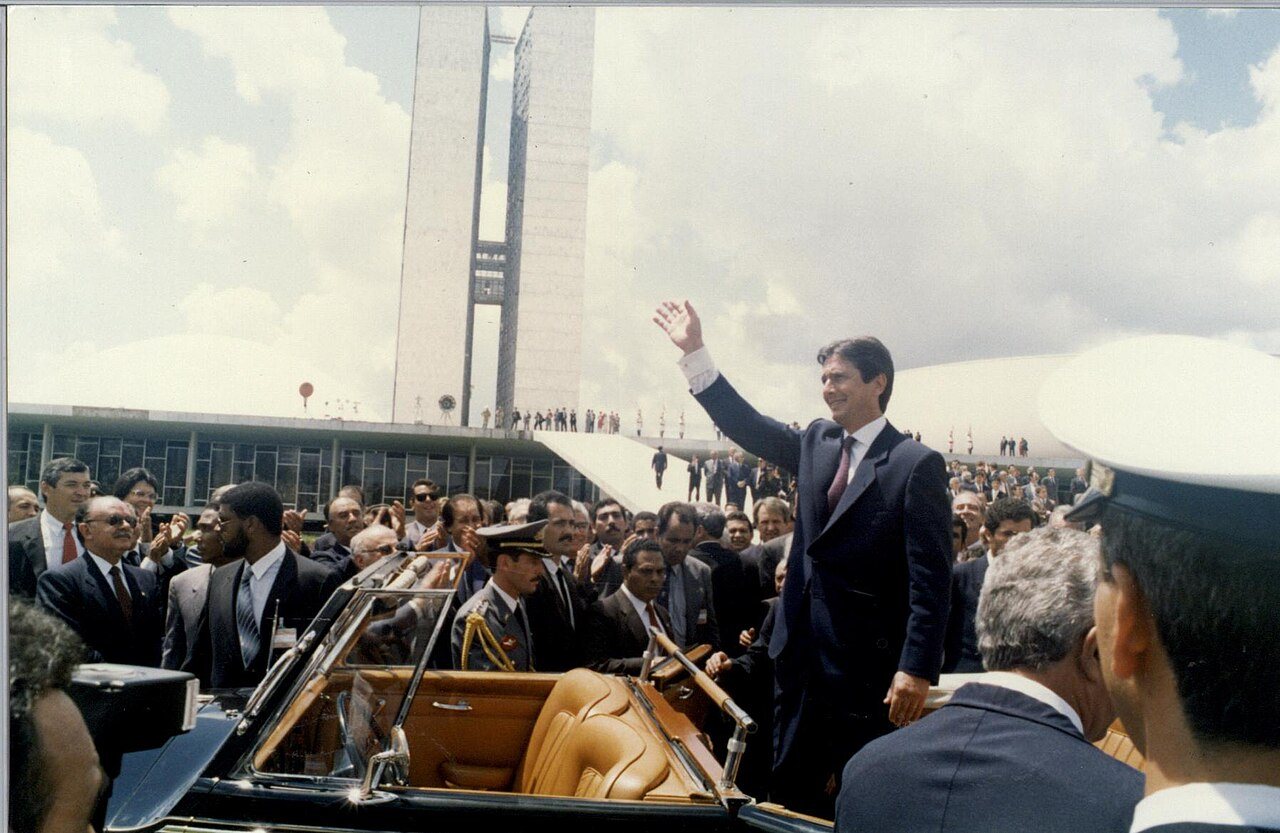
Fernando Collor waves from an open car in front of the National Congress in Brasília at his inauguration, 15 March 1990. Photo: Senado Federal, CC BY 2.0, via Wikimedia Commons
Collor was sworn in on 15 March 1990 and the next day froze most of the money in the country's bank accounts, an anti-inflation plan so drastic that people with savings suddenly could not pay their bills. Inflation came down for a few months and then came back. In 1992 his own brother gave an interview accusing him of running a kickback scheme through his campaign treasurer. Students painted their faces and marched. Congress voted to impeach him in September; he resigned on 29 December 1992, a few hours before the Senate convicted him anyway and barred him from office for eight years.
He came back, as Brazilian politicians tend to. He was elected senator for Alagoas in 2006 and served until 2023.
Lula's six more ballots
Lula lost again in 1994 and 1998, to Fernando Henrique Cardoso, whose currency plan finally ended the inflation. He won in 2002, at the fourth attempt, with a runoff share of 61 per cent, and again in 2006. He left office in 2010 with approval ratings most leaders only see in their first month. Then came the Lava Jato corruption investigations, a conviction in 2017, nineteen months in a federal police cell in Curitiba, the annulment of the convictions by the Supreme Court in 2021, and the narrow win over Bolsonaro the year after.
Today's ballot is the first one Lula has faced against a Bolsonaro who is not Jair. My own view, for what it is worth, is that the 1989 campaign is the one Brazilian politics has never quite left: a television network, an outsider against the political class, a Workers' Party accused of things it says it never did, and a result close enough that everyone involved believes the other side cheated.
Enjoyed this story?Get a new one every day on social.