Map: J. G. Bartholomew, Scottish Geographical Magazine, 1896, public domain, via Wikimedia Commons
"Today the United States is practically sovereign on this continent, and its fiat is law upon the subjects to which it confines its interposition." Richard Olney, Grover Cleveland's secretary of state, wrote that sentence in July 1895, in a note to the British government about a stretch of rainforest between Venezuela and British Guiana. It is one of the bluntest things an American diplomat has ever put on paper, and it worked, up to a point.
A hundred and thirty years later the same forest is back on Washington's desk. On 19 November Reuters reported that Jeremy Lewin, who ran the State Department's policy planning office from August until the end of October, told Guyana's foreign secretary, Robert Persaud, at a meeting in September that he could broker talks with Venezuela's acting president, Delcy Rodríguez, and floated the idea of Venezuela taking partial control of the Essequibo, the region that makes up roughly the western two thirds of Guyana. Lewin told Reuters the talks were preliminary and authorised by the White House. The State Department said its position on the boundary had not changed, and the US embassy in Georgetown said the United States still supports the 1899 arbitral award. Everything in this argument goes back to that award, and to the fight that produced it.
A line drawn by a German botanist
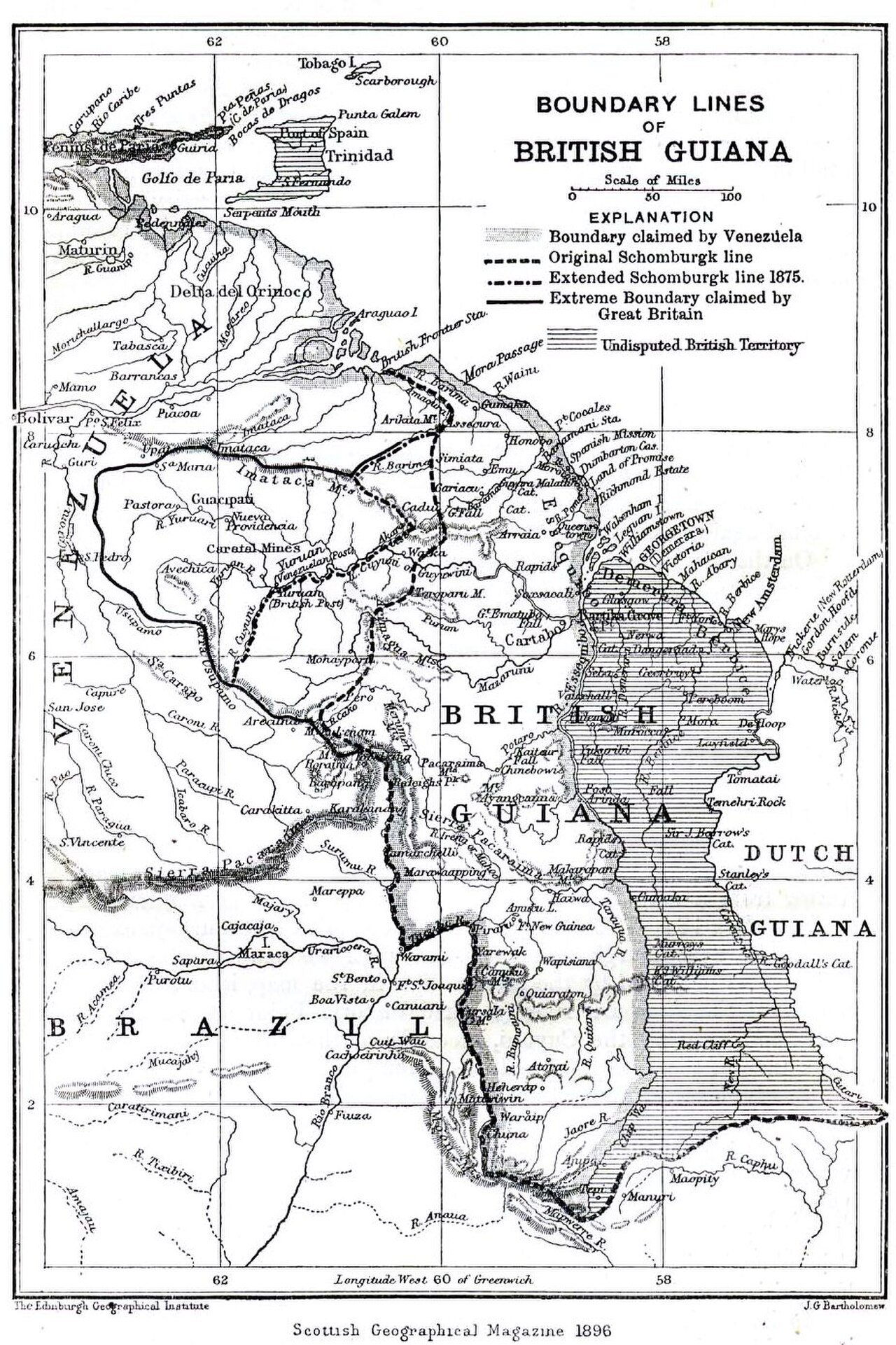
An 1896 map of the competing boundary claims, published in the Scottish Geographical Magazine. Map: J. G. Bartholomew, public domain, via Wikimedia Commons
The Dutch had colonies along the Essequibo river in the seventeenth century, the Spanish had the Orinoco to the west, and between them lay a great deal of forest that neither side bothered to define. Britain took the Dutch colonies during the Napoleonic wars and kept them. Venezuela, once independent from Spain, inherited the Spanish claim, which it read as running all the way to the Essequibo.
In 1841 the British government sent Robert Schomburgk, a German-born explorer and naturalist, to survey a boundary. The Schomburgk line, as it became known, gave British Guiana a generous slice of the disputed land, and Venezuela protested at once. For decades nobody much cared, because there was nothing there worth fighting over. Then gold turned up in the Cuyuni basin in the 1870s and 1880s, Britain began extending its claim westward, and in 1887 Venezuela broke off diplomatic relations with London.
Cleveland picks a fight with the Empire
Venezuela had a weak army and a good lobbyist in Washington. It argued that British expansion in Guiana was exactly what the Monroe Doctrine was meant to stop. Cleveland agreed. Olney's note demanded that Britain submit the whole dispute to arbitration. Lord Salisbury, the prime minister, took four months to reply and then said, in effect, that the Monroe Doctrine was not international law and the matter was none of America's business.
On 17 December 1895 Cleveland sent a message to Congress asking for money to set up an American commission to find the true boundary, and said the United States would resist any British attempt to take land beyond it. Newspapers on both sides of the Atlantic talked openly about war. For a few weeks that winter, serious people thought the two countries might really fight over it.
It didn't, mostly because Britain had worse problems. In January 1896 the Jameson Raid failed in southern Africa and the German Kaiser sent his notorious telegram congratulating the Boers. London decided it had no need of an American quarrel as well. Britain agreed to arbitration, and in February 1897 it signed a treaty with Venezuela in Washington that promised a "full, perfect, and final settlement".
Five judges and no Venezuelans
The tribunal that sat in Paris in 1899 says a lot about who was really negotiating. Britain named two of its own senior judges, Lord Russell of Killowen and Sir Richard Henn Collins. Venezuela's two seats went to Americans, the Chief Justice of the United States, Melville Fuller, and Justice David Brewer. The fifth member, who would hold the balance, was Friedrich Martens, a Russian expert in international law. Not one judge was Venezuelan.
Venezuela's lead counsel was a former American president, Benjamin Harrison, who argued the case at enormous length. (I have read accounts that he spoke for the better part of a week, in a Paris summer, and I do not envy anyone who had to sit through it.)
On 3 October 1899 the tribunal announced a unanimous award and gave no reasons at all. Britain received roughly 90 percent of the disputed territory, including the gold country, along a line that followed the Schomburgk line with some changes. Venezuela got the mouth of the Orinoco, including Barima Point, which mattered to it a great deal, and a strip to the south. Venezuela grumbled and complied.
The memo from beyond the grave
Venezuela lived with the line for half a century. Then, in 1949, the American Journal of International Law published a memorandum by Severo Mallet-Prevost, one of Venezuela's American lawyers in Paris. He had written it in 1944 and asked that it be released only after his death, which came in December 1948.
Mallet-Prevost claimed that the award had been a political deal. According to his account, Martens had gone to Britain with the two British judges in the summer of 1899 and came back offering the Americans a choice: agree to a unanimous award along the lines eventually announced, or face a 3 to 2 majority that would hand Britain even more, including the Orinoco mouth. The Americans, he wrote, chose the lesser evil.
Nothing in the surviving papers of Fuller, Brewer, Russell, Collins or Martens confirms this, and historians remain divided over how much weight a lawyer's recollection, written forty-five years later, can bear. Venezuela treated it as proof. In 1962 it told the United Nations that it regarded the 1899 award as null and void.
From Geneva to The Hague
Britain, preparing to give British Guiana its independence, signed the Geneva Agreement with Venezuela on 17 February 1966, three months before Guyana became a sovereign state. The agreement did not settle anything. It acknowledged that Venezuela contested the award and set up a process for finding a solution. In practice that meant decades of talks that went nowhere, and after offshore oil was found in 2015 the dispute had a great deal more money attached.
In 2018 Guyana asked the International Court of Justice to rule that the 1899 award is valid and binding. The court found in December 2020 that it had jurisdiction and rejected Venezuela's objection in April 2023. Venezuela held a referendum in December 2023 backing its claim and has said repeatedly that it does not recognise the court. The court heard the merits this year and has not yet ruled. Rodríguez said again on Friday that Venezuela rejects the award and the court.
So the question Olney thought Washington could settle by fiat is sitting with the judges in The Hague, and an American official has now suggested settling it some other way. Whether that was one man freelancing or a sign of what the White House wants is the part nobody has answered yet.
Enjoyed this story?Get a new one every day on social.