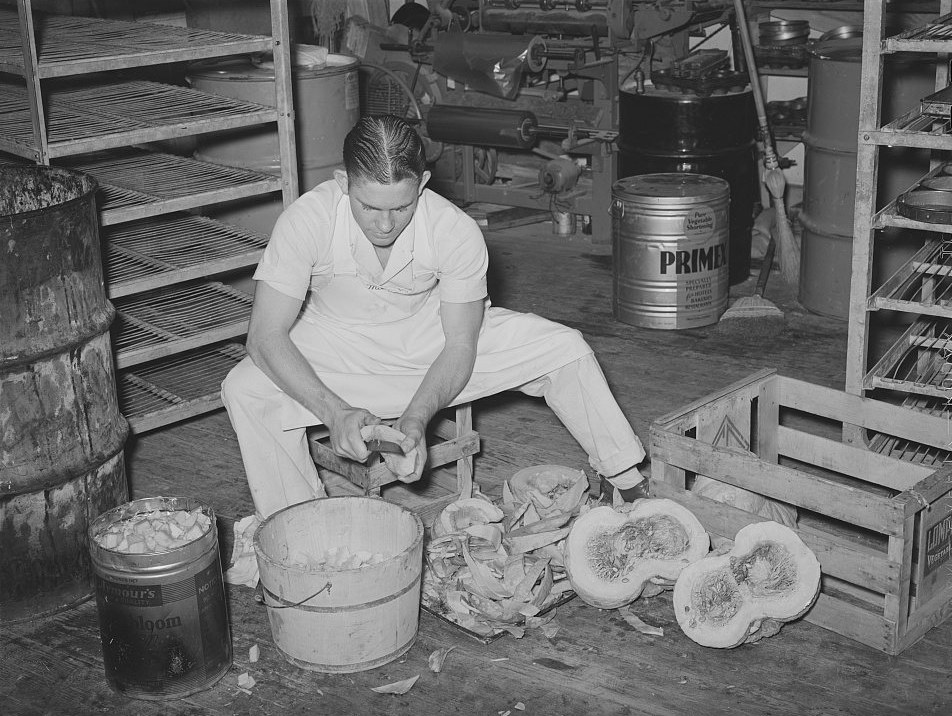
Photo: Russell Lee, Cutting up pumpkin for pies, San Angelo, Texas, November 1939, Library of Congress Prints & Photographs Division, no known restrictions
Every autumn, for about three months, the supermarket shelf with the canned pumpkin on it fills up, empties and fills up again, and almost nobody wonders where the cans come from. The answer is surprisingly narrow. Most of the canned pumpkin sold in the United States is grown within about 60 miles of Morton, Illinois, a town of some 17,000 people just south of Peoria, and most of that goes into one factory owned by Libby's. The Chicago Sun-Times put the figure this month at about 90 percent of the country's canned pumpkin. In 2025, according to the US Department of Agriculture, Illinois grew 535 million pounds of pumpkins, more than the next four states put together.
A child would be disappointed by the pumpkins themselves, which are neither round nor orange. They are pale tan, a colour somewhere between a cantaloupe and a peach, and shaped roughly like a loaf of bread that has been left to rise too long.
A farmer named Dickinson and a Kentucky squash
The variety is called the Dickinson, after Elijah Dickinson, a farmer who brought it to central Illinois from Kentucky in the early nineteenth century, or so the family story goes. It belongs to the species Cucurbita moschata, which is the same species as the butternut squash. The carving pumpkins sold for Halloween are a different species, Cucurbita pepo, along with courgettes and acorn squash. Whether the Dickinson is a pumpkin or a squash is, botanically speaking, a question with no answer, because "pumpkin" is not a botanical term at all. It is a word for whatever round-ish winter squash a particular culture has decided to call one. American food regulators have long been relaxed about it, and a can labelled pumpkin can lawfully contain a firm, golden winter squash.
What matters to a cook is the flesh. A Dickinson is dense, dry, fine-grained and sweet, and it purées to something smooth and dark orange that sets well in a custard. A jack-o'-lantern pumpkin, bred for a thin wall and a big hollow, is stringy and watery and makes a pale, sad pie. (People do it every year, out of thrift, and I admire the spirit more than the result.)
How a corned-beef company ended up in the pumpkin business
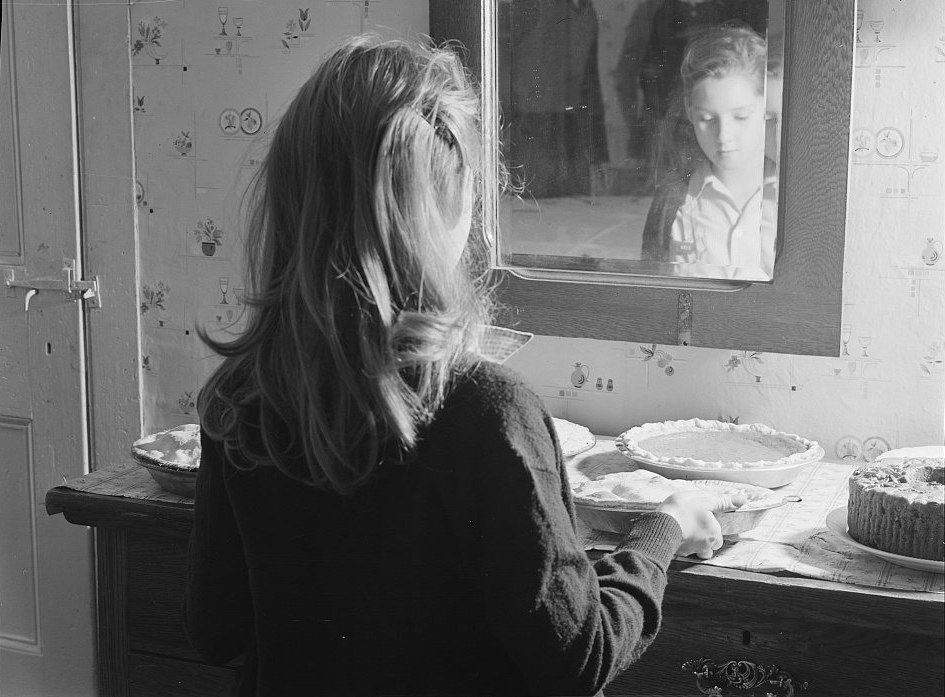
A girl looks at pumpkin pies set out on a dresser at the Crouch family Thanksgiving dinner in Ledyard, Connecticut, November 1940. Photo: Jack Delano, Library of Congress Prints & Photographs Division, no known restrictions
Libby, McNeill & Libby started in Chicago in the 1860s as a meat-packer and made its name with corned beef in a tapered tin. By the twentieth century it canned almost everything. Libby's says it has been selling pumpkin since 1925. A cannery had been built in Morton in the 1920s to handle the local crop, and in 1929 Libby's bought it from the Dickinson family along with exclusive rights to their pumpkin. The company has grown its pumpkins from its own proprietary seed ever since, a line descended from the Dickinson and kept within the company.
The timing was good. Pumpkin pie was already an old American dish (a recipe for "pompkin" baked in a crust appears in Amelia Simmons's American Cookery of 1796), but making one from scratch meant cutting up, seeding, boiling and straining a whole squash, which took most of an afternoon. A can turned it into a twenty-minute job. When Thanksgiving became a fixed national holiday and the supermarket became the place where most Americans bought food, the can was waiting. Libby's began printing a pie recipe on the label in the middle of the century, and it is still there; a good share of the pies on American tables next month will be made from it, more or less word for word.
Why it all stayed in one place
The reasons the industry never left Morton are mostly practical. Tazewell County and its neighbours have deep, dark prairie soil that drains well, and the growers there have been at it for generations, under contract to the cannery. The Christian Science Monitor, visiting in 1990, found about 4,000 acres in Tazewell and four adjacent counties feeding the plant, with Libby's doing the harvesting itself. Once a cannery, its harvesting machines and its contract growers are all in one county, moving any of them would be expensive.
Concentration has a cost, and Americans discover it every few years. When Illinois has a wet autumn, there is no other region to make up the shortfall. In 2015 heavy rain cut the Libby's harvest roughly in half and stores ran short through the holidays. There had been a similar scare after a wet season in 2009. Nobody seems to have seriously considered planting a second pumpkin belt somewhere else, and I suspect nobody will.
Harvest at the plant
The harvest starts in August and runs into the autumn. When the Monitor's reporter watched it, machines lifted the pumpkins off the vines and rolled them into rows across the fields, and a tractor with a conveyor scooped them into trailers holding about 22 tons apiece. At the plant a hydraulic platform tipped each trailer up so the pumpkins tumbled into a washing pit. In the peak weeks the line now runs around the clock, and Nestlé, which owns the Libby's brand, says most of its pumpkins are grown with what it calls regenerative practices.
Morton calls itself the Pumpkin Capital of the World and holds a festival every September, with a parade and a great deal of pie. The harvest usually winds down around this time of year, and the cans from this year's fields are on their way to the shelves for Thanksgiving.
Enjoyed this story?Get a new one every day on social.