Photo: Horace Nicholls, public domain, via Wikimedia Commons
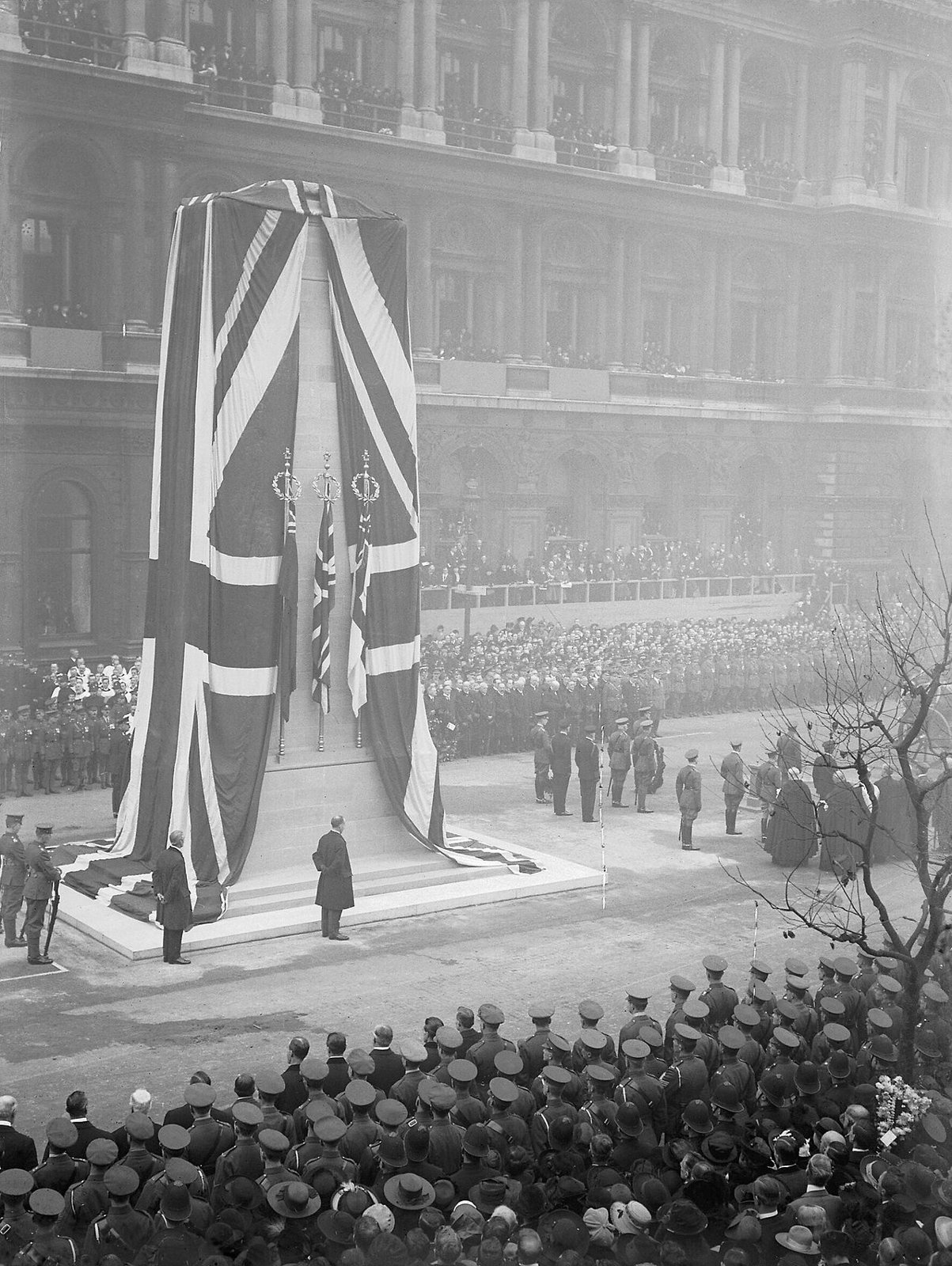
On Saturday 19 July 1919, the Allied victory parade swung out of the Mall and into Whitehall, and more than 15,000 soldiers began saluting a box made of wood and plaster. Marshal Foch saluted it. General Pershing saluted it. Field Marshal Haig and Admiral Beatty saluted it. Its architect, Edwin Lutyens, had not been invited.
The box was the Cenotaph. On Sunday, the King's Troop fired the guns on Horse Guards Parade to mark the two-minute silence, and Britain's National Service of Remembrance took place around the stone version that replaced it. Almost nobody standing on Whitehall thinks of it as a prop. For its first year, that is exactly what it was.
A catafalque for Peace Day
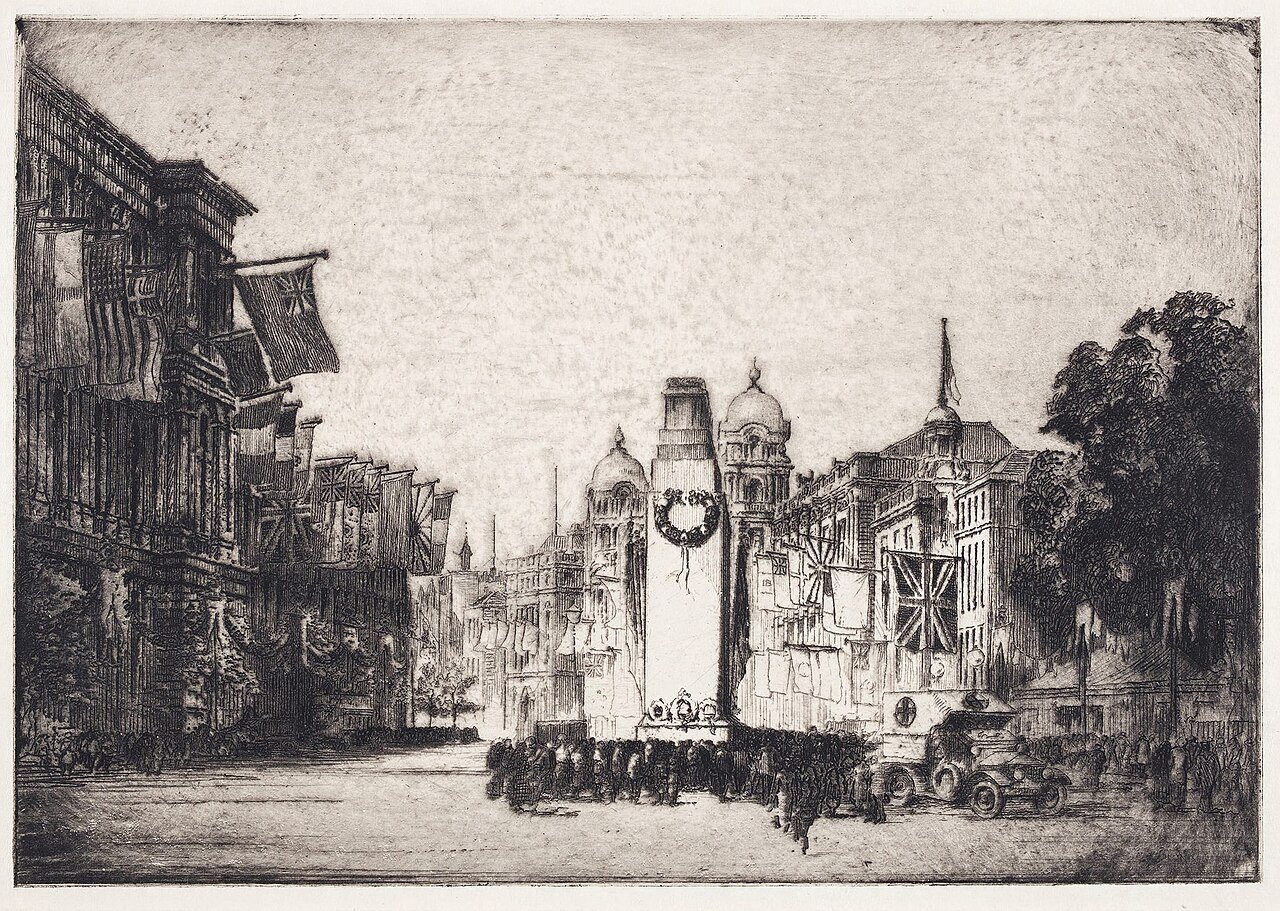
The temporary Cenotaph in Whitehall, etching by William Monk, about 1919. Public domain, via Wikimedia Commons
The government wanted a centrepiece for the parade, something the troops could salute as they passed. Lloyd George asked Lutyens for a "catafalque", a word normally used for the platform that holds a coffin at a state funeral, and he wanted it non-denominational: no cross, no saints, nothing that would leave out the Hindu, Muslim, Jewish or unbelieving soldiers of the empire.
Nobody knows the exact date of the meeting. Most historians put it in early July, and Lutyens had the go-ahead by 7 July, which left the Office of Works less than two weeks to build it. The story that Lutyens sketched the design on the same day he was asked is told so often it is almost part of the monument. He did sketch it quickly. But he had been thinking about an empty tomb for years (he and Gertrude Jekyll had long called a stone seat in her garden "the cenotaph of Sigismunda"), so he was not starting from nothing.
What went up on Whitehall was timber and plaster, painted to look like stone, with real laurel wreaths and silk flags. It was put in place quietly on 18 July.
The flowers that changed the plan
The parade was meant to be the end of it. Instead, people started leaving flowers on the day, and they kept coming. The estimate usually given is that more than a million people visited in the week after the parade, and the base of the plaster pylon disappeared under wreaths. Newspapers started calling for it to be kept, and an MP asked in the Commons what the government intended to do.
The cabinet gave in quickly. On 30 July 1919, eleven days after the parade, it approved rebuilding the Cenotaph in Portland stone on the same spot. Lutyens was firm about the site. The ground, he said, had been "qualified by the salutes of Foch and the allied armies". He waived his fee.
Lutyens and his stone flags
The permanent Cenotaph is not quite a copy of the temporary one. Lutyens took the chance to refine it, and the refinement is almost invisible. There is no truly straight line on it. The sides lean in so slightly that, if you extended them, they would meet about 1,000 feet above the ground. The horizontal surfaces are curved too, as if they were sections of a sphere whose centre lay about 900 feet below Whitehall. His calculations filled 33 pages of a notebook. I have stood in front of it several times trying to see the curve, and I cannot.
He lost one argument. He wanted the silk flags replaced with stone ones, painted, because he thought cloth would fade and fray and look shabby. The cabinet said no, so the real flags stayed, and they are still there, replaced as they wear out. (He was probably right about the fraying.)
The stone version was unveiled by George V at 11 o'clock on 11 November 1920, the same morning the body of the Unknown Warrior was carried past it on the way to Westminster Abbey. Within a week an estimated 1.25 million people had filed past, and the flowers were piled around it about ten feet deep.
What stands on Whitehall now
It is a short monument for what it carries: just over 35 feet tall, on a base about 15 feet by 9, in the middle of a road that buses still use on every other day of the year. The words THE GLORIOUS DEAD run along its sides. The dates of the Second World War were added in 1946, in Roman numerals like the first. It has been listed at Grade I since 1970. The top section of the original plaster Cenotaph went to the Imperial War Museum, which lost it to a German bomb in the next war.
On an ordinary weekday it stands on a traffic island between government offices, with taxis going round it and the flags moving a little in the wind.
Enjoyed this story?Get a new one every day on social.