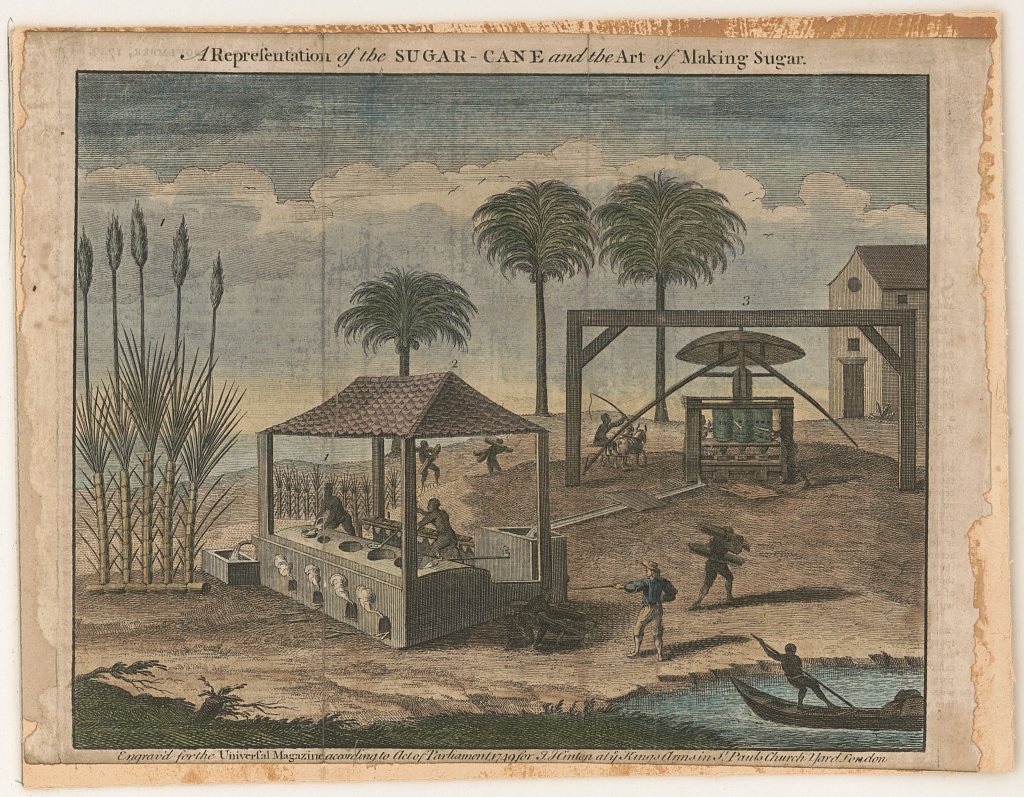
Engraving: John Hinton, Universal Magazine, 1749, Library of Congress Prints & Photographs Division, no known restrictions
The Café Royal on Regent Street, London, on the evening of 23 November 1972. John Berger has just won the Booker Prize for his novel G., and he gets up at the dinner to speak. In a short, prepared speech he tells the room that the company paying for his prize got rich in the Caribbean, that "the modern poverty of the Caribbean is the direct result of this and similar exploitation," and that he is giving half the money to the Black Panthers.
It was only the fourth year of the prize, and as far as I know nobody had used the dinner like that before.
On Monday night in London the 2026 prize went to M John Harrison for The End of Everything, his thirteenth novel. He is 81, the oldest winner the Booker has had, and according to the Booker Prize Foundation's chief executive, Gaby Wood, he is also the first winner to come out of the science fiction world. The judges were chaired by Mary Beard. The cheque is £50,000. Harrison sat on the judging panel himself in 2022, the year Shehan Karunatilaka won, and this was his first time on the shortlist.
A sugar company and a book prize
The Booker was conceived in 1968 by the publisher Tom Maschler and Graham C. Greene, and first awarded in 1969. The money came from Booker McConnell, a food and trading conglomerate whose fortune had been made in the colony of British Guiana, now Guyana.
The Booker connection to the colony went back a long way. Josias Booker arrived in Demerara in 1815 and managed Broom Hall, a cotton plantation where nearly 200 people were enslaved. His brother George joined him later, and a third brother, William, became the plantation's attorney. When Britain abolished slavery, the brothers received government compensation for 52 people, £2,884 in the money of the day. None of that is my research. The Booker Prize Foundation has published it on its own website, which is to its credit, even if it took about two hundred years.
By the twentieth century the company dominated the colony's sugar industry so thoroughly that you still find the place called "Booker's Guiana" in histories of the period. Its estates were nationalised in 1976, ten years after Guyanese independence.
"I have to turn this prize against itself"
Berger knew this history when he went to the dinner, and the speech he read out was built around it. He said Booker McConnell had "extensive trading interests in the Caribbean for over 130 years." He said he would share the prize with the Black Panther movement in Britain because "they have links with the struggle in Guyana, the seat of Booker McConnell's wealth." And he gave the reason for keeping the other half: he was going to spend it on a book about the migrant workers of Europe, "the eleven million" of them, so that the book "would be financed from the profits made directly out of them or their relatives and ancestors."
The line people remember is the one about the two halves: "The half I give away will change the half I keep."
The prize was then £5,000, so each half was £2,500. That was a good deal of money in 1972, and the British Black Panthers were a small London group, separate from the American party that shared the name.
What the speech did and did not change
Much of the comment afterwards was about manners. Berger had been rude to his hosts, which in London counts for more than whatever he had been rude about. G., an odd and difficult novel about a young seducer in Europe before the First World War, also won the James Tait Black Memorial Prize for 1972, so it hardly needed the attention. The speech gave it some anyway.
The other half of the money did go into the migrant book. A Seventh Man, made with the photographer Jean Mohr, came out in 1975 and is still in print. I think it is a better book than G., though I suspect I am in a minority on that, and Berger, as far as I know, never said which he preferred.
The prize itself went on much as before. It changed sponsors and names, became the Man Booker in 2002 and went back to plain Booker in 2019, and the money grew tenfold. It took decades, and a public reckoning with British slavery that reached well beyond literature, before the Foundation put the Booker brothers' history on its own site.
Monday night at the Booker
Berger died in January 2017, aged 90, so he did not live to see a science fiction writer take the prize, which I think would have amused him.
The judges read Harrison's book as a novel about the present. Mary Beard called it "the politics of now seen through the lens of the future," which is a political reading by any measure. Harrison's own description was blunter: "It's a grim world and it will keep on being grim." Nobody needed to raise the sponsor's history this time (the Foundation had already put it on its website).
His own speech on Monday included the line "no one writes a novel alone," and I think it was exactly the right thing for an 81-year-old to say after fifty years of writing books that the prize used to ignore.
Enjoyed this story?Get a new one every day on social.