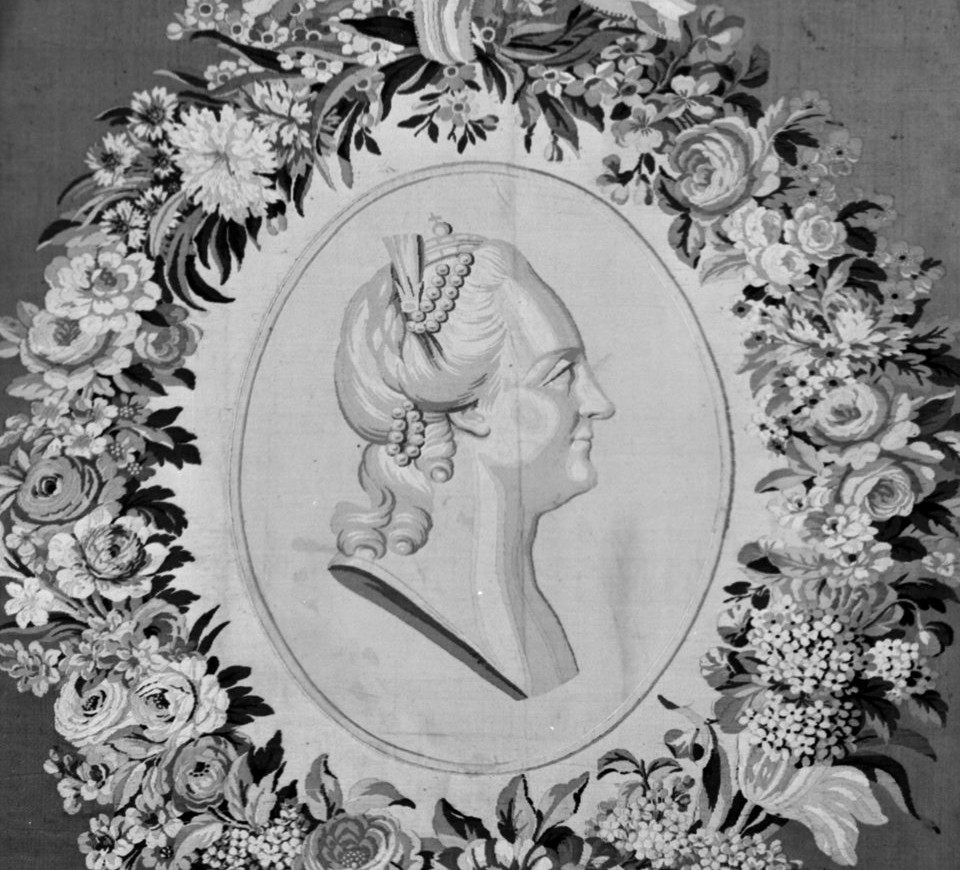
Woven silk: Philippe de Lasalle, Catherine II of Russia, c. 1771, The Metropolitan Museum of Art, CC0
A little before six on the morning of 28 June 1762, by the old Russian calendar, a hired carriage came up the drive of Mon Plaisir, the small Dutch-style pavilion by the sea at Peterhof, and a Guards officer named Alexei Orlov went in without knocking. He woke the woman asleep in the back bedroom, the Empress Catherine, consort of Peter III, and told her that one of the conspirators had been arrested the night before. "Everything is ready to proclaim you," he said, or words to that effect. "You must get up."
She got up. She did not change out of the black dress she had been wearing for the court mourning, and she did not wait for her husband, who was due at Peterhof later that day for his name-day celebrations. The two of them got into the carriage and set off for St Petersburg, nineteen miles away, at a gallop. Everything that followed over the next thirty-four years, from the partitions of Poland to the taking of Crimea, comes back to the decision made in that carriage, which was simply not to wait.
A marriage that had run out of road
Catherine had been born Sophie of Anhalt-Zerbst, a princess of a German state so minor that its name needed explaining, and brought to Russia at fourteen to marry the heir, her second cousin Peter. She converted to Orthodoxy, learned Russian, and spent eighteen years married to a man who played with toy soldiers on the bed, worshipped Frederick the Great of Prussia and told anyone who would listen how much he disliked Russia.
The Empress Elizabeth died on 25 December 1761, and Peter became emperor. Within weeks he had done the two things most likely to unite the capital against him. He ended Russia's war with Prussia while Russian troops held East Prussia, gave back everything they had taken, and began preparing a new war against Denmark over Holstein, a quarrel that mattered to him as Duke of Holstein and to nobody else in Russia. And he put the Guards regiments, the makers of every Russian ruler since Peter the Great, into Prussian uniforms and Prussian drill, with his own Holstein troops promoted over their heads.
Catherine, meanwhile, was pregnant by Grigory Orlov, an artillery officer with four brothers in the Guards, and had given birth in secret in April. Peter had started saying in public that he would divorce her and marry his mistress, Elizabeth Vorontsova. At a state banquet on 9 June he called her a fool across the table in front of four hundred guests. That evening he ordered her arrest, and was talked out of it by his uncle. Everyone who was there understood that the order would come again.
The plot, and the arrest that forced it
The conspiracy that existed by midsummer was not elegant. The Orlov brothers had been quietly recruiting among the Guards for months and claimed, probably with some exaggeration, to have thirty or forty officers on their side. Nikita Panin, the tutor of Catherine's son Paul, wanted the boy made emperor with his mother as regent, and Princess Dashkova, nineteen and the sister of Peter's mistress, believed she was running the whole thing. Catherine put nothing on paper. The plan, such as it was, was to act when Peter left on the Danish campaign.
Then, on the evening of 27 June, a Guards captain called Passek, one of the Orlovs' recruiters, was arrested after a soldier who had heard the empress was in danger asked the wrong officer what to do. Under questioning Passek might name everyone. The Orlovs had a few hours to decide whether to run or go, and Alexei rode to Peterhof.
Three regiments before breakfast
The carriage's horses gave out short of the city and the party borrowed fresh ones from a peasant cart, which is not how the painters later showed it. Catherine's first stop was the barracks of the Izmailovsky Guards, where Orlov's friends had done their work: the soldiers poured out half-dressed, kissed her hands and the hem of her dress, and their chaplain was brought to administer an oath on the spot. The Semyonovsky regiment came next, then the Preobrazhensky, where a few officers loyal to Peter tried to stop their men and were pushed aside. By mid-morning she was at the Kazan Cathedral being proclaimed sole autocrat of all the Russias by the Archbishop of Novgorod, and by noon she was in the Winter Palace receiving the Senate and the Synod.
Her legal claim to any of this was nothing at all, since she was not a Romanov and her son was the obvious heir, and the manifesto drafted that day did not try to argue the point; it said that the fatherland was in danger, from the abandonment of the Orthodox faith and the ruin of Russia's glory, and that she had been obliged to accept the throne at the people's wish. The Guards did the rest. That night she borrowed a Preobrazhensky uniform from a young officer (the regiment had gone back to its pre-Peter green coats within hours), put on a sword, and rode out of the city at the head of some twelve thousand men to deal with her husband.
A husband who could not decide
Peter arrived at Peterhof for lunch to find his wife gone and the pavilion empty. Messengers sent to the capital did not come back. He wrote to Catherine proposing that they share power, and then that he be allowed to go back to Holstein with his mistress and his violin. Field Marshal Münnich, the one competent soldier in his party, told him to sail at once to Kronstadt, the island fortress that commanded the sea approach to the capital. Peter dithered until evening and then sailed, and when his yacht came up to the harbor boom in the dark a sentry shouted that there was no emperor, only an empress, and that they would fire. The fortress had sworn to Catherine that afternoon.
He went back to Oranienbaum and, on the morning of 29 June, signed the abdication Catherine's officers put in front of him. Frederick the Great, who had lost his best ally in a weekend, said afterwards that Peter had let himself be dethroned like a child being sent to bed.
A week after the abdication he was dead. He had been taken to a country house at Ropsha under the guard of Alexei Orlov, and the official announcement said he had died of a hemorrhoidal colic. A letter from Orlov to Catherine, confessing that there had been a quarrel at dinner and that Peter was dead before anyone could stop it, was found among her papers after her own death; some historians think it genuine and some think it was planted later to clear her. What is not in dispute is that nobody was punished, and that Alexei Orlov came out of it with estates, serfs and a count's title.
What the morning bought
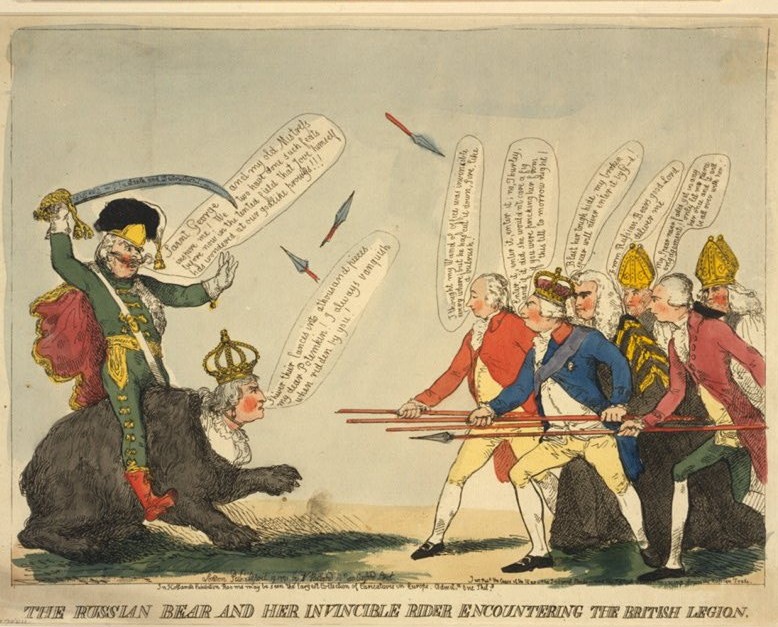
Hand-coloured caricature: The Russian Bear and Her Invincible Rider Encountering the British Legion, London, 19 April 1791, Library of Congress Prints & Photographs Division, no known restrictions
Catherine reigned until November 1796. In that time Russia took the northern coast of the Black Sea and the Crimea from the Ottomans, took the largest share in the three partitions of Poland, which removed that country from the map for 123 years, and founded Odessa and Sevastopol. She corresponded with Voltaire, bought the collections that became the Hermitage, and crushed the Pugachev rising, the largest peasant revolt in Russian history, whose leader claimed to be her dead husband come back.
None of it was inevitable on the morning of 28 June. Had she waited for Peter at Peterhof, as a prudent person would have, she would most likely have been in a convent by the end of the month, and Russia would have spent the 1760s fighting Denmark over Holstein.
The coffin that was moved in 1796
Her son Paul had waited thirty-four years for a throne he believed had been his at seven, and he took his revenge on the dead. Within weeks of Catherine's death he had Peter III's coffin dug up from the Alexander Nevsky Monastery, where it had been buried without honors, and brought to the Winter Palace to lie beside hers. The two were buried together in the Peter and Paul Cathedral in December 1796. Alexei Orlov, by then fifty-nine, was ordered to walk in front of the procession carrying the imperial crown of the man who had died in his care.
Enjoyed this story?Get a new one every day on social.