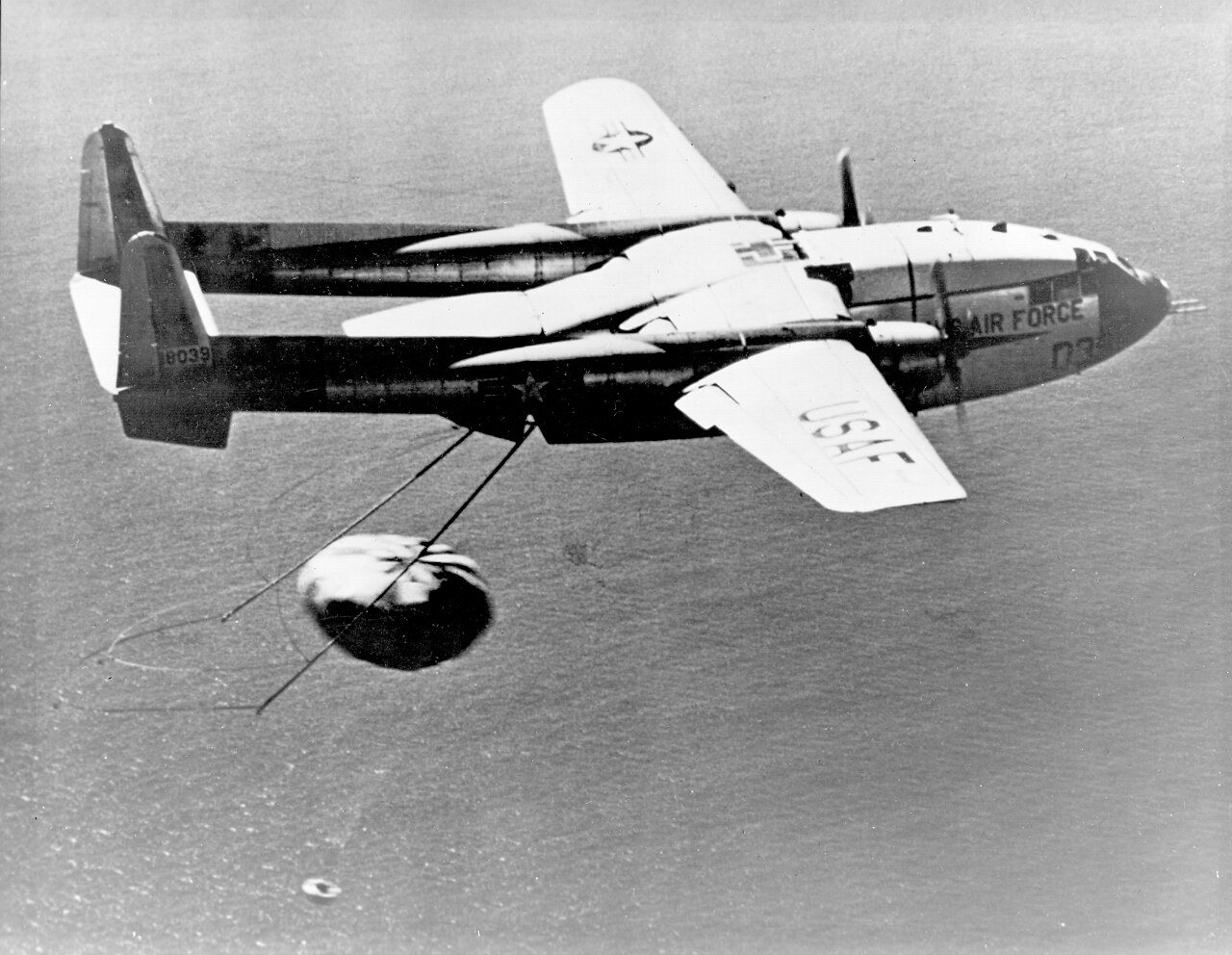
Photo: Fairchild C-119J recovering a CORONA capsule, US Air Force, 1960, public domain, via Wikimedia Commons
About 360 miles southwest of Honolulu, at roughly 8,000 feet, on the morning of 19 August 1960, a twin-boomed Air Force cargo plane was flying in slow circles over empty ocean and waiting for something to fall out of the sky. The plane was a Fairchild C-119J. Its rear clamshell doors had been taken off and replaced with a frame that let the crew trail a set of poles and steel lines behind and below the tail, a sort of flying trapeze.
The pilot, Captain Harold E. Mitchell of the 6593d Test Squadron at Hickam, was looking for a small capsule hanging from a parachute. When he found it he flew over the top of it, the trailing hooks tangled in the canopy, and the crew winched the whole thing into the back of the airplane. It was the first time anyone had caught an object returning from orbit before it hit the ground or the sea. Inside it was about 20 pounds of exposed film of the Soviet Union.
The catch in Texas
On Saturday afternoon, at about 4:20 p.m. Eastern time, SpaceX caught the upper stage of its Starship rocket in the mechanical arms of its launch tower at Starbase, Texas. Ship 42 had launched on Friday evening on the program's fifteenth test flight, circled the Earth about fourteen times over roughly 22 hours, and come back through reentry to be plucked out of the air above the pad. The company has caught Super Heavy boosters this way before, but never the ship coming back from orbit. (The booster on this flight was not caught.)
SpaceX wants to catch rockets so it can refuel and fly them again quickly, like airliners. The Air Force in 1960 had a narrower reason, and a much smaller object.
A satellite that had to give its pictures back
In 1960 there was no way to send a detailed photograph down from space by radio. The CIA and the Air Force, working together in a program called CORONA, settled on the blunt option. A camera in orbit would shoot its film, wind it into a capsule, and drop the capsule back to Earth. Publicly, the launches were called Discoverer and described as engineering and biomedical research. The cover story was thin, though it held up in public for a remarkably long time.
The pressure was real. On 1 May 1960 the Soviets had shot down Francis Gary Powers and his U-2 over Sverdlovsk, and Eisenhower stopped the overflights. The United States now had no way to look at Soviet missile sites at all.
It also had a satellite program that did not work. The early Discoverer flights failed in almost every way available to them: rockets that blew up, satellites that went into the wrong orbit, cameras that jammed, capsules that came down somewhere nobody could find. The count of failures depends on which flights you treat as real attempts, but it is usually given as a dozen or so in a row. I have read the list several times and it remains impressive in a grim way.
Discoverer XIII, and the flag in the Oval Office
The turn came in August. Discoverer XIII, launched from Vandenberg on a Thor-Agena rocket, carried no camera at all. On 12 August 1960 its capsule splashed down and was fished out of the Pacific, the first man-made object ever recovered from orbit. A small American flag that had flown inside it was presented to Eisenhower in the Oval Office, which was a nice photograph for a program that could not show anyone what it was really for.
Discoverer XIV went up on 18 August, this time with a camera. It spent about a day in orbit taking pictures. Then it dropped its capsule over the recovery zone near Hawaii, and Mitchell caught it.
The air catch was the plan, and the sea was the backup. If the planes missed, the capsule could float, and Navy ships had a short window to pick it up before a salt plug dissolved and sank it. The sinking was deliberate, since nobody wanted a Soviet trawler finding the film first.
More than the U-2 ever saw
When the film was developed, the single mission turned out to have photographed more than 1.65 million square miles of Soviet territory, more coverage than all of the earlier U-2 flights put together. The pictures were coarse by later standards, and clouds covered part of the take. That did not matter much. For the first time, analysts in Washington could count things across the whole country instead of along a few flight paths.
CORONA kept flying until 1972 and took roughly 800,000 images. Its film helped settle the "missile gap" argument (there was a gap, but it ran the other way from what Kennedy had campaigned on). Nearly all of it stayed secret until February 1995, when President Clinton signed an executive order declassifying the early satellite photographs. The 6593d Test Squadron received the Mackay Trophy for the 1960 recovery, which must have been an odd ceremony for a unit that could not explain what it had caught.
The airplane in Dayton
Mitchell's C-119J, serial number 51-8037, survived. It sits today in the National Museum of the U.S. Air Force in Dayton, Ohio, among the cargo planes. It is a big, slightly ungainly cargo plane, and nothing about it suggests that it was once the most important catcher in the American space program.
Enjoyed this story?Get a new one every day on social.