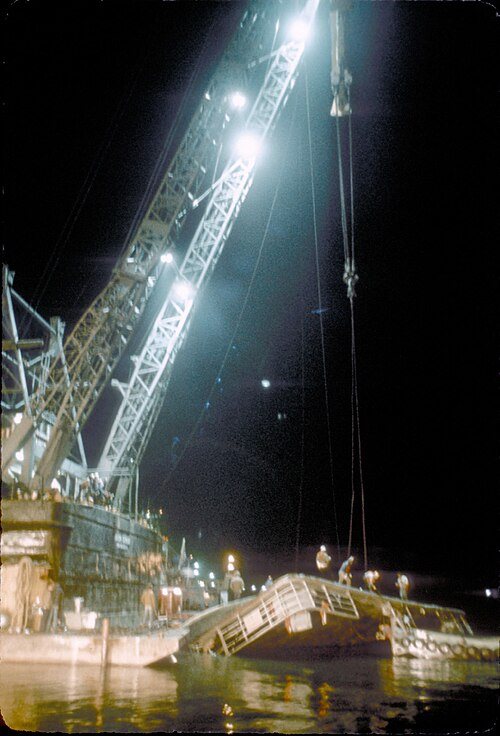
Photo: Ken Freeze, raising of the ferry George Prince, 1976, CC BY 3.0, via Wikimedia Commons
At 6:13 on the morning of 20 October 1976, the pilot of the Norwegian tanker Frosta sounded two blasts on the whistle. He was steaming upriver on the Mississippi toward Baton Rouge, past the town of Destrehan, and a small ferry had just pulled away from the east bank in front of him. It was about 40 degrees, cold for Louisiana, and the ferry's windows were shut. There was no answer from the ferry. He signalled again a couple of minutes later. By then, according to survivors, the people standing on the ferry's deck could see what was coming and were honking their car horns at it.
The ferry was the George Prince. It made a half-mile crossing to Luling on the west bank, and at that hour it was full of men driving to the refineries and chemical plants on the other side. The Frosta hit it on the port side and rolled it over.
Friday at the Port of New Orleans
I had been meaning to write about the George Prince for a while, and on Friday the river made the decision for me. At about 12:30 p.m., according to the Port of New Orleans, the tanker Atlantic Asphalt struck the American Heritage, a paddlewheel river cruise boat that had docked about two hours earlier and was letting its passengers off. The tanker hit it broadside. The riverboat began to sink, then capsized.
Nearly 200 passengers and crew were aboard, and by Friday evening officials said every one of them had been accounted for. Thirty passengers and two officers who ended up in the water went to hospital with injuries described as non-critical. Coast Guard Captain Melanie Burnham said the tanker appeared to have had "some type of a loss of steering." Mayor Helena Moreno called it a miracle on the Mississippi, which is a phrase I would normally tease a politician for, except that it is accurate. A loaded tanker hit a boat full of people on the lower Mississippi and nobody died, which has not always been how this goes on this stretch of river.
A ferry built in 1937
The George Prince was built in Slidell in 1937, and for decades it was simply how people in St. Charles Parish got across the river. There was no bridge between Destrehan and Luling. If you lived on one bank and worked on the other, you drove onto the ferry, sat in your truck for a few minutes and drove off.
That is why the passenger list on 20 October read the way it did. The dead were mostly young men from the parish going to work, plus the people who happened to be going the same way. Ninety-four families, by one local count, had someone on board. The youngest victim was sixteen.
What the river did in two minutes
The Frosta was a big ship, around 670 feet long, and a ship that size coming upstream against the current cannot stop or swerve in the space of a ferry crossing. The ferry kept going. The tanker's bow went into its port side at mile 120.8 above Head of Passes, about 25 river miles above the spot where the American Heritage went over on Friday. The George Prince capsized to starboard and the tanker's hull passed over the passenger area.
One survivor, who worked at a Texaco plant across the river, later told the local paper that he was sitting in his truck and never saw the ship. The impact threw him into the windshield and took him down with the vehicle. He said the windshield blew out somewhere around 65 feet down and the water pushed him up. He surfaced, swam clear of the propellers and was pulled off the ferry, which by then was standing almost on end in the river.
Other boats came at once. The Frosta's crew radioed the Coast Guard and put lifeboats down. The crew of another ferry, the Ollie K. Wilds, laid two benches across as a gangplank and took sixteen people off the upturned hull. Coast Guard helicopters and divers followed. The divers found nobody alive inside.
The death toll is usually given as 78. Some accounts say 77, and the number of survivors is given as anything from 16 to 18 depending on whether crew are counted, which tells you something about how chaotic that morning was. Either way, it is still described as the deadliest ferry accident in American history, and I have not found anything to contradict that.
Who had the right of way
The Coast Guard's Marine Board of Investigation filed its report in April 1978 and put the blame on the ferry. The George Prince had no lookout posted, sounded no warning and held its course across the bow of a ship it could not have outrun. Tests after the accident found alcohol in the blood of the pilot and of several other crew members. The pilot had died, so the question of what he thought he was doing went with him.
The more lasting finding was about the rules. At the time, ferries on the river were generally treated as having the right of way over through traffic, which sounds sensible until you picture what it asks of a deep-laden tanker in the current. The board recommended changing the inland rules so that vessels going up and down the river would have priority over boats crossing it, requiring passenger vessels to use bridge-to-bridge radio, and making ferries run to fixed, published schedules. Royd Anderson, a documentary maker who has spent years on the disaster, credits the accident and the settlements that followed with changes in maritime law and in pilot testing, including random drug and alcohol tests.
The bridge that was already going up
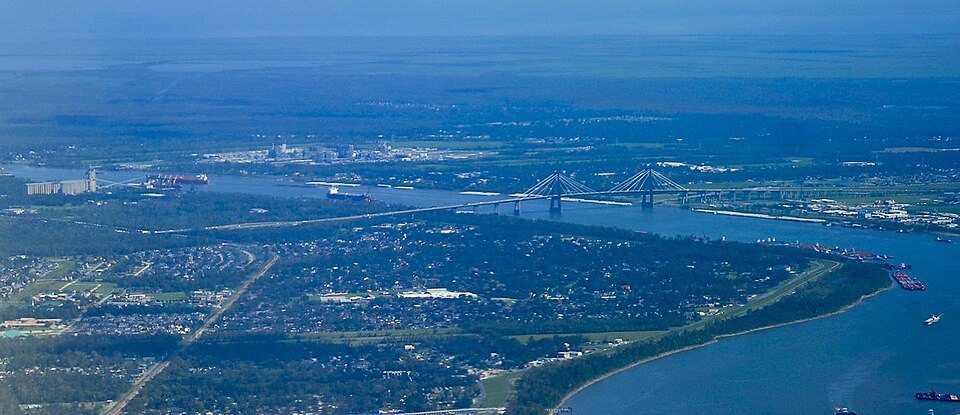
Photo: Tomás Del Coro, aerial view of Destrehan and the Hale Boggs Memorial Bridge over the Mississippi, CC BY 2.0, via Wikimedia Commons
The cruel detail, and every account mentions it, is that a bridge was under construction about three quarters of a mile away. It opened seven years later as the Luling Bridge and is now called the Hale Boggs Memorial Bridge. Once it carried traffic, the Destrehan to Luling ferry stopped.
For a long time the parish did not talk about the George Prince much. In 1978 officials refused to put a memorial at the St. Charles Parish courthouse, calling it too painful a reminder. A monument went up only in 2009, after Anderson's documentary brought the story back. The ferry's bell, raised during salvage, is on display at the Destrehan East Regional Library. Last month, on the fiftieth anniversary, people gathered for a memorial in a small park directly beneath the bridge. The St. Charles Parish sheriff, Greg Champagne, told a reporter that his father would normally have been on that ferry and was not, and that his mother spent hours not knowing.
The NTSB investigators who will try to explain what went wrong with the Atlantic Asphalt's steering were due to reach New Orleans on Saturday morning.
Enjoyed this story?Get a new one every day on social.