Document: Eunice Foote, \"Circumstances Affecting the Heat of the Sun's Rays\", American Journal of Science and Arts, 1856, public domain, via Wikimedia Commons
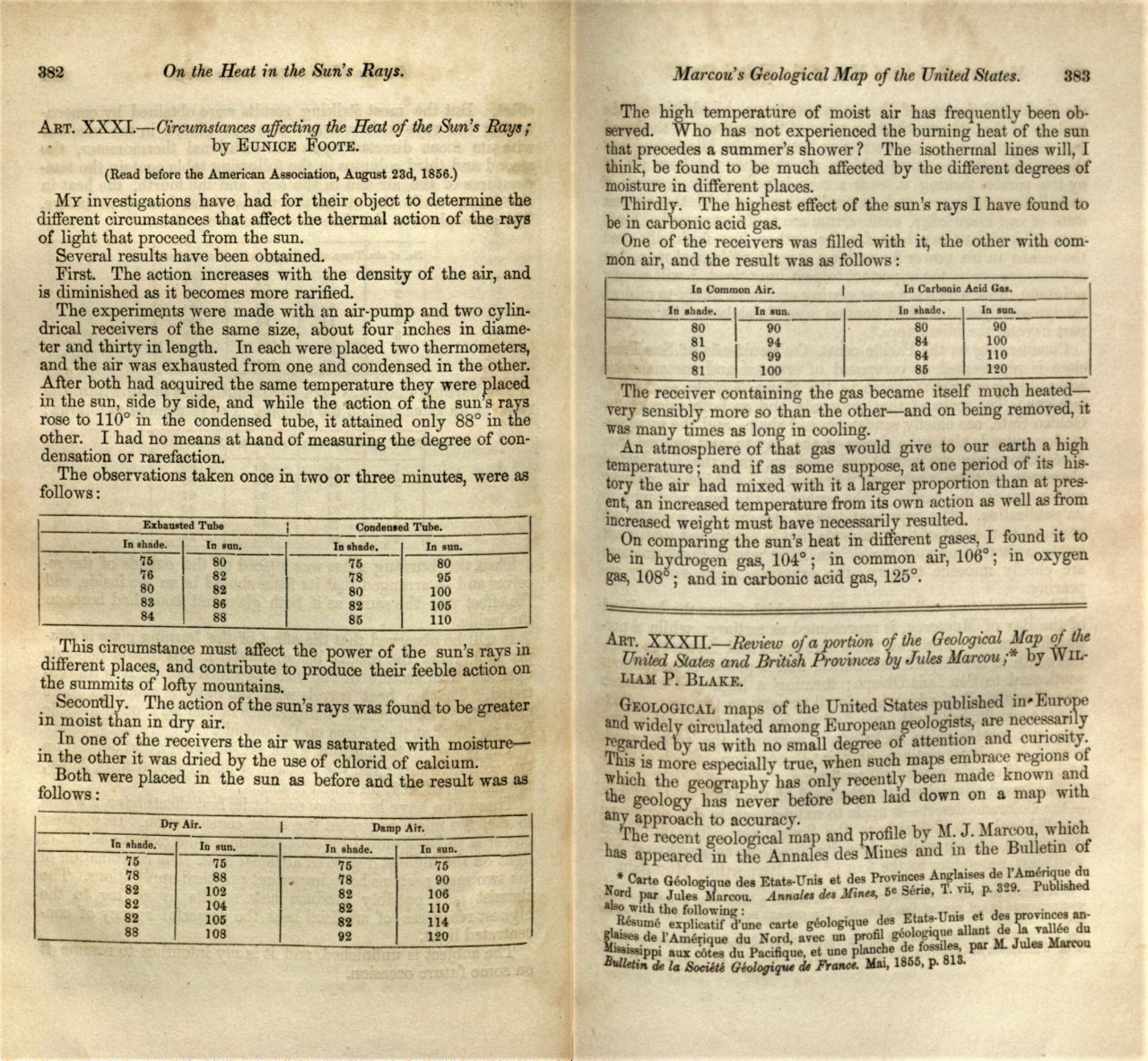
"An atmosphere of that gas would give to our earth a high temperature; and if as some suppose, at one period of its history the air had mixed with it a larger proportion than at present, an increased temperature from its own action as well as from increased weight must have necessarily resulted."
That sentence sits near the bottom of page 383 of the American Journal of Science and Arts for November 1856. The gas is carbon dioxide, which she called carbonic acid gas. The author was Eunice Foote, a 37-year-old from upstate New York with no university post, no laboratory and no particular standing among the men who ran American science. She had worked it out with an air pump, a few thermometers and the sun.
Two glass tubes in the sun
Her method was simple enough to repeat on a kitchen table. She took two glass cylinders, about four inches across and thirty inches long, and put thermometers inside each. Then she changed what was in them, pumping the air out of one tube and into the other, wetting one and drying the other with calcium chloride, and finally filling one with carbon dioxide and leaving ordinary air in its partner. She set the pairs side by side in the shade, let them settle, moved them into sunlight and wrote down the readings every two or three minutes.
Compressed air heated up faster than thin air (110 degrees against 88 in one run) and damp air beat dry, but the cylinder of carbon dioxide beat everything. "The highest effect of the sun's rays I have found to be in carbonic acid gas," she wrote, and gave the figures: 104 degrees in hydrogen, 106 in common air, 108 in oxygen and 125 in carbon dioxide. The tube of gas also stayed warm "many times as long" once it was taken out of the sun.
Read aloud by Joseph Henry
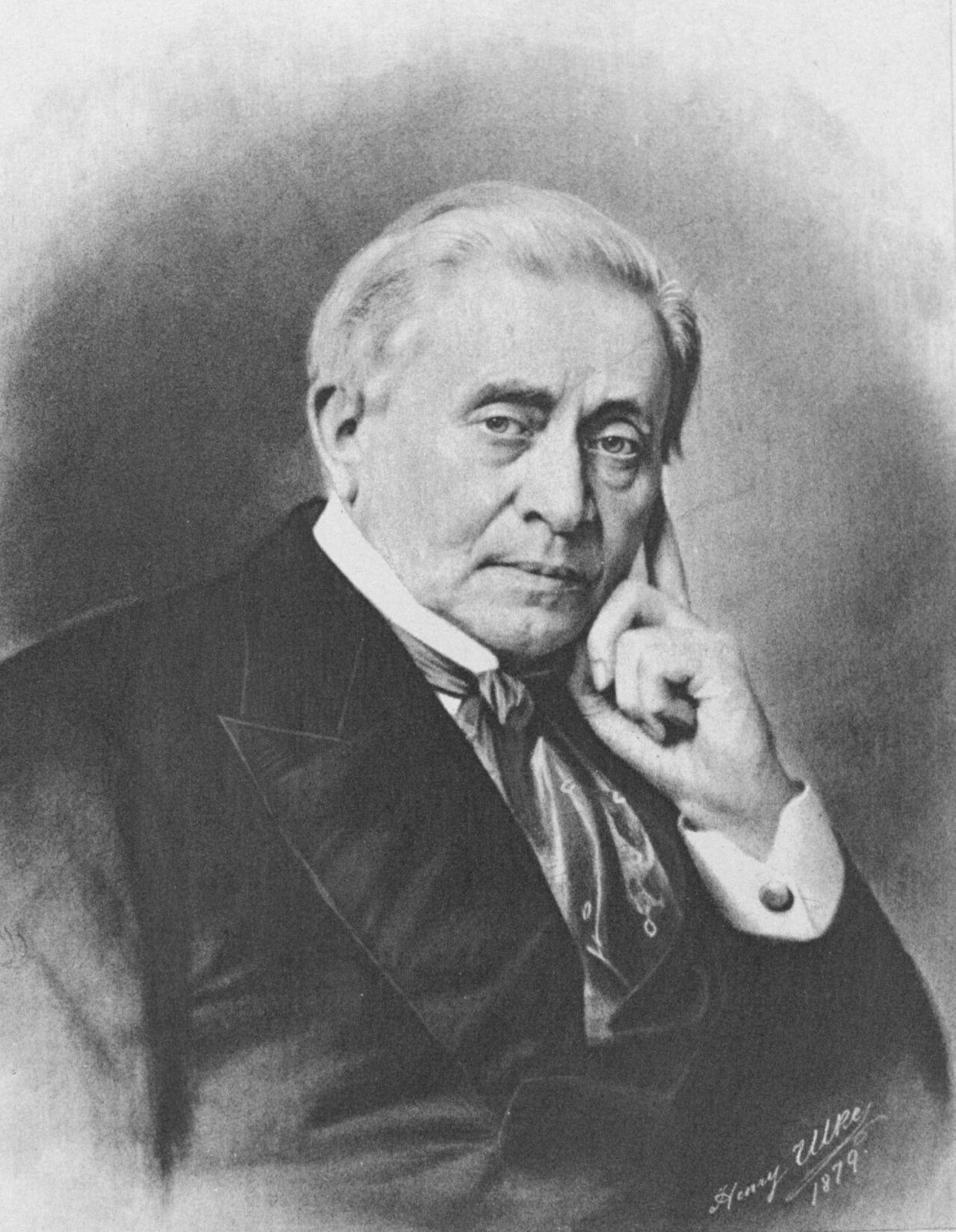
Joseph Henry, first secretary of the Smithsonian, who read Foote's paper in Albany in 1856. Portrait by Henry Ulke, 1879, public domain, via Wikimedia Commons
The American Association for the Advancement of Science met in Albany that August. On 23 August 1856 Foote's paper was presented, but not by Foote. It was read by Joseph Henry, the secretary of the Smithsonian Institution and a friend of the family. Whether she was barred from speaking or simply not expected to is not clear from the record; either way, the convention was that a man read it.
The New-York Daily Tribune reported that Henry called the work interesting and valuable, and also said there were difficulties in interpreting it. The paper did not appear in the association's printed proceedings. It went into the American Journal of Science instead, next to a paper by her husband, Elisha Foote, a judge and inventor. Scientific American ran a short item that year headed "Scientific Ladies," which praised her and then got on with the week's other news.
She had a public life beyond the experiment. In 1848 she and Elisha had both signed the Declaration of Sentiments at the Seneca Falls convention, and she later held patents of her own. She published one more paper, on static electricity in gases, in 1857. After that, as far as anyone has found, she published no more science.
What she did not prove
It is worth being fair to Henry here. Foote's experiment had real problems. She did not measure the pressure inside the cylinders, and adding gas changes the temperature on its own account. She did not separate visible sunlight from the infrared heat that the glass and the earth give off, and it is the infrared that matters for what we now call the greenhouse effect. She also offered no mechanism. What she had was a result and a guess about what it meant for the planet, and the guess turned out to be right.
Tyndall, three years later
In 1859 the Irish physicist John Tyndall, working in London with far better equipment, began publishing measurements of how gases absorb radiant heat. He showed that oxygen and nitrogen let it through almost untouched, while water vapour and carbon dioxide soak it up. His full paper came out in 1861, and for a century and a half the textbooks started the story with him.
Historians have argued about whether Tyndall knew of Foote. The Philosophical Magazine, on whose board he sat, reprinted her husband's paper from the same American issue and did not reprint hers. But there is no evidence he ever read it, and the order in which he tested his gases looks like someone who did not know her answer in advance. Roland Jackson, who has written about Tyndall at length, concluded in 2019 that he probably never saw it. I find that more depressing than a plot would be.
Foote died in 1888. Her paper turned up again in 2011, when a retired petroleum geologist named Raymond Sorenson came across an account of the Albany meeting and noticed the date.
Antalya, 170 years on
The UN climate conference, COP31, opened in Antalya on 9 November and goes into its second week on Monday. Turkey is the host and Australia is running the negotiations, under an arrangement that has caused some friction over who has the final word. The air outside the conference centre carries roughly 425 parts per million of carbon dioxide, against about 280 before the industrial age.
Foote's tubes are not in a museum, because nobody kept them. Her sentence about the earth's temperature is now quoted in climate talks and school textbooks, which is a lot of attention for a paper that a man had to read out for her.
Enjoyed this story?Get a new one every day on social.