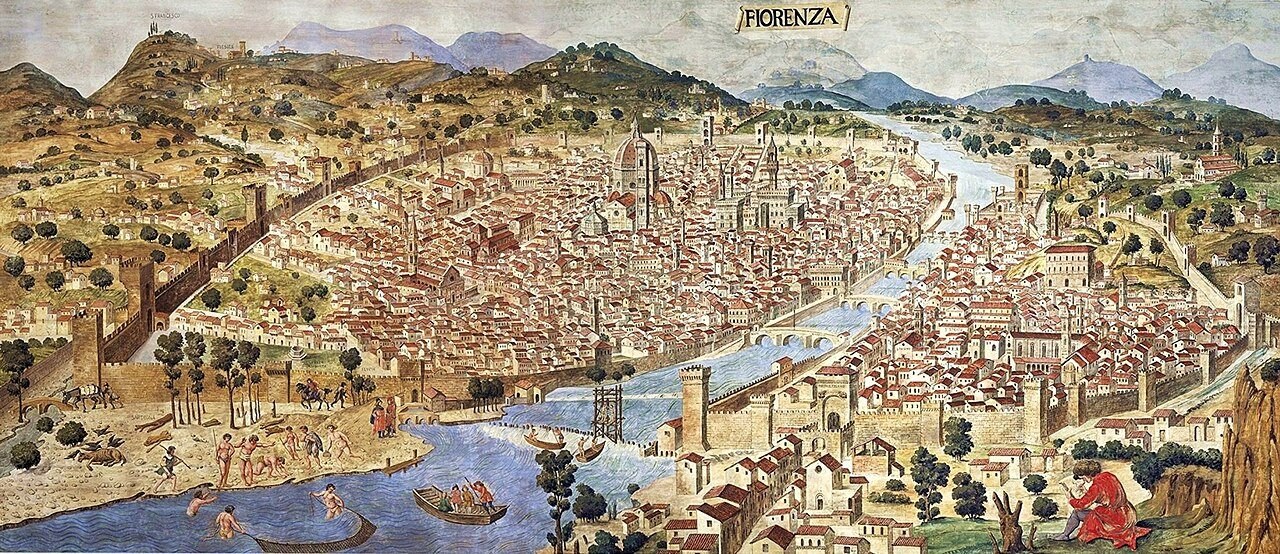
After the Pianta della Catena (c. 1470) attributed to Francesco Rosselli, public domain, via Wikimedia Commons
In the summer of 1427 Palla di Nofri Strozzi, or more likely a clerk at his elbow, drew up a list of everything he owned. It ran to 54 farms, 30 houses, a bank with 45,000 florins of capital and a thick stack of government bonds. Every head of household in Florence was doing the same thing that summer, while ten officials and their staffs worked through the city. Strozzi's gross total came to 162,925 florins, the largest in Florence by a distance.
Californians voted on Tuesday on a one-time 5 percent tax on about 200 billionaires and turned it down, 56 to 44 on the early count, after Sergey Brin alone put $102 million into the opposition. I mostly write about the medieval world and rarely get to mention a ballot measure. This week I can, because Florence had the same argument nearly six centuries ago, lost it in a different way, and kept the files.
A war with Milan and 73 forced loans
Florence had been fighting Filippo Maria Visconti, Duke of Milan, since 1423, and the war was eating the treasury. The city lived on gabelles (excise on wine, oil, meat, salt and milling), an old property valuation called the estimo, and forced loans from its wealthier citizens, who were paid back in bonds of the Monte at 5 percent. One modern tally finds 73 of those forced loans between 1423 and 1428. The same account puts the 1426 deficit at 682,000 florins, a number I would treat as approximate but not as exaggerated.
The loans were resented for a reason any merchant today would recognise. A man could be assessed on his goods with no allowance for what he owed against them. A law ordering a full survey passed in May 1427. Niccolò da Uzzano and Rinaldo degli Albizzi, both rich and both leaders of the governing circle, are usually credited with it, and Machiavelli, writing a century later, gives the popular glory to Giovanni di Bicci de' Medici instead. Historians treat that second claim with some care, as one does most things Machiavelli says about Medici virtue.
Half of one percent, payable in cash
The catasto taxed wealth at 0.5 percent. Land and houses were valued by capitalising their yield at 7 percent, business assets and bonds went in alongside, and the deductions were generous. You could take off your debts (except, the rules said, debts owed to Jews), your own home even if it was a palazzo, your workshop and tools, and 200 florins for each mouth in the household. Servants and slaves did not count as mouths. About 400 slaves lived in the city that year, which is a detail the guidebooks leave out.
The result was the most exact picture of wealth any medieval city ever made of itself. Florence had 9,780 households. Of those, 1,431 had no assessed wealth at all, and 137 households, 1.4 percent of the total, held just under 30 percent of everything assessed. Only about one household in eight owed anything. A butcher on the rolls paid 7 florins, a coppersmith 2. Strozzi paid a little over 500 and reportedly had to borrow to find it, since his fortune was in farms and paper. Giovanni de' Medici, on about 91,000 florins, paid around 405.
The tax that was only supposed to be collected now and then
Here the comparison with California gets uncomfortable for both sides. Five percent once is ten times the Florentine rate. The catasto, though, was not a single payment. It was expected to bring in about 25,000 florins a levy, and the government simply kept levying, especially after a new war against Lucca began in 1429. One account of the city's finances counts 12 collections in 1428, 7 in 1429, 25 in 1430 and 40 in 1431. If that last figure is right, a taxpayer gave up about a fifth of his taxable wealth in twelve months.
Yields fell as it went on, down to about 18,500 florins a levy. People had noticed where the money could go. Giovanni de' Medici kept a secret ledger, and the bank's branches and cash abroad were outside the assessors' reach. Landowners understated their tenants. Villages in the hills were simply missed. By August 1432 the city owed the Medici bank 155,000 florins, so the family with the secret ledger was also the one financing the government.
What Cosimo did with the files
Strozzi and Albizzi moved against Cosimo de' Medici, Giovanni's son, in 1433 and had him exiled. It lasted a year. The city's dependence on his bank was one of the reasons he came back in 1434, and when he did he cancelled overdue taxes, which made him popular, and sent Strozzi to Padua. Strozzi planned his return for the rest of his life and died there on 8 May 1462, at about 90, without seeing Florence again.
Cosimo kept the catasto. He kept it because a tax assessed by officials on a detailed declaration is a wonderful thing to have if you control the officials. Rivals found their returns examined and their assessments raised, while Medici friends and the Medici themselves did rather well. The reform had been sold as a way to take the assessor's favouritism out of Florentine taxes, and under Cosimo it put that favouritism on a firmer footing. There were revisions through the century, the ninth and last in 1480, and in 1495, after the Medici had been thrown out, it was abolished in favour of the decima, a 10 percent levy on real estate with the family home exempt.
The painting I would like to believe in
Masaccio's Tribute Money, in the Brancacci Chapel, shows Saint Peter paying a tax collector with a coin taken from a fish's mouth. It was painted in the middle of the 1420s, while all of this was being argued over, and it has been read as a comment on the tax debate. I would love that to be true. Nobody has ever produced a document that proves it, and the Gospel story needs no help from Florentine politics, so I will leave it as a nice idea.
The part nobody planned
The returns sit in the state archive in Florence. In the 1970s David Herlihy and Christiane Klapisch-Zuber put them on computer, and their study covers some 260,000 people in about 60,000 households across the city and its territory, with ages, occupations, debts and animals. You can search the city's records online today, thanks to Brown University, and find which Florentines claimed to be how old (the rural ages cluster suspiciously on round numbers).
Back in California, a rival measure banning wealth taxes was ahead on the early count on Wednesday, and the votes are not all in. My own view is that the catasto failed as a fair tax within ten years, and that the people who filled it in would be appalled to learn how much we still enjoy reading it.
Enjoyed this story?Get a new one every day on social.