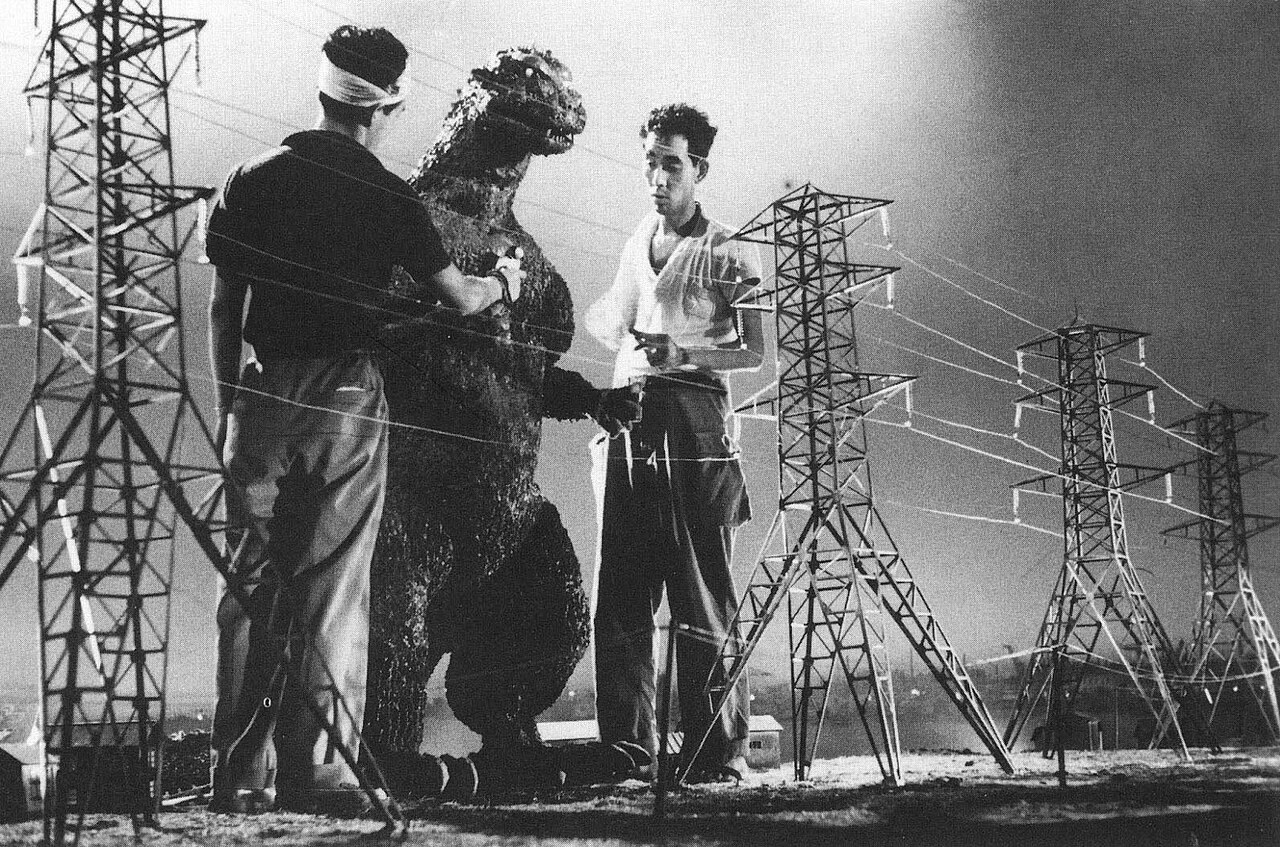
Photo: Toho production still, 1954, public domain in Japan and the United States, via Wikimedia Commons
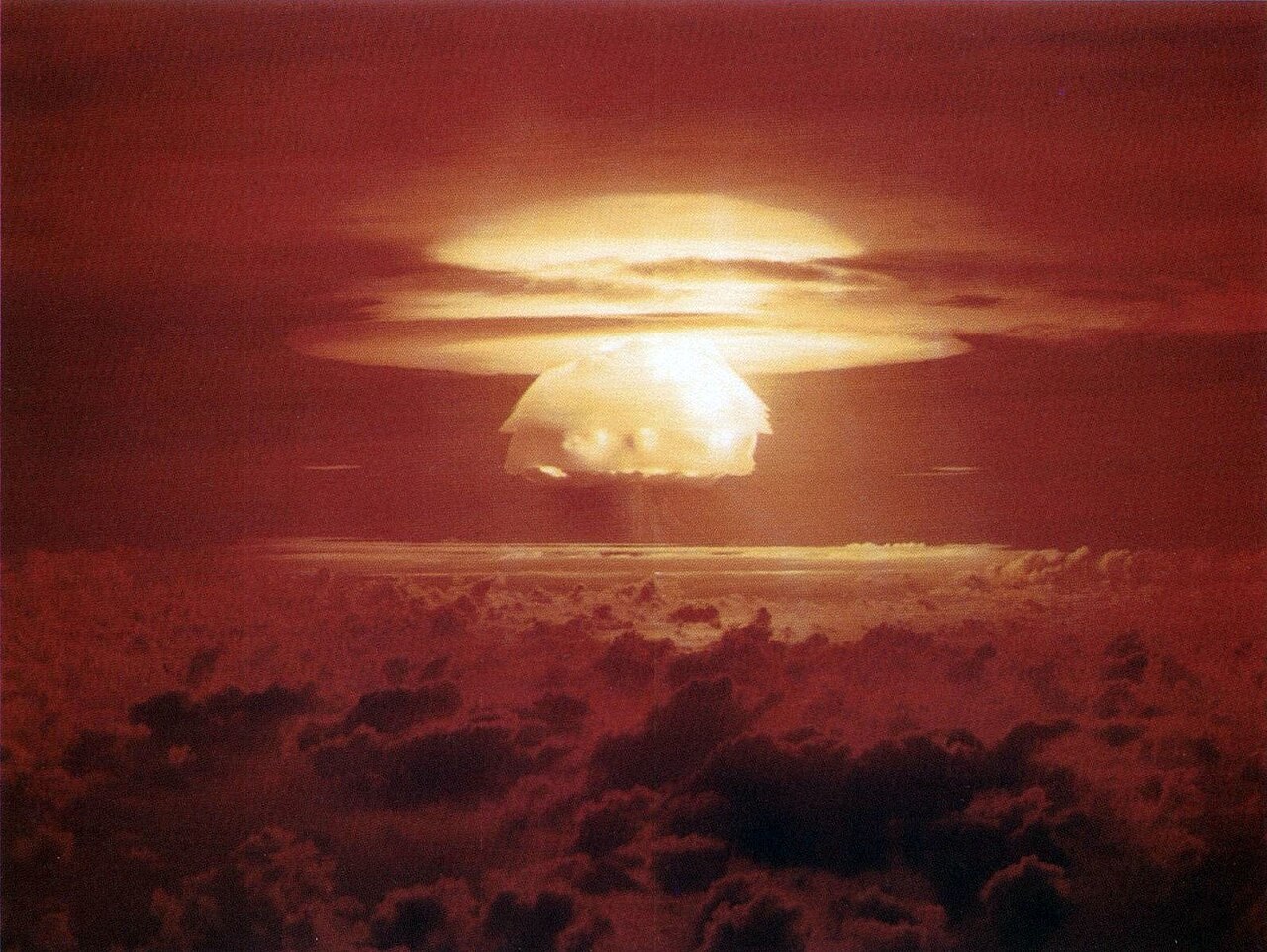
Fifteen megatons. That was the yield of Castle Bravo, the hydrogen bomb the United States set off at Bikini Atoll just before seven on the morning of 1 March 1954, and it was roughly two and a half times what its designers had expected. About 80 miles to the east, outside the zone the US Navy had told shipping to avoid, a wooden tuna boat out of the port of Yaizu was hauling in its lines. It was called the Daigo Fukuryū Maru, Lucky Dragon No. 5, and there were 23 men aboard.
Eight months later, on 3 November 1954, a film called Gojira opened in Japanese cinemas. Its first scene is a fishing boat on a calm sea, a flash of white light from below the horizon, and a radio operator tapping out a distress call as the deck catches fire. Nobody in Japan needed that explained. Toho's new Godzilla film, Godzilla Minus Zero, opens in Japan on 3 November this year, 72 years to the day after the first, so this seems a fair week to go back to the boat.
A boat outside the danger zone
The Castle Bravo fireball and cloud over Bikini Atoll on 1 March 1954. Photo: United States Department of Energy, public domain, via Wikimedia Commons
The crew saw the flash in the west, heard the blast some minutes later, and about two hours after that a fine white powder began falling on the boat and kept falling for hours. It got into their hair and their eyes and the tuna in the hold. They called it shi no hai, death ash; it was pulverised coral from the reef, made radioactive by the bomb. By evening the men were nauseous, and over the following days their skin blistered and their hair came out. They did not radio for help, by some accounts because they feared being detained by the Americans, and sailed the two weeks home to Yaizu.
Two days after they landed the Yomiuri Shimbun broke the story, and Japan, nine years after Hiroshima and Nagasaki, had a third list of nuclear casualties. All 23 men went to hospital with radiation sickness. The radio operator, Aikichi Kuboyama, aged 40, died in Tokyo on 23 September. His last words, as reported, were a wish that he would be the last victim of an atomic or hydrogen bomb.
Tuna nobody would buy
The Lucky Dragon's catch was contaminated, and so were catches from other boats that had fished the same waters. Inspectors with Geiger counters went through the Tokyo fish market; the government later said around 450 tonnes of tuna were condemned and buried. Prices collapsed, and sushi shops put up signs saying their fish came from the Atlantic. A petition against nuclear testing begun by a group of housewives in a Tokyo suburb gathered more than 30 million signatures within the year.
The United States first suggested the boat might have been spying, then in January 1955 settled with the Japanese government for a payment most accounts put at two million dollars, without admitting liability. American doctors said Kuboyama had died of hepatitis from a blood transfusion; Japanese doctors said radiation sickness.
A producer on an aeroplane
Tomoyuki Tanaka, a producer at Toho, was flying home from Jakarta that spring with a hole in his autumn schedule, a co-production having fallen through. By his own account he looked out of the window at the sea, thought about the Lucky Dragon, and thought about an American film that had done well in Japan the previous year, The Beast from 20,000 Fathoms, in which an atomic test wakes a dinosaur. By the time he landed he had a monster that came out of the Pacific because of a hydrogen bomb.
The name is the one part of the story nobody can pin down. Gojira blends gorira, gorilla, with kujira, whale, and the long-standing claim is that it was the nickname of a large man in Toho's publicity department. Nobody has ever found him, and Tanaka gave different versions over the years. I have decided to believe in him anyway.
Latex over bamboo
Toho gave the picture to Ishirō Honda, who had been a soldier in China for most of a decade and had walked through the ruins of Hiroshima on his way home in 1946. The effects went to Eiji Tsuburaya, who had wanted to make a giant-octopus film and settled for a lizard. Tsuburaya's team built a Tokyo of plaster and balsa at one twenty-fifth scale and put a man inside a monster suit to walk through it. The suit was latex over bamboo and wire and weighed, depending on who you ask, somewhere around a hundred kilos. Haruo Nakajima, the stuntman who wore it most, could manage a few minutes at a time before he had to be pulled out and hosed down.
The composer Akira Ifukube made the roar by dragging a resin-coated leather glove down the strings of a double bass and slowing the tape. The film cost around 60 million yen and sold 9.6 million tickets in Japan.
What the film actually says
People who know Godzilla from the later films, where he fights a moth and eventually a robot version of himself, are surprised by the first one, a grim picture about a city being burned. A woman on a commuter train says she barely survived Nagasaki and now this. A mother crouched in a doorway tells her children they will be with their father soon. Hospital wards full of children are passed under Geiger counters, which in November 1954 was not science fiction but the spring's newsreel. The scientist who finally kills the monster burns his research first so it can never become a weapon, and the last line warns that if testing continues another Godzilla will appear.
Honda said later that he wanted radiation to be something the audience could see. The monster's skin was modelled on keloid scars.
Raymond Burr in a hotel room
The version most of the world saw was not that film. In 1956 an American distributor cut around forty minutes, shot new scenes with Raymond Burr as a reporter watching from a hotel window, and dubbed the rest. Godzilla, King of the Monsters! kept the burning city and lost nearly everything about the bomb: the train conversation, the Bikini references, the closing warning. The original was not shown in full in the United States until 2004.
Seventy-two years to the day
The franchise has come back round to where it started. Godzilla Minus One, set in the ruins of 1945 Tokyo, won the Academy Award for visual effects in 2024, and its sequel Godzilla Minus Zero, again directed by Takashi Yamazaki, opens in Japan on 3 November and in North America three days later.
The Lucky Dragon itself is in a hall in Yumenoshima Park on Tokyo Bay. After 1954 the boat was decontaminated, rebuilt and used as a training ship until 1967, then dumped on a rubbish tip on the reclaimed land there, where a newspaper reader spotted it and started a campaign to save it. The city built a hall around it in 1976; admission is free. Kuboyama's memorial is outside. What is still not settled, seventy-two years on, is what killed him. The American hepatitis and the Japanese radiation sickness are both still in the record, and nobody has ever reconciled them.
Enjoyed this story?Get a new one every day on social.