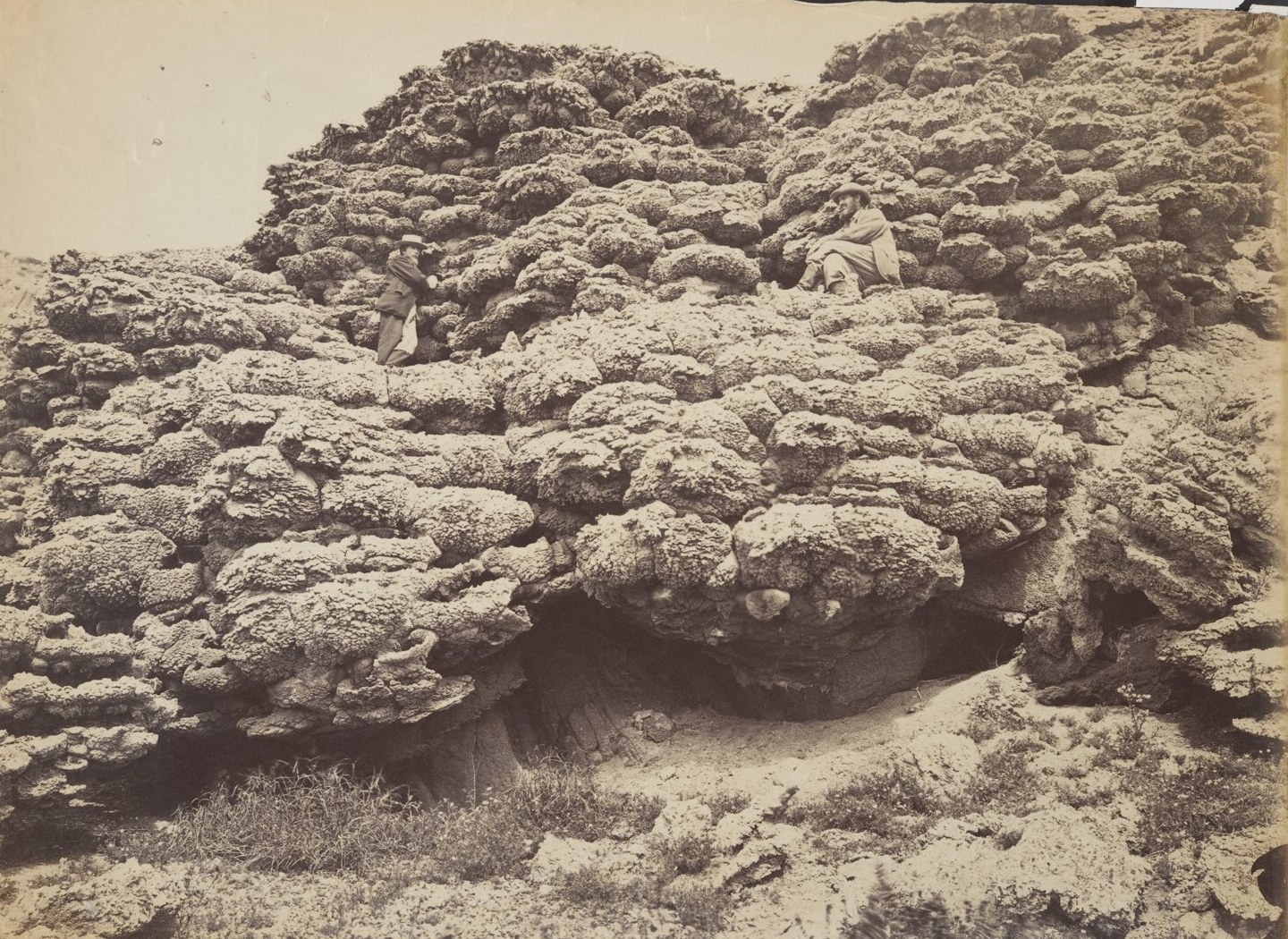
Timothy H. O'Sullivan, Tufa Rocks, Pyramid Lake, Nevada (1867), The Metropolitan Museum of Art, CC0
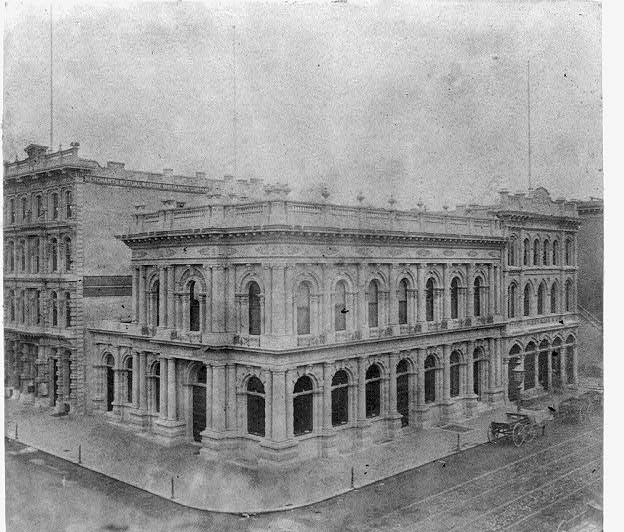
Two weather-beaten men in miners' clothes walked into the Bank of California on the corner of California and Sansome Streets, in San Francisco, and asked a clerk to lock a small buckskin bag in the vault. They did not want to say what was in it. Pressed, one of them let the clerk see: rough diamonds, rubies, garnets and sapphires, a double handful of them. The men were Philip Arnold and John Slack, cousins from Kentucky; accounts disagree on whether this was late in 1870 or early in 1871, but they agree that by the next morning the richest man in the city knew about the bag.
That man was William Ralston, the bank's co-founder, who had made fortunes on the Comstock silver mines and believed, like most of San Francisco in 1871, that the ground of the American West could produce almost anything. Diamonds had just been found in South Africa. Why not Colorado?
Nobody wanted to seem slow
The Bank of California at California and Sansome Streets, San Francisco, photographed about 1866 by Lawrence & Houseworth. Library of Congress Prints & Photographs Division, no known restrictions
Arnold played it beautifully. He was reluctant to talk and more reluctant to sell, and would not say where the stones had come from except that it was somewhere east, in Indian country, and dangerous. The more he refused, the more the financiers wanted in. A mining promoter named George Roberts brought in Ralston; Ralston brought in William Lent and General George Dodge; and Asbury Harpending, a speculator then in London trying to float mines, came home when Ralston cabled that the find was real.
The investors demanded proof. Arnold and Slack went off for a few weeks and came back with a second, larger bag, which they said came from a fresh trip to the field. Samples went to New York, where Charles Lewis Tiffany himself examined a selection and pronounced it worth about $150,000, which implied the whole haul was worth well over a million. Tiffany was also, as he did not mention, inexperienced with uncut stones, because nobody had ever brought any to his shop.
A blindfolded trip to the field
The investors then insisted on seeing the ground, and in June 1872 Arnold led a party there: Harpending, Dodge and a mining engineer named Henry Janin, who had examined some six hundred mines in his career and had, it was said, never been wrong about one. They went by train to Wyoming and then by mule for four days, blindfolded for part of the way so that they could not retrace the route. On a high sagebrush mesa they dismounted, and within minutes Harpending had kicked up a diamond with his boot. The party spent two days finding stones on the surface, in anthills and in crevices of the rock, and Janin wrote a report saying the field was worth working on a grand scale.
The San Francisco and New York Mining and Commercial Company was formed with a nominal capital of ten million dollars. Twenty-five men, including Ralston, Harpending, Lent and Dodge, paid $80,000 each. Arnold and Slack were bought out, in stages, for something in the region of $600,000 (sources give figures from $550,000 to $660,000), and the two prospectors went home.
The geologist who read the report too carefully
Clarence King was 30 years old and in charge of the Geological Exploration of the Fortieth Parallel, a federal survey of the country along the new transcontinental railroad, which was exactly where the diamond field had to be. His men had spent five years walking it. When the newspapers published Janin's account, King and his colleagues Samuel Emmons and James Gardiner worked out, from the description of the country and the days' travel from the railway, roughly where the field must lie: a mesa near Browns Park, where Colorado, Wyoming and Utah meet. If diamonds had been there, the survey ought to have found them. And nowhere on earth, the geologists knew, did diamonds, rubies and sapphires lie in the same gravel; they form in different rocks.
King took a small party by train and then by mule and reached the mesa in the first days of November 1872, in cold weather. They found stones, as promised, but only where the ground had been disturbed: anthills that had been poked with a stick held gems, and anthills left alone held none. A ruby sat in a hollow in a rock where no water could have carried it. And then one of the men picked up a diamond with facets: somebody with a lapidary's wheel had worked on it before it ever reached the sagebrush.
King rode straight to the railroad and went to San Francisco. On 10 and 11 November he laid the evidence before Janin and the directors and, in his own account, had to talk them out of sitting on it for a few days so that they could sell their stock. The company dissolved, and Ralston, to his credit, refunded the investors out of his own pocket. The newspapers had the whole story by the end of the month. It made King a national figure, and seven years later he became the first director of the United States Geological Survey.
What the stones were
Arnold had bought them. In 1871 and again in 1872 he had travelled to London, under a false name, and purchased parcels of cheap uncut stones, mostly low-grade South African diamonds and rubbish rubies and garnets of the kind sold by the bag, for something like $35,000 in all. The second "trip to the field" had been a trip to a London jeweller. The mesa had been salted twice, with the stones pushed into the anthills with a stick.
Harpending spent the rest of his life insisting he had been as much a victim as anyone, and in 1913 wrote a book called The Great Diamond Hoax, which is self-serving and very readable.
The loose end
Philip Arnold went back to Elizabethtown, Kentucky, bought a large house and a farm, and when Lent sued him there, Kentucky juries proved unwilling to hand a local man's money to a San Francisco banker. Arnold eventually settled for $150,000 and kept the rest. In August 1878 he was shot in the shoulder in a dispute with a rival banker and died early the next year, of pneumonia, at 49, having never said a word in public about the diamonds.
John Slack simply disappeared. He had taken his share and left San Francisco before the scheme collapsed, and for years nobody knew where he had gone. The best-sourced account has him turning up as a coffin-maker in White Oaks, New Mexico, where he died in 1896, apparently without much money and without ever being asked about the mesa. The site of the field is still marked on the map as Diamond Peak, in the far northwestern corner of Colorado, and people are said to go up there with sieves even now. Nobody has ever explained what Slack did with his share of the money, or whether his quiet, slow-witted manner, which everyone in San Francisco remarked on, was the best piece of acting in the whole affair.
Enjoyed this story?Get a new one every day on social.