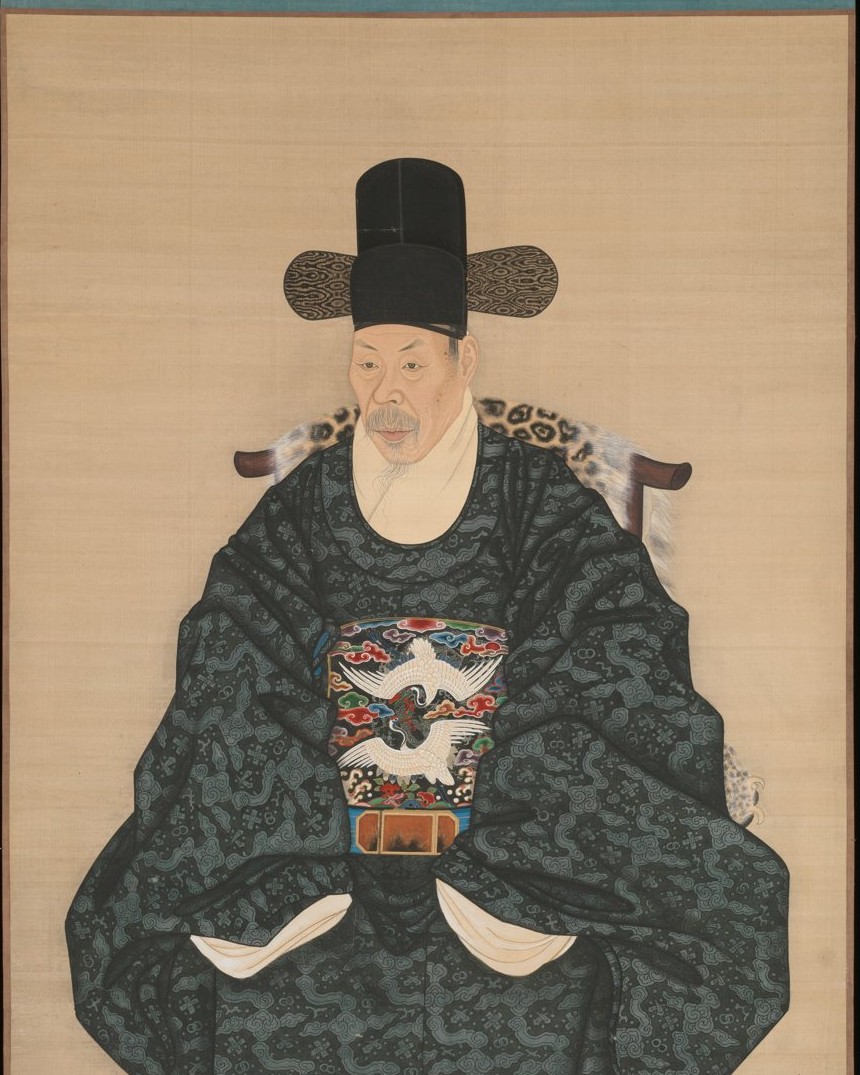
Portrait of the Joseon official Yun Dongseom (1710 to 1795), unidentified artist, about 1790 to 1805. The Metropolitan Museum of Art, CC0
On Thursday more than half a million South Korean students will sit the suneung, the national university entrance exam, and this year the government is worried about their spectacles. After a run of cases this year in which test-takers used AI-powered smart glasses, including on a national tax accountant's exam whose top scorer later admitted he had cheated, every one of the 1,300 test sites is to have at least one supervisor trained to spot the devices. Education Minister Choi Kyo-jin has said they tend to have thick, horn-rimmed frames. Proctors have been told to watch for odd movements of sleeves, collars and buttons.
The country already treats this exam day like a national emergency, with late starts at offices, police escorts for late students and flights held during the English listening section. The worry about cheating is much older than any of that. Korea has been running high-stakes state exams for more than a thousand years, and for most of that time the people setting them were struggling to keep up with the people gaming them.
The Chinese official who stayed
The gwageo, Korea's civil service examination, began in 958 under King Gwangjong of Goryeo. The idea came from Shuang Ji, an official from the Chinese state of Later Zhou who had arrived with an embassy, fallen ill and stayed on. He advised the king to recruit officials by written examination on the Chinese model rather than by birth and patronage, and Gwangjong liked the advice so much that he kept Shuang Ji at court for good.
Under the Joseon dynasty, from 1392, the system settled into three branches: a literary exam for civil officials, a military exam, and a set of "miscellaneous" exams for interpreters, doctors and other technical posts. The literary exam ran in stages, from provincial qualifiers up to a final palace exam held before the king, and each stage had a fixed quota. At the final level only 33 men passed in a regular sitting. In practice nearly all of them came from yangban families, the landed aristocracy, who could afford to keep a son studying the Confucian classics for twenty years.
Paper scrolls on open ground
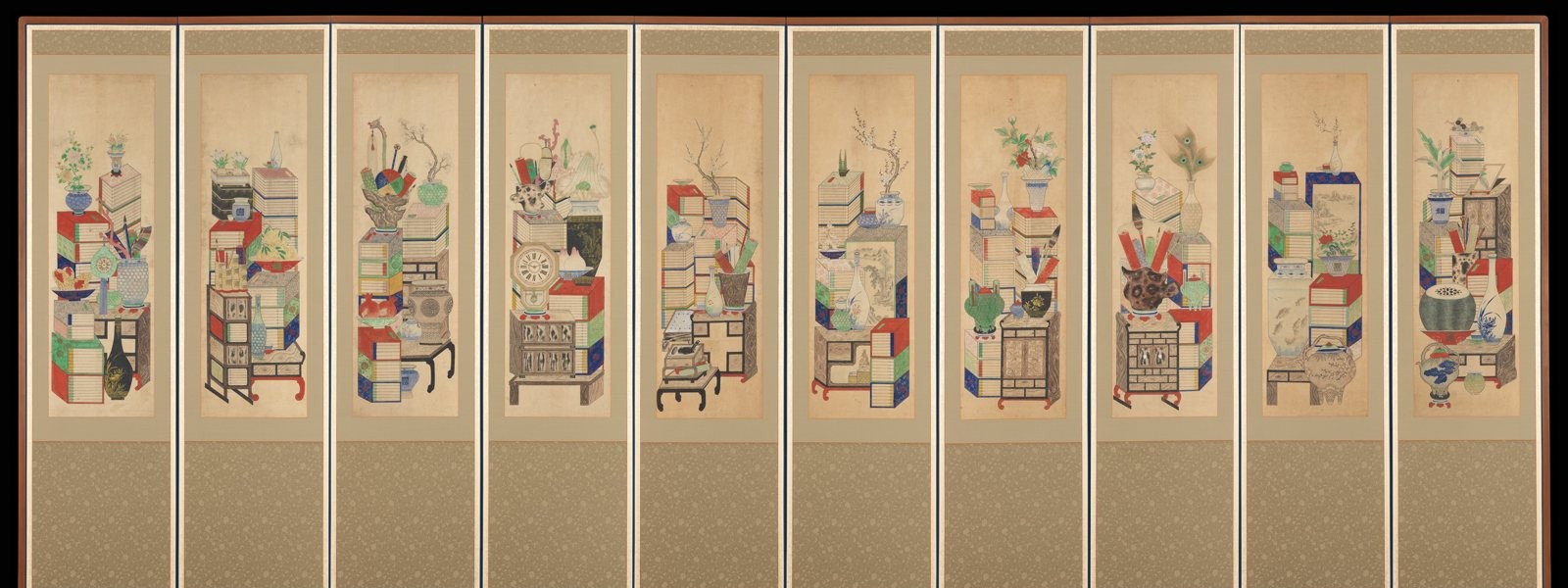
A Korean ten-panel screen painted with stacked books, brushes and scholars' objects, early 20th century. The Metropolitan Museum of Art, CC0
The Korean exam looked very different from the Chinese one. Chinese candidates were locked into rows of tiny cells for days. Joseon candidates sat on the ground in the open, under sunshades, in a palace courtyard or a field, with their answers written on long sheets of paper they brought themselves.
You can probably see the problem. A crowded field is a gift to anyone who wants to pass a note or a page of commentary to a friend, or to have a better scholar sit nearby and write the answer for him. Korean historians use two words for the commonest offences: chasul, getting someone else to compose your answer, and hyeopchaek, carrying books or notes into the exam ground. Both turn up repeatedly in complaints recorded at court in the later centuries of the dynasty, along with complaints about servants and hangers-on who crowded in with the candidates. (There is also a well-travelled story about answers being passed in through a hollow tube buried under the exam ground. I have never found a solid source for it, and I would treat it as folklore until someone does.)
The last exam in 1894
An American teacher named Dalzell Bunker, who taught at the royal English school in Seoul, left an account of what turned out to be the final gwageo, held in a large open field at Gyeongbok Palace on 25 May 1894. He wrote it up about four decades later, so the details should be taken with that in mind. Ten thousand candidates were said to be there. Exam paper of the standard government size was being sold on the grounds, carried in on porters' backs. And there were rumours, he wrote, that a candidate with money could buy a paper already finely written and ready to hand in.
The system was abolished later that year in the Gabo Reforms, which also ended the legal distinction between yangban and commoners. It had been running, in one form or another, for 936 years.
A thousand years of the same headache
It would be easy to make this sound like a story of a corrupt old system replaced by a fair modern one, and it is not quite that. The gwageo did let some men of modest family rise, and the suneung, for all the pressure it puts on teenagers, is about as transparent as a mass exam gets. What has not changed is the basic arithmetic. When one day's paper decides a whole career, some people will try very hard to cheat, and the examiners usually find out how after the fact.
The Joseon court issued rule after rule against these practices, and the complaints kept coming anyway. This week the ministry has talked about detectors, about shutting off Wi-Fi at test sites, even about making smart devices flash or beep when in use. Officials admit that jamming signals runs into the law and that supervisors cannot search a student's belongings without consent. Whether a supervisor trained to look for thick frames can do better than a Joseon guard watching for a sleeve full of notes, we will find out on Thursday afternoon.
Enjoyed this story?Get a new one every day on social.