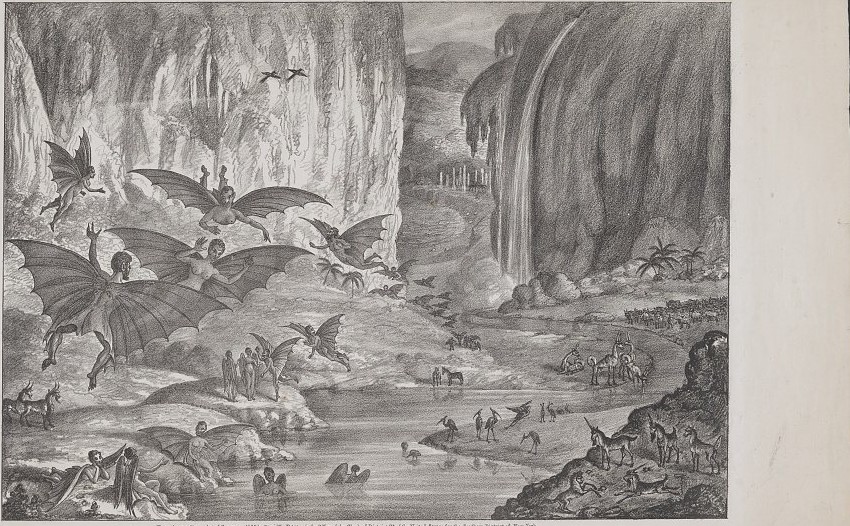
Lithograph published by Benjamin H. Day, New York, 1835, Library of Congress Prints & Photographs Division, no known restrictions
"GREAT ASTRONOMICAL DISCOVERIES LATELY MADE BY SIR JOHN HERSCHEL, L.L.D. F.R.S. &c. At the Cape of Good Hope." The headline ran across the second page of the New York Sun on Tuesday 25 August 1835, over a note that the article was reprinted from a supplement to the Edinburgh Journal of Science. Readers who paid their penny that morning learned that Herschel, the most celebrated astronomer alive and the son of the man who had discovered Uranus, had built a telescope so large that it could show objects on the moon as if they were a hundred yards away, and that he had been using it.
The first instalment was mostly about the telescope. The Sun's readers would have to come back the next day to find out what he saw, and they did, in numbers no newspaper had ever recorded.
A lens of twenty-four feet
The Edinburgh Journal of Science was a real publication, which helped, although it had stopped appearing two years earlier, which nobody in New York was in a position to check. Herschel was really at the Cape of Good Hope, where he had arrived in January 1834 to catalogue the stars of the southern sky, and letters took months to get there and back, which helped more.
The telescope the Sun described had a lens 24 feet across, weighed nearly seven tons, and magnified 42,000 times; the image, too faint to see at that magnification, was projected through a second instrument onto a screen in a darkened room, where Herschel and his staff could examine it at leisure. The physics was nonsense and the detail was superb. A reader who knew nothing about optics got six paragraphs of brass fittings, and a reader who knew a little found enough jargon to be reassured.
Then, on the Wednesday, the paper got to the moon. There was a beach of brilliant white sand. There were forests of trees like yews and firs, a plain covered in dark red flowers "precisely similar," the paper said, to the poppy of the English countryside, and herds of brownish animals like small bison, which had a flap of skin across their eyes to keep out the sun. There was a creature like a goat, bluish grey, with a single horn. By the Thursday there were beavers that walked upright, carried their young in their arms and lived in huts with chimneys, from which, the Sun noted, it was reasonable to conclude that they had discovered fire.
Vespertilio-homo
On Friday 28 August the Sun introduced the inhabitants. They stood about four feet tall, were covered in short copper-coloured hair, and had thin membranous wings that folded neatly down their backs when they walked. Herschel's party, the paper said, had classified them as Vespertilio-homo, the bat-man, and had watched them bathing, eating fruit, and talking to one another with evident animation; it added, in a passage that did a great deal for sales, that some of their behaviour was not suitable for description in a family newspaper. A later instalment found a second, finer race of them living near a temple roofed in polished sapphire.
The last article, on Monday 31 August, explained why there would be no more. The observers had left the telescope pointed at the eastern horizon, the rising sun had come through the great lens and set fire to the observatory wall, and by the time repairs were finished the moon had moved out of range. The series simply stopped, with Herschel supposedly back at work on other things, and the Sun went on selling the back numbers as a pamphlet.
The best-selling newspaper in the world
The Sun was two years old. Benjamin Day had founded it in September 1833 as the first successful penny paper in New York, at a time when the established papers cost six cents and were written for merchants. His paper was written for everyone else, sold on the street by boys rather than by subscription, and lived on crime, oddity and whatever would get a clerk to part with a cent. On 28 August, the day of the bat-men, the Sun announced that it had printed 19,360 copies, which it claimed was more than any newspaper on earth, the Times of London included. The claim is the Sun's own, and I would not stake much on the last few hundred, but the general picture is not in doubt: the presses ran all day, and the paper could not print copies fast enough to meet the crowd outside its office on Nassau Street.
The rival papers did what rival papers do. Several reprinted the story as fact. Yale, it was said at the time, sent a party of scientists to New York to inspect the original journal, and they were sent from office to office until they gave up; the story is a good one and I have never found a reliable source for it.
The man who wrote it
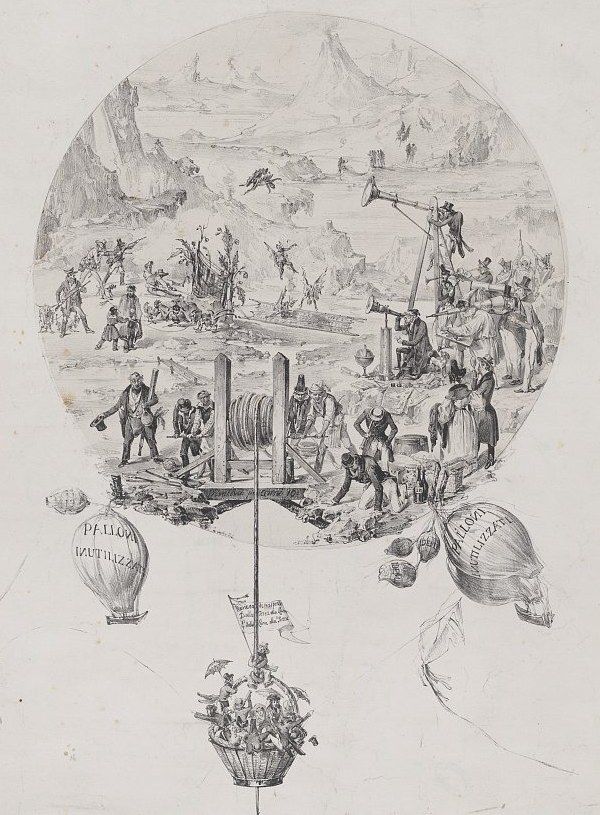
Italian satirical print of 1835 mocking the moon story: astronomers with giant telescopes survey a lunar landscape of winged figures while balloons marked 'useless' hang beneath. Lithograph by F. Wenzel, 1835, Library of Congress Prints & Photographs Division, no known restrictions
The one paper that smelled a rat was the New York Herald, whose owner, James Gordon Bennett, hated Day, and who announced on 31 August that the whole thing was a hoax written by one of the Sun's own men, an English-born reporter named Richard Adams Locke. Bennett was right. Locke, who was in his mid-thirties and had been hired by Day a few months earlier, never denied it with much energy and admitted it outright in 1840. He said later that he had meant the thing as satire, aimed at a popular Scottish preacher and writer, Thomas Dick, who had calculated the population of the moon at some four billion souls and whose books Americans were buying in large numbers. If so, the satire was too good. The Sun never retracted. On 16 September it allowed, in print, that the story might be a hoax, observed that if it was it had done nobody any harm, and declined to say either way.
Edgar Allan Poe, who had published his own story about a balloon voyage to the moon two months before the Sun's series began, was convinced Locke had stolen the idea from him, said so, and then changed his mind and wrote admiringly of how well the hoax had been done. Nine years later Poe sold the Sun a hoax of his own, about a balloon crossing of the Atlantic in three days, and the paper ran it on the front page.
The astronomer finds out
Herschel heard about his discoveries months later, when the newspapers finally reached the Cape. His first reaction, in a letter, was amusement: his real observations, he wrote, could never hope to be so interesting. The amusement wore off. For the rest of his life he was asked about the bat-men by people who had not read his actual work, and by the 1840s he was writing to friends that he was heartily sick of the whole business.
People usually tell this story as one about gullible readers, and I think that is unfair to the readers. They had no way of checking a story credited to a real scientist in a real journal 3,000 miles away, and when it was over most of them went on buying the Sun, which had, after all, given them a very good week. The paper kept its circulation and kept Locke. Benjamin Day sold the whole thing to his brother-in-law in 1838 for $40,000, and said for the rest of his life that it was the silliest thing he ever did.
Enjoyed this story?Get a new one every day on social.