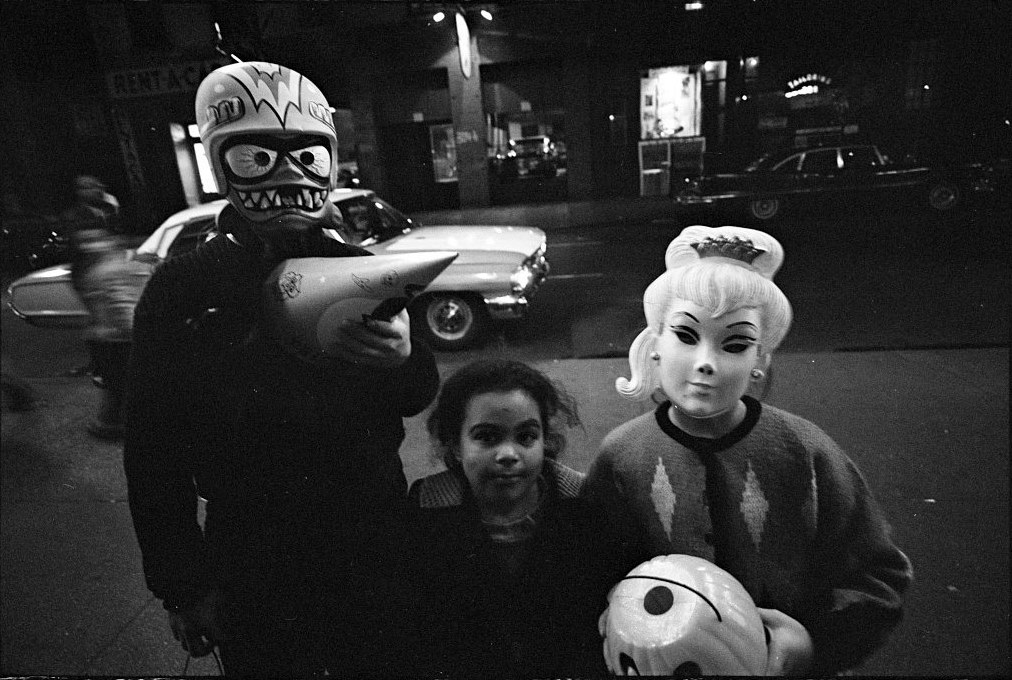
Photo: Angelo Rizzuto, October 1964, Library of Congress Prints & Photographs Division, no known restrictions
About two dollars. That is what the production designer of Halloween, Tommy Lee Wallace, paid at Bert Wheeler's magic shop on Hollywood Boulevard in the spring of 1978 for a rubber mask of Captain Kirk, made a few years earlier by Don Post Studios from a cast of William Shatner's face. Back at the production office he cut the eyeholes bigger, sprayed the rubber a dead bluish white, pulled the hair about until it looked wrong, and tried it on for the director. John Carpenter has said it looked like nothing at all, which was exactly what he wanted. Shatner, by his own account, did not find out for years.
That mask has been on cinema screens almost every October since, and this October more than most: horror has been one of the few dependable things at the box office this year. The film it came from was made by people in their twenties with no money, in three weeks, in the wrong season.
The Babysitter Murders
The idea came from a producer, Irwin Yablans, who had distributed Carpenter's previous film, a cheap and effective thriller called Assault on Precinct 13. Yablans wanted a film about a killer stalking babysitters, and had a title for it, The Babysitter Murders. On a flight he had the better idea: set it on one night, 31 October, and call it Halloween. Nobody had used the title for a feature film before.
The money, roughly $300,000, came from a Syrian-American producer, Moustapha Akkad, who had just spent a fortune on an epic about the birth of Islam and was willing to risk a small sum on a horror film he could sell abroad. Carpenter agreed to write it, direct it and compose the score for $10,000 and a share of the profits. His co-writer and producer was Debra Hill, 27, who wrote most of the dialogue for the teenage girls and named the fictional town, Haddonfield, Illinois, after her own hometown in New Jersey. The psychiatrist chasing the killer is called Loomis, after a character in Psycho, and the casting of Jamie Lee Curtis, 19 and in her first film, was partly a joke on the same theme: her mother, Janet Leigh, had been murdered in the shower in that film, and Yablans thought the newspapers would enjoy it. Curtis was paid $8,000.
Spring in South Pasadena, dressed as autumn
Halloween was shot in about 20 days in the spring of 1978, mostly in South Pasadena and a few streets of Hollywood standing in for a small town in Illinois in late October. Southern California in May has no fallen leaves, so the crew bought bags of them, painted them autumn colours, scattered them in front of the camera and swept them up again for the next shot. If you watch closely there are palm trees behind an Illinois street. Nobody has ever minded.
Donald Pleasence, the one real name in the cast, worked for a few days for a reported $20,000 and was, by Carpenter's account, baffled about why anyone would make the film. The killer, credited as The Shape, was played for most of the film by Carpenter's friend Nick Castle, who was paid $25 a day and told to walk, not run. The camera does a great deal of the acting: Carpenter and his cinematographer, Dean Cundey, shot in widescreen with a Panaglide, an early rival to the Steadicam, so the audience spends long stretches gliding behind people who do not know they are being watched.
Three days of piano in 5/4
The one thing Halloween has that every imitation lacks is its music. Carpenter screened an early cut, without a score, for an executive at 20th Century Fox, who was not frightened at all. He then sat down at a piano and wrote the score in about three days. The main theme is in 5/4, a rhythm his father, a music professor, had taught him to tap out on bongos when he was a boy, and it is played on a synthesiser and a piano, because that was what he could afford. It is a dozen notes. I have heard it come out of a phone at a bus stop and watched three strangers look up.
What it earned, and what it started
The film opened on 25 October 1978 in Kansas City, with no particular fanfare, and grew slowly on word of mouth and on reviews that got better as the critics caught up with the audiences. It took in something like $47 million in American cinemas on its first run, and about $70 million worldwide, which for years made it the most profitable independent film ever made: roughly 150 times its budget.
What it started was a decade of films about a masked man and a group of teenagers, nearly all of them worse. Friday the 13th arrived in 1980, A Nightmare on Elm Street in 1984, and the rules Halloween had quietly written hardened into a genre. Carpenter did not direct any of the sequels, and has said he thought the story was finished when the first film ended with the Shape gone from the lawn and the sound of his breathing over empty rooms.
I will say what I think, since it is my job. Halloween is better than nearly everything made in its image because it is patient, and because almost nothing in it is explained. There is no backstory worth the name, no reason, no face. There is a man in a mask that cost two dollars, standing very still across the street in the afternoon, and that is still enough.
Enjoyed this story?Get a new one every day on social.