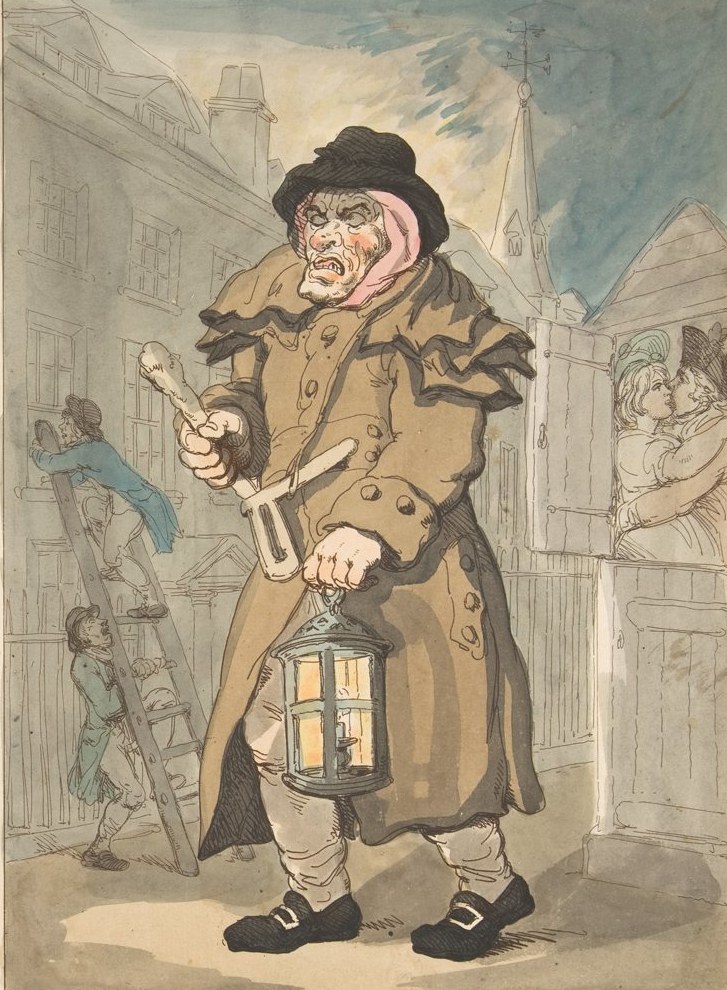
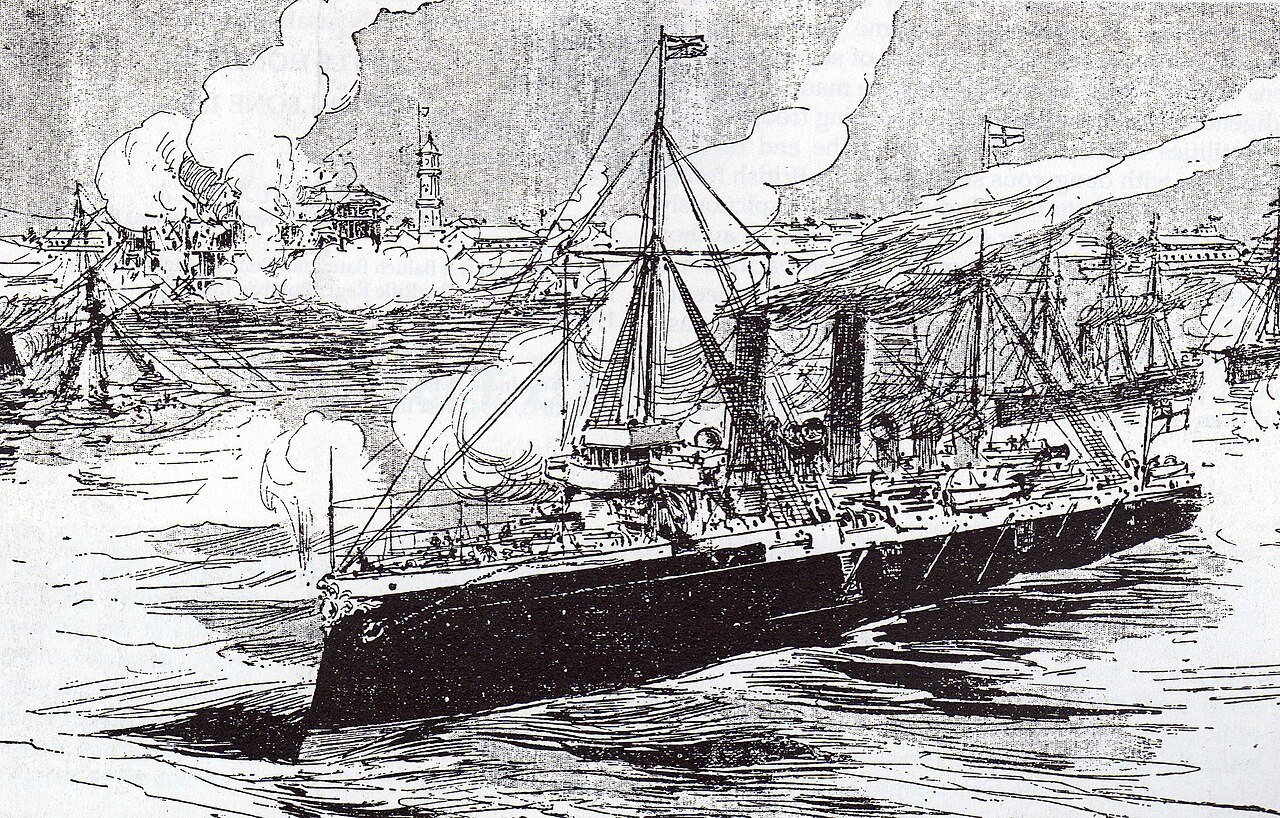
Thomas Rowlandson, A Brace of Public Guardians (detail), 1800, The Metropolitan Museum of Art, CC0
"Francis Smith was indicted for the wilful murder of Thomas Millwood, on the 3rd of January." That is how the Old Bailey record for 13 January 1804 opens, and it is a flat sentence for one of the strangest trials the court had seen. Smith did not deny the shooting. Nobody suggested he had known Millwood or gained anything by his death. His defence, put simply, was that he had not shot a man. He had shot a ghost.
The opinion of the judge who tried him turned out to govern English law on mistakes for the next 180 years.
Two months of a thing in a sheet
Hammersmith in 1803 was a village on the Thames about four miles west of Hyde Park Corner, with market gardens, a church and no police. London had none either, in the modern sense; it had parish watchmen, men like the one on our cover, who walked a beat with a lantern and a rattle and were widely held to be useless.
From some time in November 1803 people in Hammersmith began reporting a figure in white in the lanes around the churchyard after dark. The story that went round was that it was the ghost of a man who had died by his own hand the year before and been buried in consecrated ground against the custom. Witnesses said it was very tall, that it wore a shroud or a white sheet, and that it grabbed people. A pregnant woman was said to have been seized crossing the churchyard and to have died of the shock a few days later. A wagoner with sixteen horses and eight passengers was said to have fled and left the lot in the road. A brewer's servant told a magistrate he had been caught by the throat.
How much of this happened and how much was Hammersmith frightening itself over Christmas, I cannot tell you, and nor could the court. What is documented is that on 29 December the watchman, William Girdler, chased the figure and lost it, and that by the first week of January there were men walking the lanes at night with loaded guns looking for a ghost.
Black Lion Lane, eleven o'clock
Francis Smith was one of them. He was 29, an officer of the Excise, and on the night of 3 January 1804 he was out to catch the thing. A little after eleven he was in Black Lion Lane, a narrow way between hedges and garden walls, when a figure in white came towards him.
Thomas Millwood was a bricklayer, walking home from his parents' house. He was wearing what men in his trade wore: white linen trousers, a white waistcoat and a white apron. He had, as it happened, already been mistaken for the ghost once that winter. A relative, Mrs Fulbrooke, told the court that she had urged him to cover the white with his greatcoat, and that he had not.
Smith said afterwards that he had challenged the figure and got no answer. Millwood's sister Anne, who was standing at a gate a few yards away, testified that she heard a man say he would shoot, and that the shot came almost at once. The ball struck Millwood in the jaw and killed him where he stood. Smith, by every account, was appalled, went straight to the Black Lion public house and gave himself up.
The judge's instruction
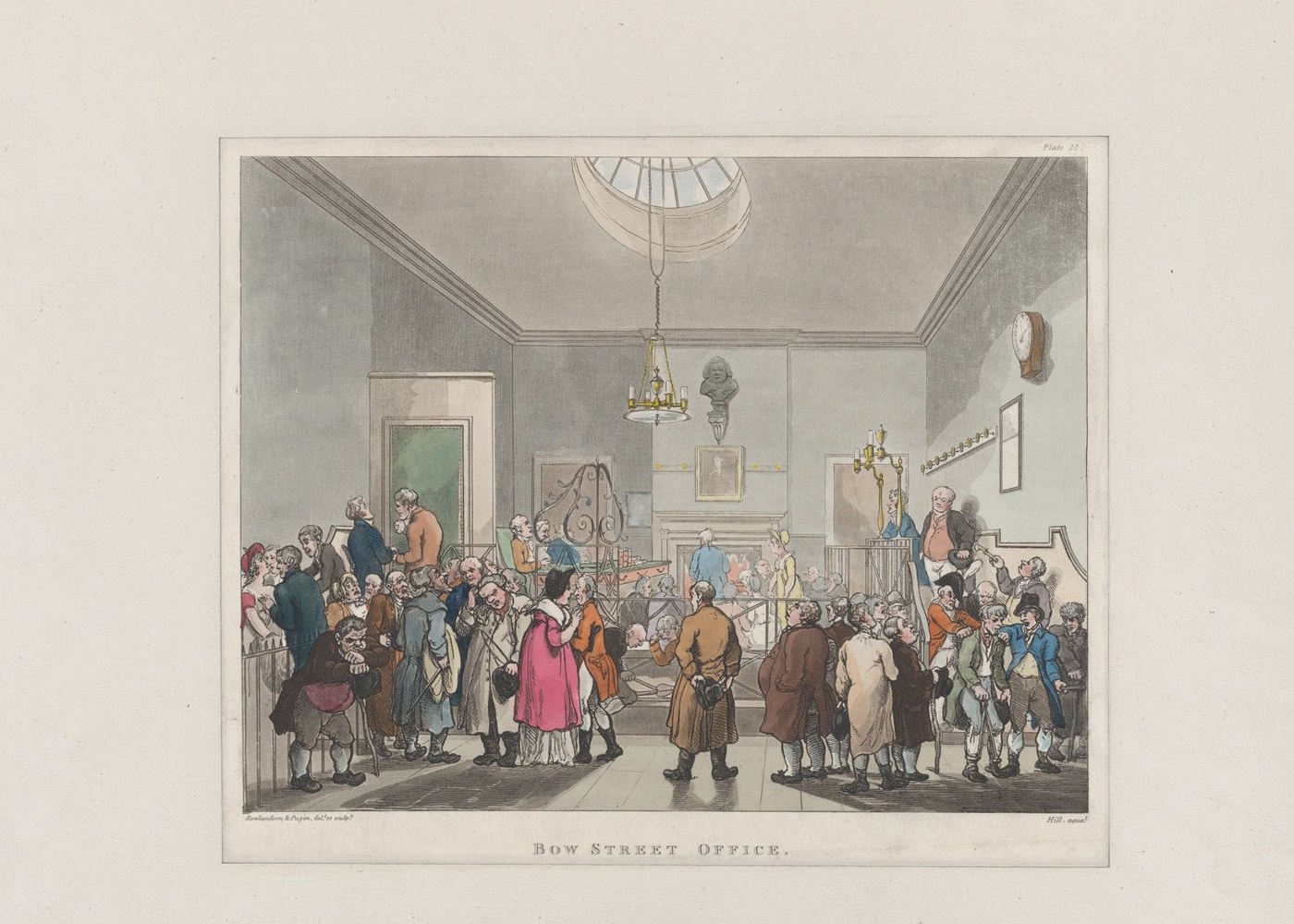
Thomas Rowlandson and Augustus Pugin, Bow Street Office, from The Microcosm of London, 1808, The Metropolitan Museum of Art, CC0
Smith came before the Lord Chief Baron of the Exchequer, Sir Archibald Macdonald, ten days later. Almost all the evidence was favourable to him: his good character, his remorse, the panic in the village, the fact that the dead man's own family had feared exactly this. The jury came back with a verdict of manslaughter.
Macdonald would not take it. He told them that all killing was murder unless justified by law or done in self-defence, and that neither applied: a man who fires to kill at a figure he believes is a ghost has still fired to kill. Good character, he said, had nothing to do with it. The jury went out again and did as they were told. Smith was convicted of wilful murder and sentenced to be hanged on the Monday and his body given to the surgeons for dissection.
He was not hanged. The execution was put off so that the case could go to the King, and George III commuted the sentence to a year's hard labour. So the law said one thing and the mercy of the Crown said another, and the question Macdonald had refused to let the jury answer was left hanging in the air: if a man kills in the honest belief that what he is doing is lawful, and he is wrong, what is he guilty of?
The ghost confesses
Within days the ghost gave itself up too. An elderly shoemaker named John Graham came forward to say that he had been going about in a white sheet to frighten his apprentice, who had been scaring Graham's children with ghost stories. Whether Graham was behind every sighting or only some, nobody established. I have never seen a record of his being charged with anything, and I doubt there is one.
Hanging in the air until 1984
Lawyers did not forget the case. For most of the next two centuries English courts took Macdonald's line in one form or another: a mistaken belief could only excuse you if it was a reasonable mistake. A reasonable man does not believe in ghosts, so Smith's belief could not save him.
Then came Gladstone Williams, a young man who saw what he thought was an assault in a London street and waded in to stop it, punching a man who turned out to be lawfully detaining a thief. Williams was convicted of assault. The Court of Appeal quashed the conviction, in a judgment reported in 1984 that is still simply called Williams. Lord Lane, the Lord Chief Justice, ruled that a defendant is to be judged on the facts as he honestly believed them to be, reasonable or not; reasonableness is only evidence of whether the belief was really held. The Privy Council confirmed that in Beckford v The Queen in 1988, and Parliament wrote it into section 76 of the Criminal Justice and Immigration Act 2008, where it still sits. Textbook discussions of the point still tend to open with a bricklayer in white trousers in a Hammersmith lane.
Black Lion Lane is still there, running down towards the river, and so is a Black Lion pub, though the hedges are long gone. The thing I keep coming back to is not the law. It is that Thomas Millwood had already been taken for the ghost before Francis Smith met him, and that somewhere in those two months of sightings, some of the white figures in the lanes were a shoemaker in a sheet, and some of them, nobody has ever worked out how many, were a man walking home from work.
Enjoyed this story?Get a new one every day on social.