Photo: U.S. Air Force, 1968, public domain, via Wikimedia Commons
Before the bomber went up on the morning of January 21, 1968, somebody on the crew did what people on long flights have always done. He found some cushions, foam pads with cloth covers, and pushed them under the instructor navigator's seat in the lower deck, where they would be handy later. The spot happened to be on top of a heater vent.
The plane was a B-52G from Plattsburgh Air Force Base in upstate New York, call sign HOBO 28, and it was flying a loop over northwest Greenland as part of the Thule Monitor Mission. Its job was to keep an eye on the big early-warning radar at Thule Air Base, so that if the radar went silent, Strategic Air Command would know whether that meant a broken cable or the start of a war. In the bomb bay were four B28 hydrogen bombs of about 1.1 megatons each.
On Thursday the Danish parliament voted 109 to 0 to approve a security agreement between the United States, Denmark and Greenland that lets the Americans modernize and expand that same base, now called Pituffik Space Base, and set up new defence areas at Narsarsuaq in the south and Mestersvig in the east. Greenland's own parliament approved it earlier this month. It builds on a defence agreement from 1951, which is the one HOBO 28 was flying under.
A heater that would not cool down
The cabin was cold that afternoon, and the crew opened a valve to pull more hot air from an engine into the heating system. The heater was not cooling that air properly before it reached the cabin. The cushions over the vent began to smoulder, then caught.
The crew tried to fight the fire with extinguishers and failed. At 15:22, Eastern time, they declared an emergency and turned for Thule, hoping to put the plane down on the runway. Smoke filled the cabin, the electrical power went, and the aircraft commander, Captain John Haug, ordered everyone out over land near the base.
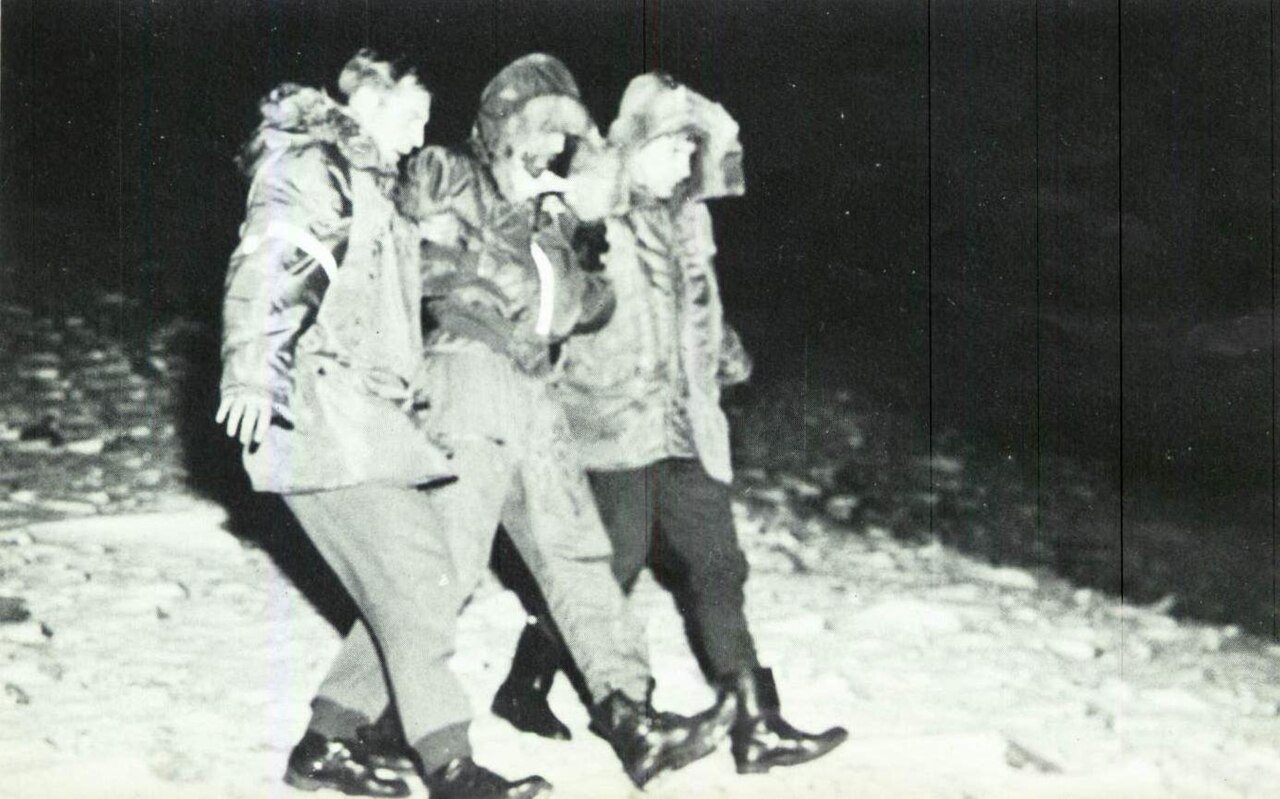
Six of the seven men made it. The co-pilot, Captain Leonard Svitenko, had given up his ejection seat to a spare pilot on board and tried to bail out through a lower hatch. He suffered fatal head injuries. The tail gunner, Staff Sergeant Calvin Snapp, landed miles from the others and survived about 21 hours in the polar night, wrapped in his parachute. (The photo at the top of this page shows a crewman being helped across the snow after the crash.)
The bombs did not go off, exactly
At 15:39 the empty bomber hit the frozen surface of North Star Bay, roughly seven miles west of the base, at a shallow angle. There was no nuclear explosion, because these weapons were designed not to produce one unless armed in a particular sequence. But the conventional high explosives inside all four bombs detonated on impact, and that was enough to break the weapons apart and spread plutonium, uranium and tritium over the ice along with burning jet fuel. The debris field ran roughly a mile wide and three miles long.
The search began with help from local hunters and their dog sled teams, organized by Jens Zinglersen, the Danish trade official at Thule, whom the Air Force later gave a civilian service medal.
Dr. Freezelove
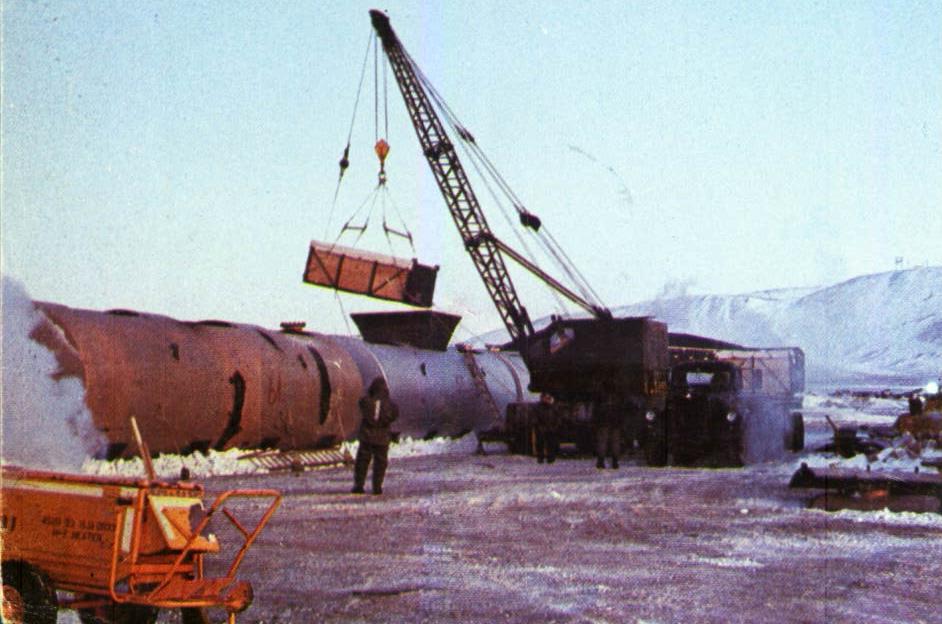
Contaminated ice being loaded into steel tanks for shipment to the United States during Project Crested Ice, 1968. Photo: U.S. Air Force, public domain, via Wikimedia Commons
The cleanup was called Project Crested Ice, and the men who did it called it Dr. Freezelove, which tells you about the mood. About 700 American and Danish personnel worked through the Arctic winter, in temperatures that regularly went far below zero, scraping up the blackened snow and ice and loading it into steel tanks at the base.
The tanks went to the Savannah River site in South Carolina, and the bomb wreckage went to the Pantex plant in Texas. The last tank was shipped on September 13, 1968, and the whole operation cost about $9.4 million. General Richard Hunziker, who ran it, said 93 percent of the contaminated material had been removed.
The part that was never found
A report written in July 1968 said investigators had recovered most of the weapons material but could not identify any part of one of the four thermonuclear secondaries. A mini-submarine searched the seabed that summer and gave up after technical problems. In 2008 the BBC, working from declassified documents, reported that one bomb had in effect been left on the bottom of the bay. A 2009 study by the Danish Institute for International Studies disagreed, concluding that no bomb was missing and that the underwater search had been for a piece of uranium from a weapon core. I have read both and I lean toward the Danish study, but I would not bet the house on either.
The letter in Copenhagen
The crash was a political problem in Denmark, because Denmark had a declared policy of keeping nuclear weapons off its territory, Greenland included. In 1995 it emerged that Prime Minister H.C. Hansen had written in 1957 in a way the Americans took as quiet permission to bring nuclear weapons to Thule, and a later official Danish report confirmed the United States had stored them in Greenland until 1965. The press called it Thulegate.
Danish workers who had cleaned up the ice spent years saying it had made them ill. Nearly 200 of them sued the United States in 1987 and lost, though the case pried loose classified files. In 1995 the Danish government paid about 1,700 former Thule workers 50,000 kroner each.
The new agreement says only NATO members may set up military installations on Greenland, and it leaves room for the US Golden Dome missile defence plans. It does not mention cushions.
Enjoyed this story?Get a new one every day on social.