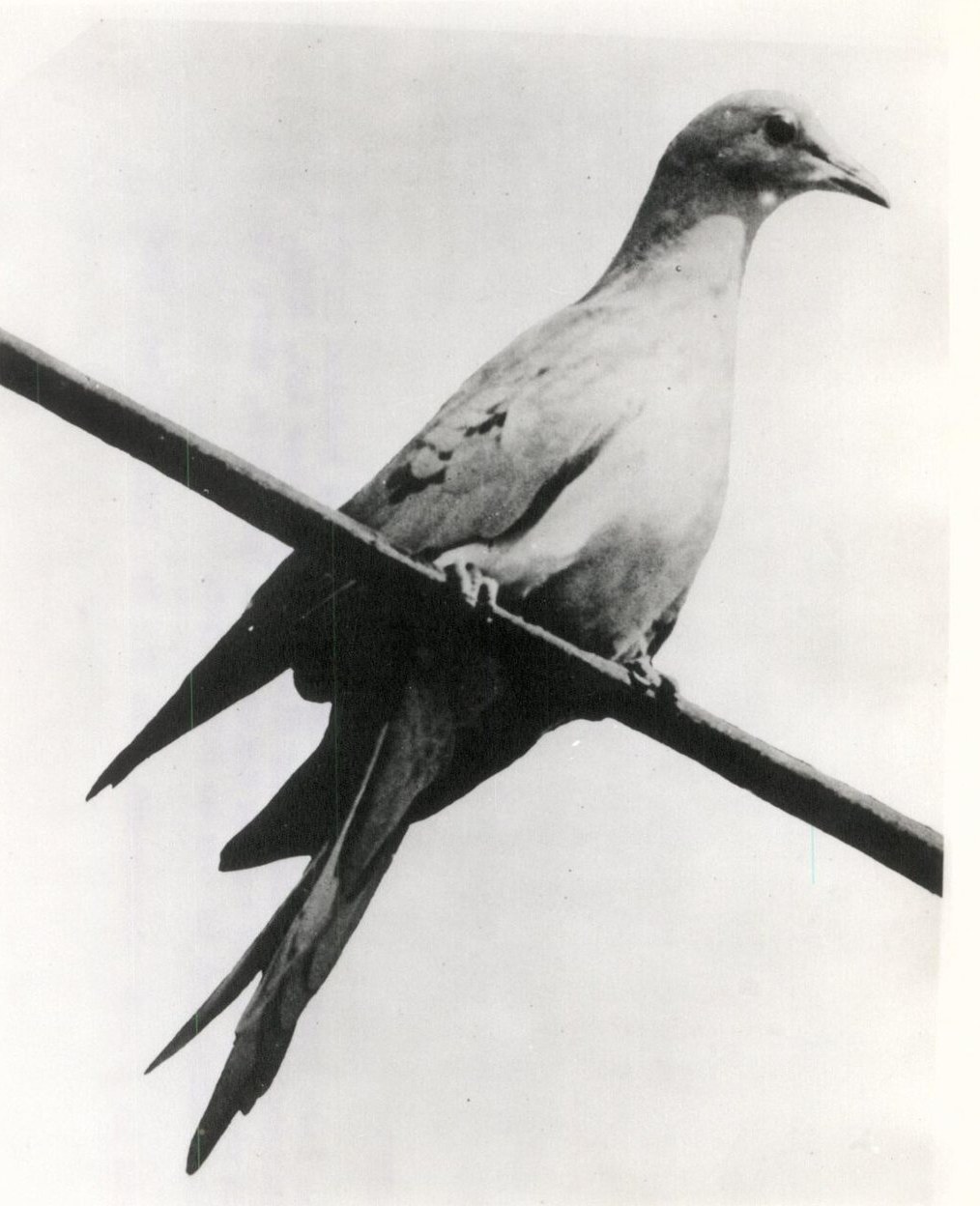
Photo: Martha, the last known living passenger pigeon, author unknown, public domain, via Wikimedia Commons
Some time around one in the afternoon on 1 September 1914, a keeper at the Cincinnati Zoological Garden went into the aviary and found an elderly grey pigeon lying on the floor of her cage. She was about 29 years old, which is very old for a pigeon, and she had been the only one of her kind left alive anywhere for about four years. Her name was Martha.
The same zoo lost Fiona the hippo on Thursday. According to the Associated Press, a visitor had tossed a knit hat in the air about eleven days earlier, a ceiling fan caught it and flicked it through a gap above the viewing window, and Fiona swallowed it. Her keepers stood her on a vibration plate borrowed from a horse farm several times a day to shake it loose. It did not work, and surgery is not an option on a full-grown hippo. Fiona had been famous since 2017, when she was born six weeks early at 29 pounds, smaller than any hippo calf recorded before her, and hand-reared on milk the staff collected from her mother.
Her fame grew in the shadow of a worse story, the shooting of Harambe the gorilla at the same zoo in 2016, and for a lot of people in the city she was simply the good news. Cincinnati has done this before, though: fixed its whole attention on one animal in one enclosure. A hundred and twelve years ago it was a pigeon.
Billions, then one
The passenger pigeon was probably the most numerous bird in North America when Europeans arrived. The famous accounts come from the early 1800s: the ornithologist Alexander Wilson estimated one flock in Kentucky at more than two billion birds, and John James Audubon wrote of the sky being darkened for days. I would treat the exact numbers with suspicion (nobody was counting), but nobody disputes that the flocks took hours to pass overhead.
They nested in vast colonies, and that made them easy to kill. Once railways and the telegraph arrived, market hunters could follow the nestings across states and ship birds to city markets by the barrel. The colonies collapsed in the 1870s and 1880s, faster than almost anyone expected. A bird shot in Pike County, Ohio, in 1900 is usually given as the last reliable record of a wild one.
A cage in Cincinnati
The Cincinnati zoo had kept passenger pigeons since the 1870s, and by the 1900s its small flock was one of the last captive groups in the country. Where Martha herself came from is not certain; the most common account says she came from a flock kept by a breeder in Wisconsin or Chicago, and she was named after Martha Washington.
The birds stopped breeding. A biologist at Clark University in Massachusetts, Clifton Hodge, offered cash rewards for anyone who could find a nesting pair in the wild, and the offers ran in newspapers for several years. Nobody ever collected. Martha's last companion, a male called George, died in 1910, and from then on visitors came to the zoo specifically to look at her. Accounts say she was so still on her perch that some threw sand at her to make her move, which the keepers eventually roped off the cage to stop. I have never seen a source I would fully trust for that story, but it fits what we know about zoo crowds.
Three hundred pounds of ice
When she died the zoo froze her body in a block of ice weighing about 300 pounds and sent it by train to the Smithsonian Institution in Washington. There she was skinned and mounted, and her insides were preserved separately.
She became a kind of relic. In 1966 she was flown to San Diego for a zoo conference with a flight attendant assigned to look after her, and in 2014, for the hundredth anniversary of her death, she was put on show in an exhibition at the National Museum of Natural History called Once There Were Billions.
Four years after Martha, in February 1918, the same Cincinnati aviary lost Incas, the last known Carolina parakeet. That was the only parrot native to the eastern United States, and it went the same way, with nobody quite able to say when the wild ones had gone.
The aviary in Cincinnati today
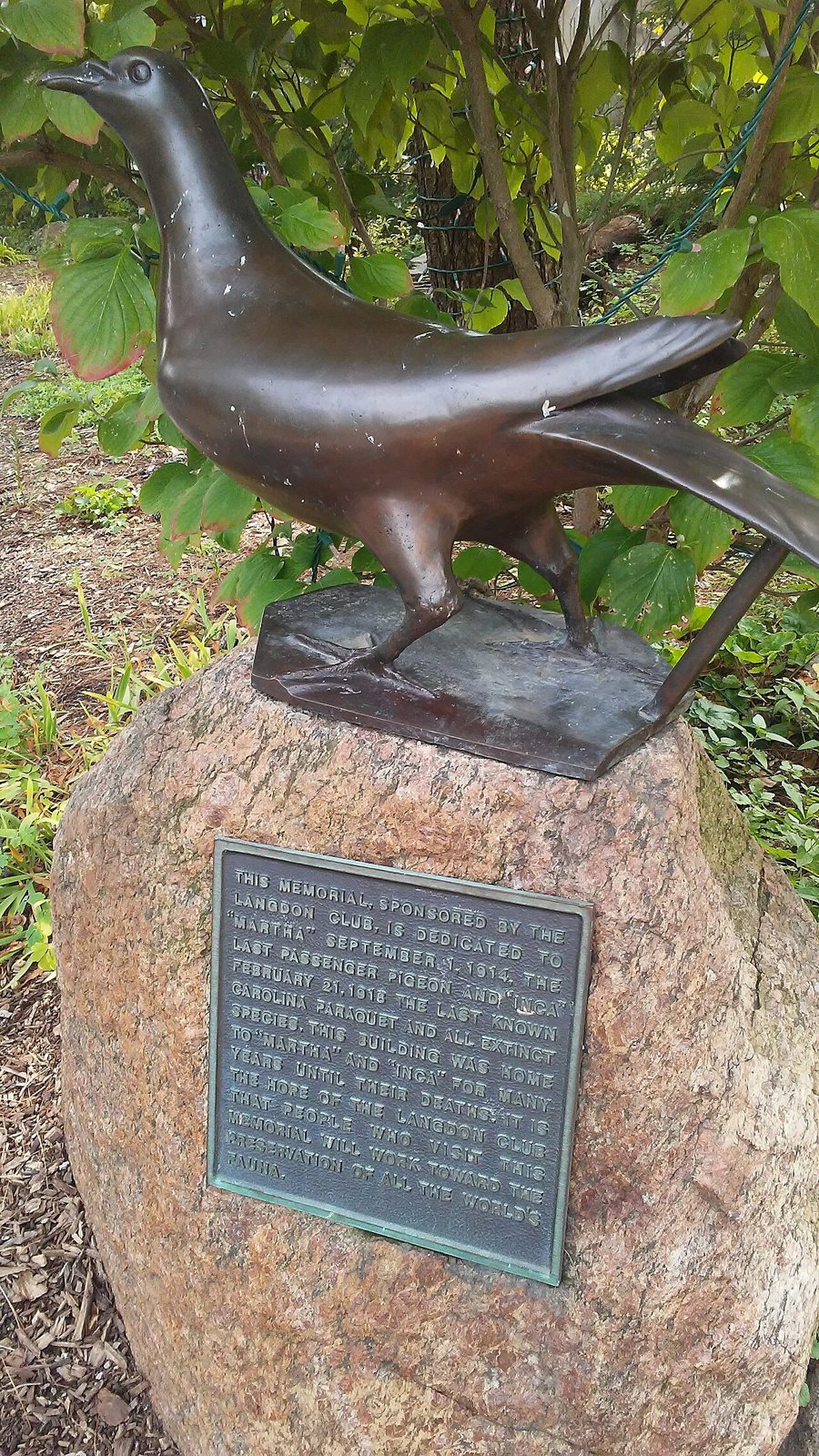
The bronze passenger pigeon and plaque at the memorial in the Cincinnati Zoo. Photo: William Tuttle, CC BY 4.0, via Wikimedia Commons
The small pagoda-roofed building where Martha and Incas lived is still standing at the Cincinnati Zoo. It was turned into the Passenger Pigeon Memorial in 1974 and is now a National Historic Landmark, with an exhibit on lost North American birds inside and a bronze pigeon on a boulder by the path. On Thursday a small crowd gathered a short walk away, at Hippo Cove.
Martha herself is in Washington, at the Smithsonian, in a case of her own when she is on display and in the collections when she is not.
Enjoyed this story?Get a new one every day on social.