Hormuz Fell in 1622 When a Shah Hired the English Fleet to Evict Portugal
For most of this year the news has carried a daily count of how long the Strait of Hormuz has been closed to most shipping, since the war that began on 28 February. Around a fifth of the world's seaborne oil passed through that twenty-mile gap before the fighting started, and everyone involved talks about the strait as though its importance were a modern discovery, a fact about tankers. The strait has been the most valuable piece of water in western Asia for at least seven hundred years, and the island that gave it its name was fought over, bought, besieged and bombarded long before anyone drilled for oil. The fight that settled who sits on which shore happened in the spring of 1622, and it turned on one ruler's decision to rent a navy.
The jewel in the ring
Hormuz is a small, dry island about five miles off the Persian coast, mostly salt and red iron ore, with no fresh water worth the name, and nothing about it suggests money except where it sits. A ship coming up the Gulf from India had to pass it, and from the fourteenth century the island's rulers, the kings of Hormuz, made every one of them stop and pay.
Marco Polo passed through in the 1290s and described a city that traded in horses, pearls, spices and silk, and a heat so bad that people spent the middle of the day standing in water. By the time Ibn Battuta came in the 1330s the kingdom's merchants had a saying that the Portuguese later repeated with a straight face: if the world were a ring, Hormuz would be the jewel in it.
Albuquerque arrives
That made it the obvious target when the Portuguese came round Africa. In 1507 Afonso de Albuquerque arrived off Hormuz with half a dozen ships and a few hundred men, burned a good part of the fleet in the harbour and forced the young king to accept Portuguese overlordship and tribute. His own captains then mutinied and sailed off to India, and he had to leave. He came back in 1515, this time to stay, and started the fortress that still stands on the northern tip of the island.
For the next century Hormuz was Portuguese in everything but name. The kings kept their title and their palace; a Portuguese captain kept the fort, the customs and the fleet, and sent the proceeds to Goa and Lisbon. Hormuz was regularly described as the most profitable customs post in the Portuguese empire east of Africa, and the garrison that held it was never large. It did not need to be. Nobody in the Gulf kept a fleet that could face Portuguese galleons for long (the Ottomans tried in 1552 and went home), and an island with no water cannot be besieged by an army that cannot cross to it.
A shah with an army and no boats
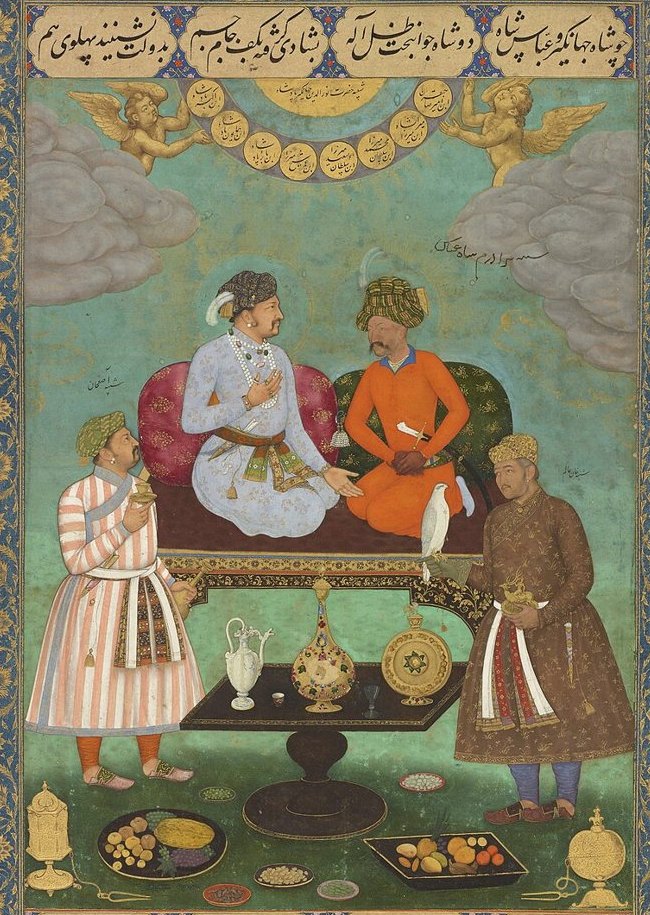
Shah Abbas I came to the Persian throne in 1588, at seventeen, with the Ottomans holding half his western provinces and the Uzbeks raiding in the east. By the 1610s he had beaten both, rebuilt the army around musketeers and artillery, moved his capital to Isfahan and turned Persia into a serious power again. He also wanted the coast. In 1602 his forces took Bahrain from its Portuguese-backed garrison, and in 1614 and 1615 they took the mainland port opposite the island, a village called Gombroon, and began to squeeze.
What Abbas did not have was a fleet. Persia had never built one. He could take the mainland and cut the island's water supply from Qeshm, but he could not put troops across five miles of open water under the guns of Portuguese ships, and Rui Freire de Andrade, the Portuguese commander sent out in 1619, built a new fort on Qeshm to make the point.
The English were the other piece. The East India Company had been trading at Jask on the Persian coast since 1616, buying silk, and had already fought off a Portuguese fleet there in the winter of 1620. Abbas noticed. In the autumn of 1621 his governor of Fars, Imam Quli Khan, sat down with the Company's agents and made them an offer that the Company's men, who were merchants rather than soldiers, found impossible to refuse and very difficult to explain to London.
The deal
The Company would supply the ships: five warships and four smaller vessels under Captains Richard Blyth and John Weddell. Persia would supply the army and pay half the cost of victualling the fleet. The spoils would be shared, Christian prisoners going to the English and Muslim prisoners to the Persians. And once Hormuz fell, the English would have a trading post on the island, exemption from customs on their own goods, and half the customs revenue on everyone else's.
It was, on the face of it, an act of war against a country England was at peace with, since Portugal was then ruled by the king of Spain. The captains went anyway, partly because the silk trade depended on keeping Abbas sweet, and partly because Imam Quli Khan made it clear that the Company's position in Persia depended on saying yes.
In January 1622 the fleet attacked the Portuguese fort on Qeshm, which surrendered quickly; one of the handful of English dead was William Baffin, the Arctic navigator who had given his name to Baffin Bay, killed while taking measurements for the guns. Rui Freire was captured and shipped off to India. Then the ships crossed to Hormuz and bombarded the fortress from the sea while the Persian army, ferried across in English boats, dug in on the landward side. The Portuguese ships in the harbour were sunk or burned. After two months the garrison, short of water and with the walls breached, gave up at the end of April. The Persians took the island; the English took the loot they could carry and sailed.
What Abbas did next
He did not rebuild Hormuz, and that, more than the siege, is the decision that mattered. Abbas had the town's merchants, their goods and much of the population moved across the water to Gombroon, which he renamed after himself: Bandar Abbas, the port of Abbas. The customs house went with them. The island, which had no water and no reason to exist except as a fortress, was left to decay, and within a generation it was a ruin with a garrison. The English got their post at Bandar Abbas and their share of the customs, which turned out to be far less than promised and was argued over for decades. The Portuguese tried to retake the island four times in the 1620s, failed every time, and fell back on Muscat, which they held until the Omanis threw them out in 1650. In London the Duke of Buckingham, as Lord High Admiral, threatened to prosecute the Company for making war without a licence and settled for £10,000; King James, who had been told nothing, took the same sum.
Who holds the shore
Before 1622 the Gulf's chokepoint belonged to whoever held the island in the middle of it, and for a century that was a European power in a fortress. After 1622 it was controlled, as far as anyone controlled it, from the Persian mainland, and the outside powers who wanted a say, the Dutch, then the British, then the Americans, had to get it with fleets rather than forts. Bandar Abbas is still Iran's largest commercial port and the headquarters of its navy. Hormuz island has a few thousand inhabitants, a small tourist trade based on its coloured soil, and the shell of Albuquerque's fort on the point, which you can walk round in an afternoon.
I am wary of history that announces lessons for the present, and the Gulf has had more than enough of those this year. Still, having spent a week with the Company's letters and the Portuguese chronicles, my own view is that the interesting figure in 1622 is not the admiral or the governor but the shah who owned no ships, worked out exactly what a trading company would do for half a customs house, and then quietly moved the customs house somewhere else.