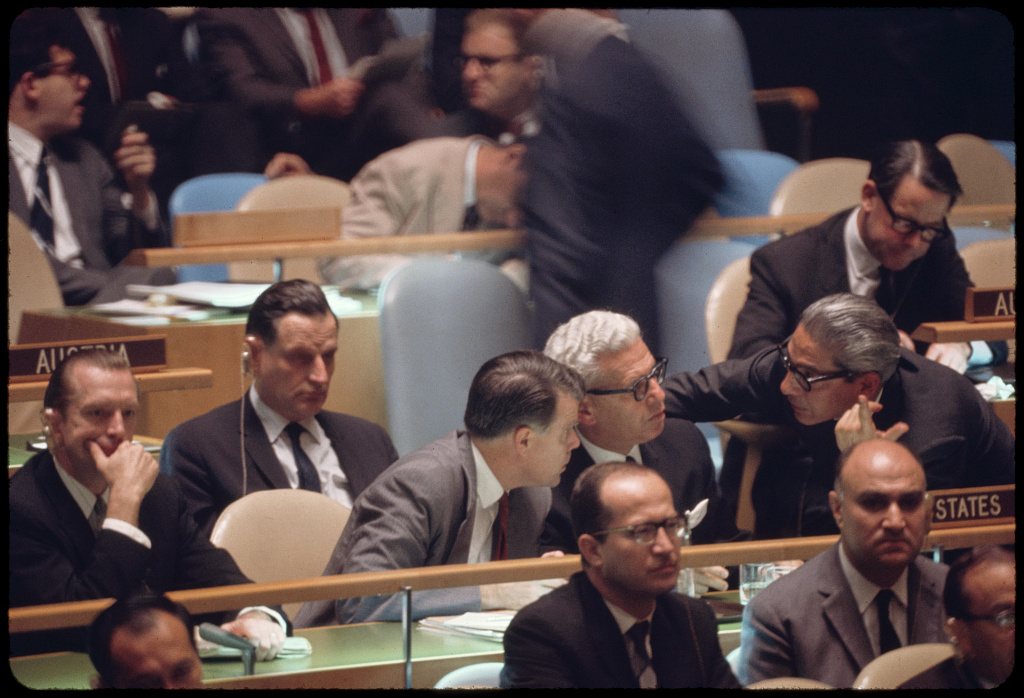
Photo: Dan Hadani collection, National Library of Israel, CC BY 4.0, via Wikimedia Commons
"Gvirotai ve-rabotai, mahapach." Ladies and gentlemen, an upheaval. Haim Yavin said it on Israeli television at ten o'clock on the night of 17 May 1977, as the polls closed and the station's sample count came in, and the word has never left the language. Israel had one television channel then, so almost everyone in the country who was awake heard it at the same moment.
Israelis go to the polls again tomorrow, 27 October, and the word will be used a great deal over the next two days whatever the result. It is worth remembering what it originally described, because the 1977 upheaval was not a swing of a few seats. It was the end of a political order that had run the country since before it was a country.
Twenty-nine years of one party
Mapai, the labour party of David Ben-Gurion, had led every Israeli government since the first election in January 1949. It had run the Jewish community in Palestine under the British before that. By 1977, merged with smaller parties into a bloc called the Alignment, it had held the prime minister's office through four wars, mass immigration and the building of the state. Its people ran the army, the trade union federation, the kibbutz movement and most of the economy. The opposition was for losing to.
The man who did most of the losing was Menachem Begin. He had commanded the Irgun underground against the British, founded the Herut party in 1948, and led it or its successors into eight general elections in a row, from 1949 to 1973, without winning one. Ben-Gurion refused to say his name in the Knesset. In 1973 Herut's bloc merged with several smaller groups into a new alliance called the Likud, which is the one still contesting tomorrow's election, and Begin lost with that too.
A dollar account in Washington
Labor's troubles in 1977 were partly of its own making and partly the long shadow of the Yom Kippur War of October 1973, when Egypt and Syria attacked on the holiest day of the year and the army was caught unprepared. Golda Meir resigned the following spring. Yitzhak Rabin, a general with no party machine behind him, took over, and in February 1977 he beat Shimon Peres for the party leadership by 1,445 votes to 1,404.
Then, on 15 March, the newspaper Haaretz reported that Rabin and his wife Leah still held a bank account in Washington from his years as ambassador there. Holding foreign currency abroad was illegal for Israelis at the time. Leah Rabin said the account was hers. Rabin, who could have let her take the blame, announced on 7 April that he was stepping down as the party's candidate, and Peres led the list into the election instead. It was the latest in a string of scandals to hit the party within a year, and it came five weeks before polling day.
On the other side, Begin was in hospital. He had a heart attack in March and spent most of the campaign out of sight, while Ezer Weizman, the former air force commander, ran it for him. The Likud's posters barely mentioned their leader.
The night of the sample
What made 1977 different was not only the Likud. A new party, the Democratic Movement for Change, had been founded the year before by Yigael Yadin, the archaeologist who had been the army's second chief of staff, and it promised clean government and electoral reform. It drew its voters almost entirely from the Alignment's side of the map.
The results, when they came, gave Likud 43 of the Knesset's 120 seats, up from 39. The Alignment fell from 51 to 32. Yadin's party took 15. The religious parties held steady. Turnout was just over 79 percent. Nobody could remember a governing party losing a third of its seats in one night, and the Alignment had done it while its opponent was recovering from a heart attack.
Much of the shift came from Jews whose families had arrived from Morocco, Iraq, Yemen and elsewhere in the Middle East in the 1950s and been settled in development towns and poor neighbourhoods, where Mapai was the landlord, the employer and the party, all at once. They had been voting against it in growing numbers since the late 1960s. In 1977 they did so decisively, and they have been the Likud's base ever since. (I have heard this explained a dozen different ways by Israeli friends, and the explanations agree on the fact and disagree on everything else.)
At the Likud headquarters in Tel Aviv that night Begin, by most accounts, asked for a skullcap and recited a blessing before he said anything political. The journalists in the room were as surprised by the gesture as by the result.
What the upheaval did next
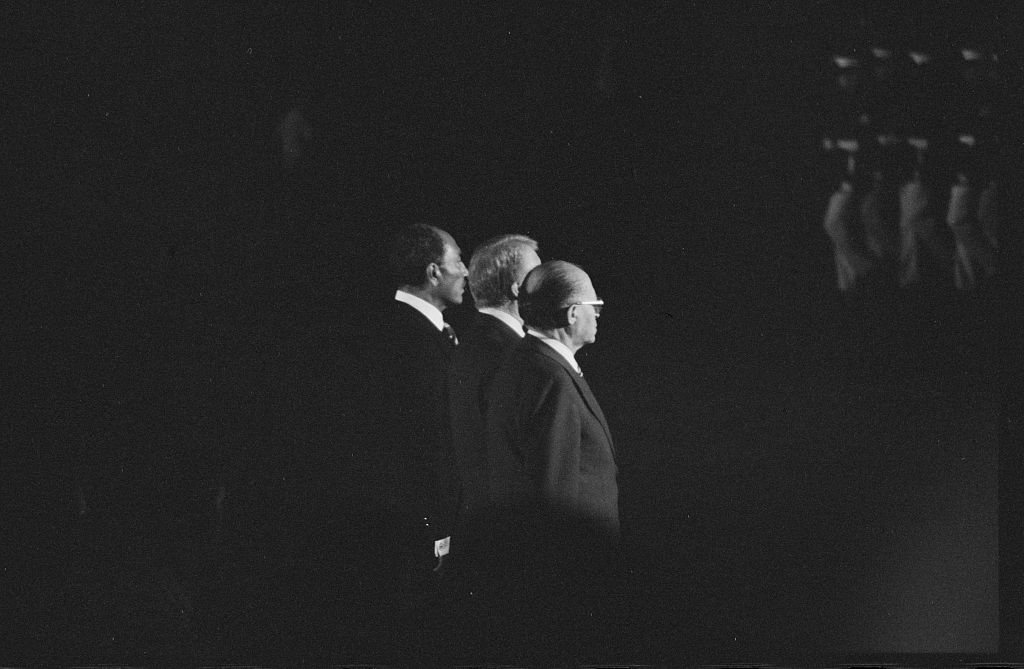
Anwar Sadat, Jimmy Carter and Menachem Begin reviewing Marines at the Camp David signing, 6 September 1978. Photo: Marion S. Trikosko, Library of Congress, no known restrictions
Begin formed his government on 20 June 1977 with the religious parties and Ariel Sharon's small list, and persuaded Moshe Dayan, a Labor man and the hero of 1967, to cross the floor as foreign minister. He said from the start that he wanted to meet the Arab leaders. Hardly anyone took that seriously from a man who had spent thirty years as the voice of the hard line.
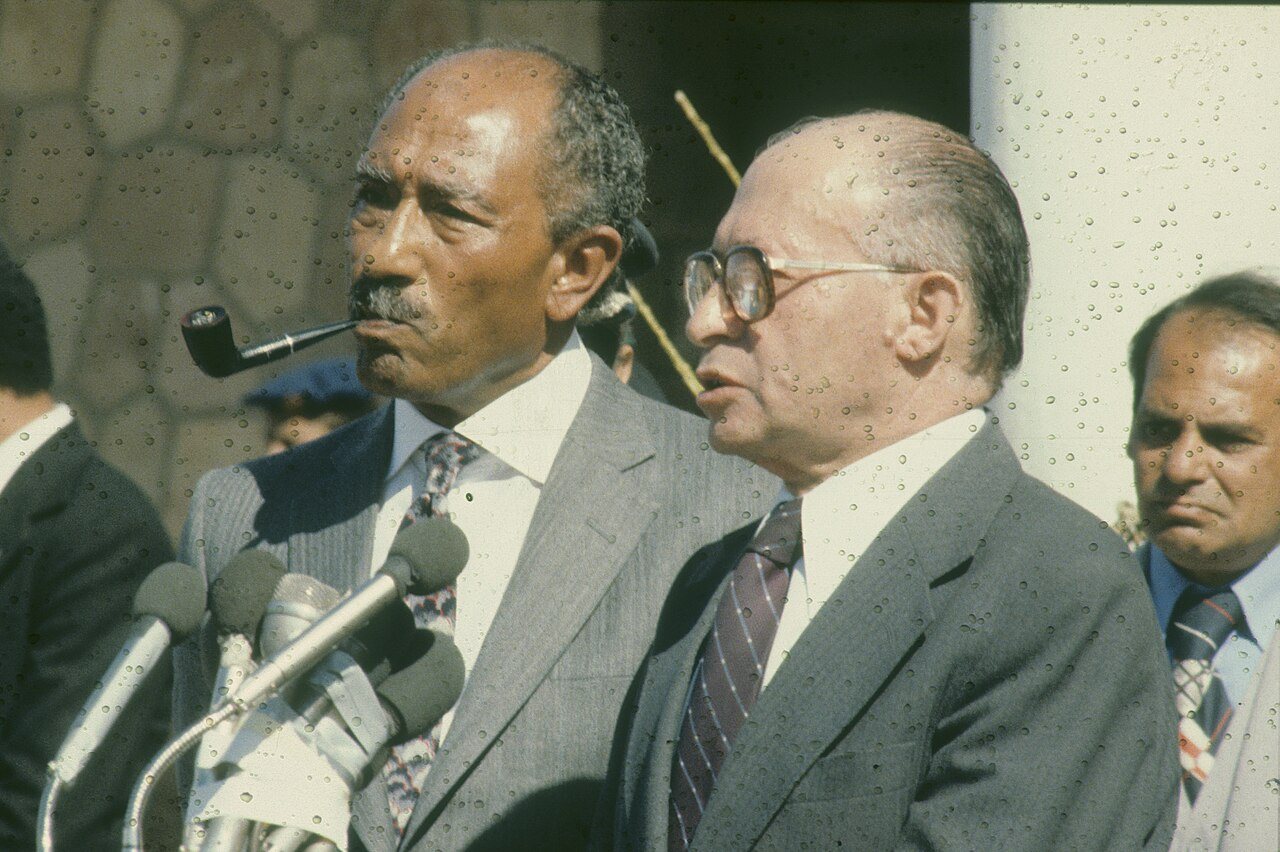
Five months later, on 19 November 1977, Anwar Sadat's plane landed at Ben Gurion airport and the Egyptian president addressed the Knesset. In September 1978 the two men spent thirteen days with Jimmy Carter at Camp David. The peace treaty was signed in Washington in March 1979, and Begin and Sadat shared the Nobel Peace Prize. The photograph at the top of this story shows them together at a press conference in that period, the one with the pipe and the one with the glasses, two men who in May 1977 had never been in the same room.
The lesson Israelis drew is that it took the hard-liner to make peace, because only he could sell it to his own side. That argument has been made about a great many leaders since, not always convincingly.
Tomorrow
The Likud is still there, led for most of the last three decades by Benjamin Netanyahu, who was a 27-year-old working in Boston when Begin won. The Alignment's successor, Labor, has spent most of the last twenty years as a small party, and the lineage of Yadin's reform movement, which fell apart within two years, is a warning that still gets quoted at every new centrist list.
Tomorrow's vote is for the same 120 seats, under the same proportional system, with the same ten o'clock close and the same televised sample count, and the first word out of the anchor's mouth will be studied very carefully. Whether anything happens that deserves the word, I would not want to guess the night before.
Enjoyed this story?Get a new one every day on social.