Israel Is Deadlocked Again. In 1984 the Answer Was Two Prime Ministers Taking Turns
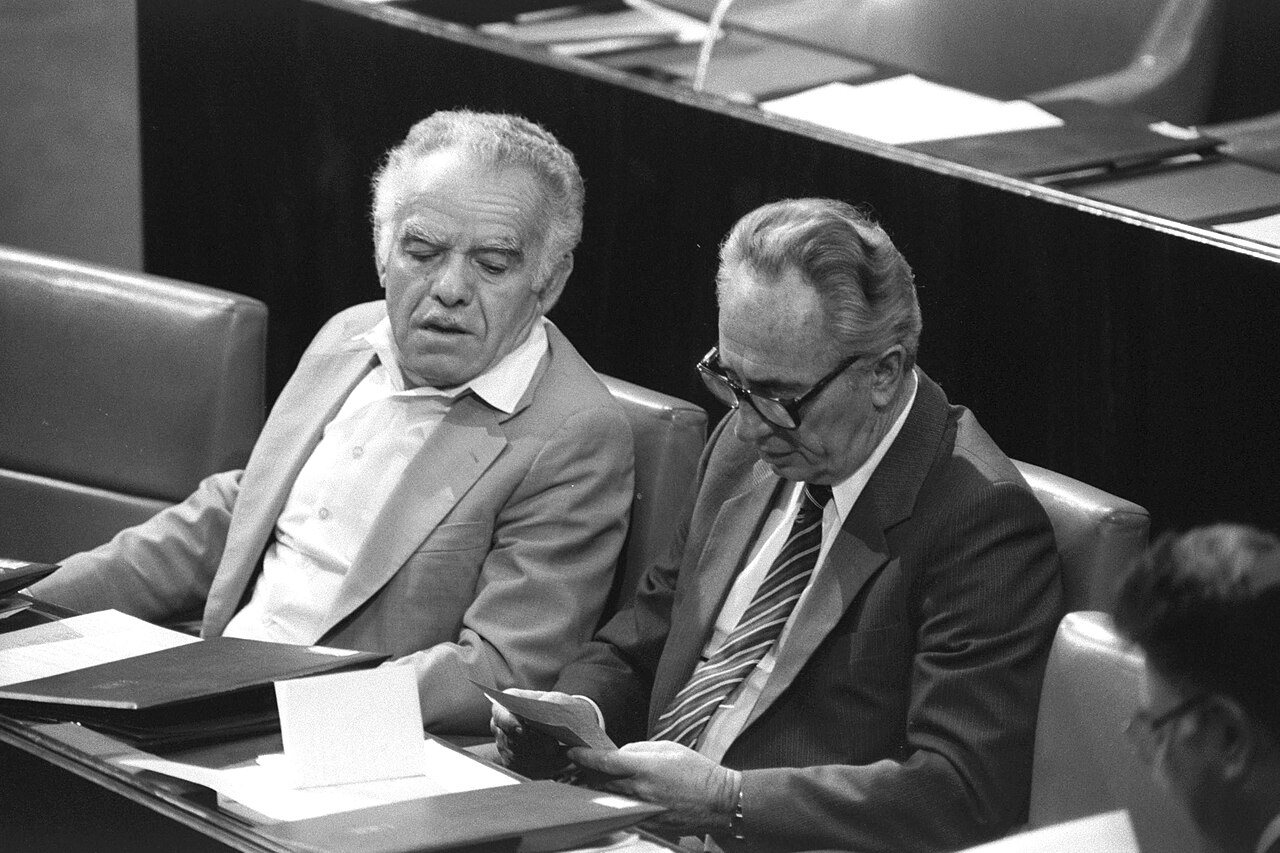
The exit polls that came in after ten o'clock last night gave Benjamin Netanyahu's Likud somewhere between 24 and 30 seats, Gadi Eisenkot's new Yashar party somewhere between 19 and 23, Naftali Bennett's list a dozen or so, and the two blocs anywhere from 50 to 60 apiece depending on which channel you were watching. What none of the four polls gave anybody was 61. Official results are expected on 4 November and President Isaac Herzog has until 11 November to hand somebody the task of forming a government. Israel has been here before, more than once, and the first time it happened the country tried something that had never been done: it elected two prime ministers and had them take turns.
July 1984: forty-four to forty-one
The election of 23 July 1984 was held in the middle of two disasters at once. The army had been in Lebanon for two years with no agreed way out, and inflation was running at an annual rate of around 400 per cent, so that shops repriced goods during the day and people spent their salaries the hour they received them. Menachem Begin had resigned the previous autumn and withdrawn into his flat; Yitzhak Shamir was leading Likud into its first election without Begin's name on it. The Labour Alignment, led by Shimon Peres, was expected to win comfortably.
It did not. The Alignment took 44 seats and Likud 41, and the remaining 35 were scattered across a dozen small parties, including, for the first time, one seat for Meir Kahane. When the small parties were sorted into the people who would sit with Peres and the people who would sit with Shamir, neither man reached 61. President Chaim Herzog gave Peres the first attempt at building a coalition in early August. After a month it was clear that there was no majority for either a Labour government or a Likud one, and that another election would probably produce the same result with a worse economy.
The deal
What Peres and Shamir signed on 13 September 1984, and the Knesset approved the next day by a large margin, was a national unity government with a rotation clause. Peres would be prime minister for the first 25 months, with Shamir as foreign minister and "acting prime minister". In October 1986 they would swap chairs. An inner cabinet of ten, five from each side, would decide the big questions, and each side had a veto in it. Yitzhak Rabin, Peres's lifelong rival inside Labour, took defence and kept it for the full four years, which turned out to matter.
The general assumption in Jerusalem was that the rotation was a fiction. Peres, people said, would find a reason to call an election before October 1986, or Shamir would walk out first. Journalists wrote "rotation" in inverted commas. Peres had a reputation, not entirely unfair, as a man who had never won an election outright and was not above manoeuvre.
Two years that did more than most
The odd thing about this government of mutual suspicion is that it did three large things, two of which nobody else had managed.
The first was Lebanon. In January 1985 the inner cabinet voted to pull the army back in stages, and by June most of it was out, leaving a strip along the border that Israel called the security zone and held for another fifteen years. Rabin ran the withdrawal; Likud ministers voted against it in cabinet and stayed in the government anyway, because the alternative was an election they might lose.
The second was the economy. On 1 July 1985 the government imposed what became known as the Economic Stabilization Plan: a sharp devaluation, a freeze on prices and wages agreed with the trade union federation and the employers, deep cuts to subsidies, and an end to the central bank printing money to cover the deficit. The finance minister who carried it was Yitzhak Modai of Likud; the prime minister who spent his political capital on it was Peres of Labour. Within a year inflation was under 20 per cent. In September 1985 the currency was replaced: one new shekel for a thousand old ones. The new shekel is still what Israelis spend.
The third was quieter at the time. Between November 1984 and January 1985, in an operation called Moses, roughly 8,000 Ethiopian Jews were flown out of refugee camps in Sudan to Israel, until the story leaked and Sudan shut the airlift down.
20 October 1986
Then the date came, and Peres resigned, and Shamir became prime minister, and Peres became foreign minister. It happened on schedule, without a crisis, to the surprise of nearly everyone who had written about it two years earlier. There had been talk inside Labour for months about ways to avoid it; Peres used none of them. (I have always thought that the decision to honour the deal is the most interesting thing Peres did in a very long career, and it is the thing he gets the least credit for.)
Shamir's two years were less eventful by design. He had the job he wanted and no intention of doing anything dramatic with it, and the first intifada, which began in December 1987, was handled by Rabin at defence.
Why nobody has managed it since
Israel voted again in November 1988 and got the same answer: Likud 40, Alignment 39. There was another unity government, but this time Shamir was prime minister for the full term and there was no rotation, because Likud had the extra seat and Peres had no leverage. That government lasted until March 1990, when Peres tried to bring it down and replace it with a narrow coalition of his own. The attempt collapsed within weeks, Rabin called it "the stinking manoeuvre", and the phrase has followed Peres's reputation around ever since. Shamir formed a right-wing government without him.
Two more rotations, two more failures
Rotation came back thirty years later, twice, and failed both times in different ways. In 2020 Netanyahu and Benny Gantz signed an agreement in which Netanyahu would serve first and Gantz would take over after eighteen months. The government fell over the budget in December 2020 and the handover never happened. In 2021 Naftali Bennett and Yair Lapid signed a similar deal with Bennett going first; that government fell in June 2022 and Lapid became prime minister only because the agreement said the dissolution itself would trigger the swap. In other words, the 1984 arrangement is still the only one where the two men shook hands, waited two years, and then actually changed seats.
One more thing, which may be a coincidence and may not. The president who sat the two sides down in 1984 was Chaim Herzog. The president who has to decide, by 11 November, which of this year's deadlocked leaders gets the first try is his son. Whether anyone in the room thinks 1984 is a model or a warning, I could not tell you. My own view is that it worked because the two men disliked each other and knew it, and planned accordingly, and that is a harder thing to replicate than a clause in a coalition agreement.