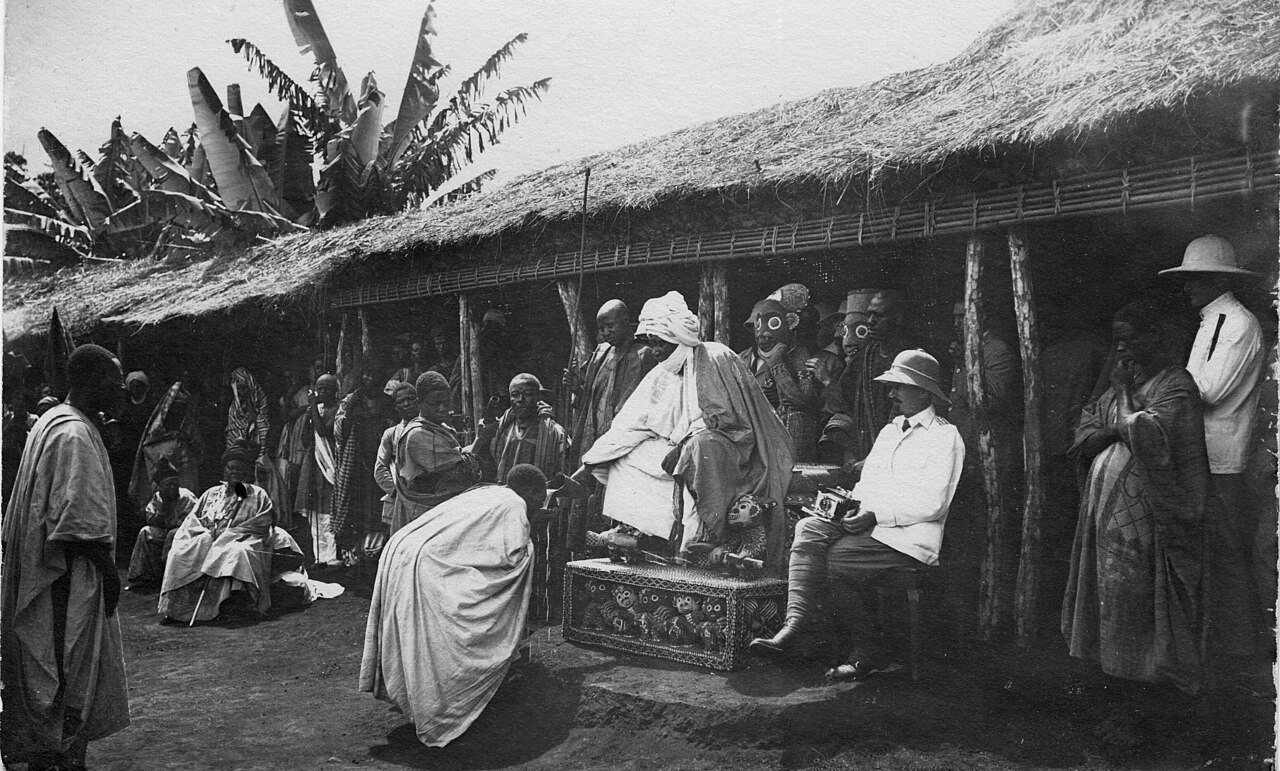
Photo: early 20th century, public domain; restoration by pjt56, CC BY-SA 3.0, via Wikimedia Commons
Some time around 1896, a young man in the town of Foumban, in the grassland hills of what is now western Cameroon, sat down with a slate and began drawing little pictures of the things around him: a man, a house, a hand, a river. He was the king of Bamum, which meant he had better things to do, and he had never been taught to read or write in any language, because there was nothing in his kingdom to read. He later said the idea had come to him in a dream. What he was trying to do was put the Bamum language on paper, and he kept at it for the next fourteen years.
A king who had seen writing but could not do it
Ibrahim Njoya was born in the 1860s or 1870s (the sources disagree, and he himself gave different ages) and became king of Bamum as a boy, after his father Nsangu was killed fighting the neighbouring Nso in the late 1880s. His mother Njapdunke ruled for him until he came of age in the 1890s, and his first years in power were spent dealing with a palace revolt that he only put down by calling in cavalry from the Fulani emirate at Banyo. The Fulani were Muslims, and they carried the Koran with them. Njoya had also seen the Hausa traders' Arabic notes and, soon afterwards, the paperwork of the Germans, whose protectorate of Kamerun reached Foumban in 1902.
So he knew that marks on paper could hold speech and carry it across distance. What he did not have was anyone to teach him how, and he seems not to have wanted to borrow a foreign script anyway. He wanted a Bamum one.
Seven versions, from 500 signs to 80
The first version was a set of pictograms, somewhere between 500 and 700 of them, each standing for a word. That is a hard way to write, and Njoya and the small circle of courtiers he set to work with him simplified it again and again. The signs got more abstract and fewer. By the versions of 1902 and 1907 they stood for syllables rather than words, and by 1910 the script that is now called A-ka-u-ku, after its first four characters, had come down to about 80 signs plus a few marks, enough to write anything in the language and small enough to learn in months. He had, without knowing it, retraced the history of writing from Egyptian hieroglyphs to the syllabary in about the time it takes to put a child through school.
He then used it. He opened schools in Foumban that taught the script alongside basic German, and he had his court write down the history of the kingdom and its customs, the royal genealogy, court cases, a book of traditional medicine, and birth records. He had surveyors walk the kingdom and drew a map of Bamum, with the script for its place names. He invented, on top of the script, a private language called Shümom with its own vocabulary, which only a few of his inner circle ever spoke. He designed a hand-powered mill for grinding corn. When the Germans wanted to impress him they sent him a cuirassier's uniform; he had already sent Kaiser Wilhelm II his great beaded throne, the Mandu Yenu, as a birthday present in 1908. It is in the Humboldt Forum in Berlin, and the one in Foumban is a copy.
A palace, a press and a religion
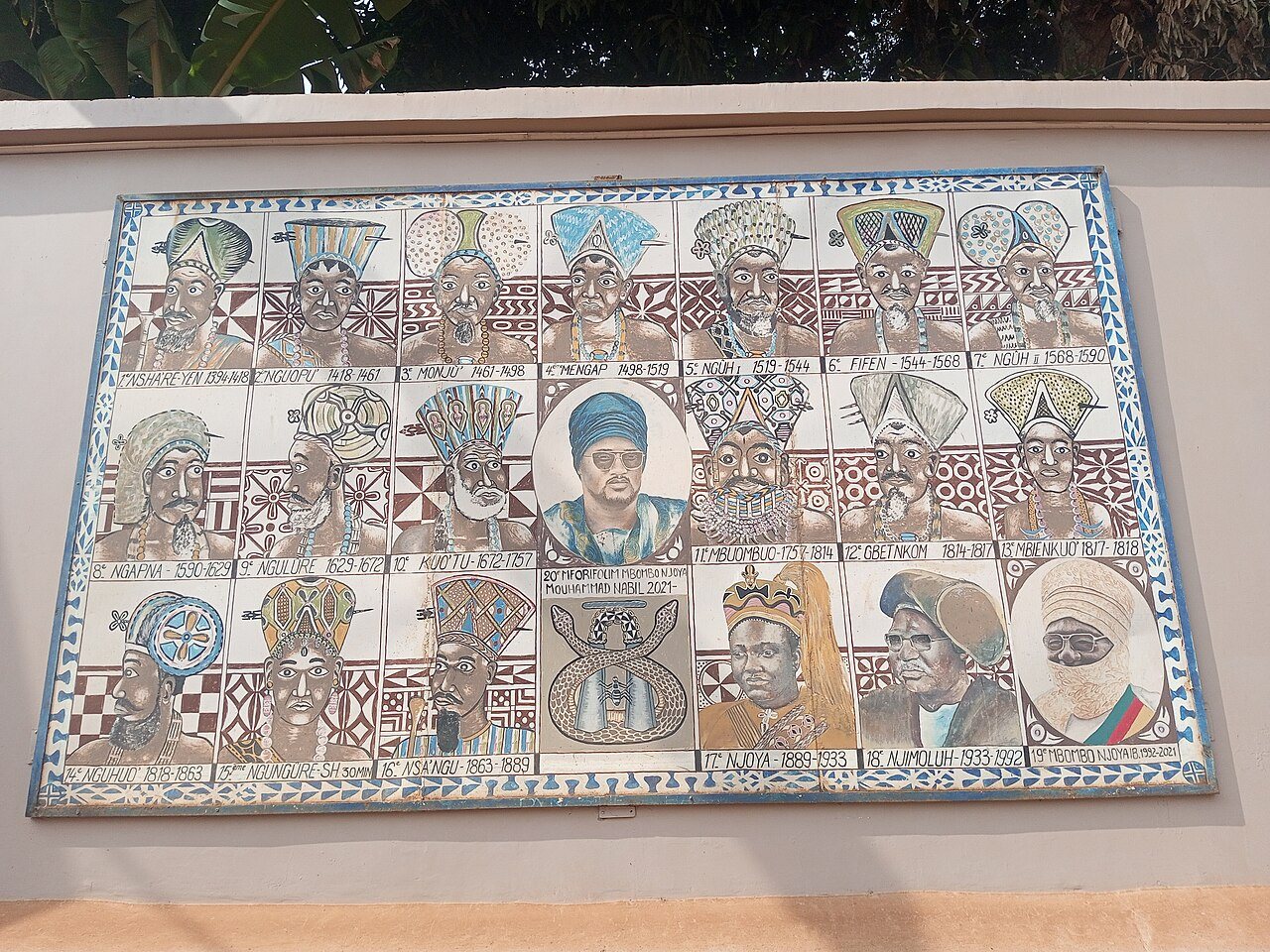
Painted panel at the Royal Museum of the Bamum in Foumban showing all twenty kings of Bamum, with Njoya in the bottom row. Photo: Devane Ndonnang Nanga Zenas, CC BY-SA 4.0, via Wikimedia Commons
When the old palace burned in 1913 Njoya designed a new one himself, a three-storey brick building with deep verandahs that owes something to the German governor's residence at Buea, which he had visited, and a good deal to Bamum building habits in raffia and clay. It is still the centre of Foumban. He also had printing type made for his script, so that the schools could have books, and this is the detail I keep coming back to: a king in the grasslands, a generation after his people's first contact with Europeans, running a press in an alphabet he had drawn himself.
His religion was his own as well. He had been a Muslim through the Fulani alliance, then a Christian for a while under the influence of a German missionary, and he ended up writing a holy book of his own that borrowed from both and from Bamum tradition, before settling on Islam for good in 1916. The missionaries were not amused by any of it. Most of what we know about his thinking comes from the books he had written in the script, which is of course the point of having one.
The French
Germany lost Kamerun in the First World War and France took the Bamum lands in 1916. The French administration did not want an African king with his own schools, his own writing and his own records, and over the 1920s it stripped him of one power after another, broke the kingdom into districts, closed the schools that taught the script, and, according to Bamum tradition, destroyed the press and the type. (I have not found a French document confirming the press; the Bamum are quite sure about it.) In 1931 the French removed him from Foumban altogether and sent him to the colonial capital at Yaoundé, where he died in 1933. His son Seidou Njimoluh Njoya was allowed to succeed him in a reduced role, and reigned until 1992.
Reading it again
The script nearly died with the schools. By the second half of the century only a handful of old men in Foumban could still read it, and a great many of the books written in it were sitting in the palace, unread and quietly rotting. A project to catalogue, conserve and teach the archive began in the 2000s with help from outside scholars, and the palace started running classes for schoolchildren in A-ka-u-ku again. The script was added to the Unicode standard in 2009, so it can be typed on a phone, which is more than Njoya's press ever managed.
Foumban opened a new Royal Museum of the Bamum on 13 April 2024, a building shaped around the kingdom's emblem of a two-headed serpent, a spider and a double gong, holding more than 10,000 objects. The present king, Nabil Mbombo Njoya, the twentieth of his line, opened it; his great-grandfather is painted in the bottom row of the panel outside, seventeenth of twenty. The throne Njoya gave the Kaiser is still in Berlin.
Enjoyed this story?Get a new one every day on social.