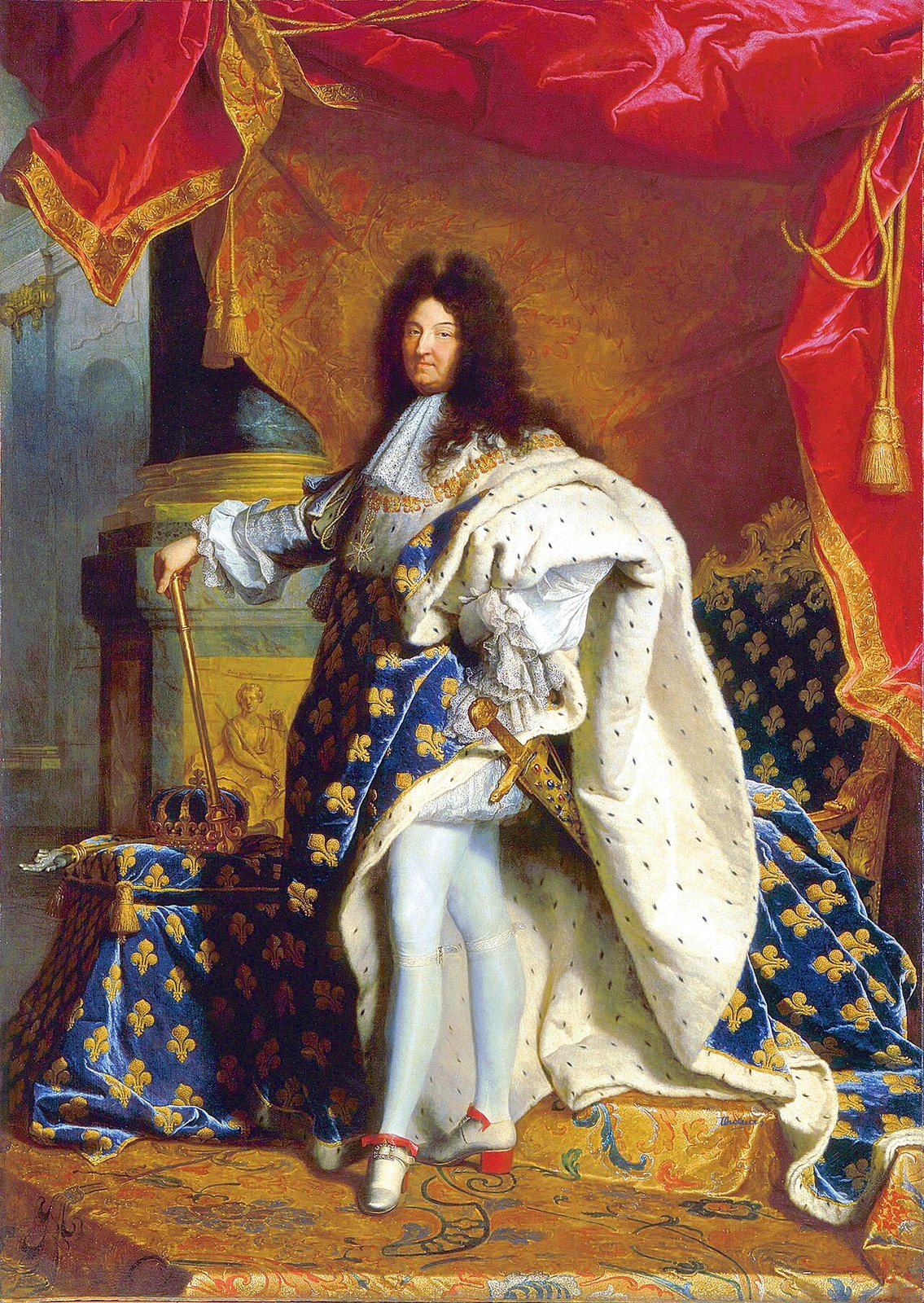
Painting: Hyacinthe Rigaud, 1701, public domain; photo CC BY-SA 4.0, via Wikimedia Commons
"The best and greatest part of our subjects of the so-called Reformed Religion have embraced the Catholic faith," the document begins, "and since by this means the execution of the Edict of Nantes remains useless, we have judged that we could do nothing better than to revoke it entirely." Louis XIV signed it at Fontainebleau on 18 October 1685, 341 years ago this month, and it was registered in Paris four days later. The claim in the first sentence was false, and most people at court knew it. The decision that followed from it was one of the worst a French king ever made, and I say that as someone who thinks Louis is generally underrated.
What his grandfather had promised
The Edict of Nantes was Henry IV's work. In 1598, after nearly forty years of wars between Catholics and Protestants that had cost France something like a tenth of its population, the king who had changed religion himself granted the Protestants (the Huguenots, as their enemies called them) a limited toleration: freedom of conscience, the right to worship in specified towns, access to public office, their own courts in some places, and for a while a set of fortified towns to guarantee all of it. It was not equality so much as a truce written as law, and it held, more or less, for eighty years.
Louis XIV inherited a kingdom in which perhaps 800,000 Protestants, a bit under five percent of the population, lived under those terms. They were disproportionately urban, literate and prosperous, and they ran a large share of the textile trade, the paper mills, the printing houses, the banks and the Atlantic ports. The king found them an irritation. One king, one law, one faith was the formula of the age, and he had a kingdom with two faiths in it.
Dragoons in the parlour
The campaign to shrink that number began long before 1685 and got steadily nastier. Through the 1660s and 1670s the crown chipped away at the edict's provisions, closing churches on technicalities, barring Protestants from guilds and professions, and offering cash to converts. Then in 1681 the intendant of Poitou hit on a cheaper method. Soldiers had to be housed somewhere, so he billeted dragoons in Protestant homes, with instructions to behave as badly as they liked until the family converted. The dragonnades, as they came to be called, spread through the south and west in 1685 and produced conversions by the tens of thousands, most of them worth exactly what you would expect.
That was the "best and greatest part" of the preamble. The king, who had been told the Protestants were nearly all gone, concluded that the edict protecting them could go too. The thinking at Versailles seems to have been that revocation would finish the job in a few months. Whether Madame de Maintenon pushed him into it, as the old story has it, is doubtful; the evidence is thin, and Louis did not need much pushing.
The terms
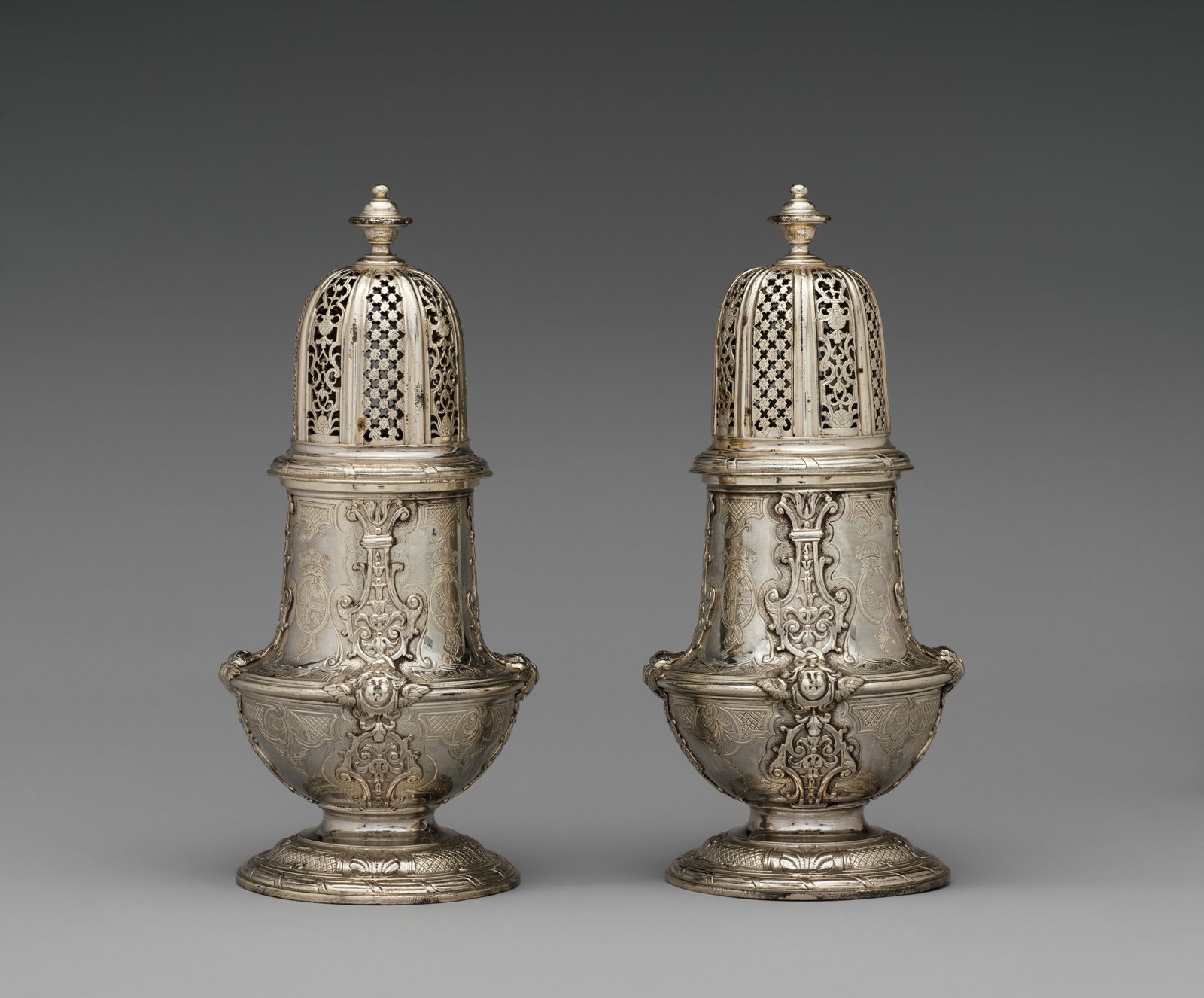
Pair of casters by the Huguenot silversmith Paul de Lamerie, London, 1733. The Metropolitan Museum of Art, CC0
The Edict of Fontainebleau ordered every remaining Protestant church in the kingdom demolished. Protestant schools were closed. Pastors who would not convert were given a fortnight to leave the country. Children were to be baptised and raised as Catholics. And then came the clause that gave the whole thing its peculiar cruelty: the laity were forbidden to leave. A man caught trying to emigrate went to the galleys; a woman lost her property. The king wanted his Protestants converted, not gone, and the galleys were meant to make sure of it.
They did not. Historians argue over the numbers, as they always do, and the estimates run from about 200,000 at the low end to figures several times higher in older books; the careful modern work tends to settle around 200,000 over the following twenty years, which is roughly a quarter of the Protestant population and a very large number of people to smuggle out of a kingdom that was watching its roads and ports. They went disguised as pedlars and pilgrims, hidden in wine barrels and under cargo, paying sailors and border guides, and leaving most of what they owned behind.
Where they went, and what they took
The Elector of Brandenburg issued his own edict at Potsdam before October was out, inviting the refugees to his thinly populated territories with tax exemptions, free land and the right to worship in French. Berlin, a modest town of a few tens of thousands, took in so many that by around 1700 a fifth or so of its inhabitants were French-speaking, and the French Cathedral still stands on the Gendarmenmarkt. The Dutch Republic took the largest share, possibly 50,000 or more, and gained bankers, publishers and the designer Daniel Marot, who did much of the decorating for William of Orange. England took perhaps 40,000 to 50,000. The silk weavers settled in Spitalfields, the silversmiths in Soho, and a Huguenot child of that migration, Paul de Lamerie, became the finest goldsmith London had in the eighteenth century. Around 200 Huguenots reached the Dutch colony at the Cape of Good Hope in 1688 and 1689 and planted vines in a valley the Dutch called Franschhoek, the French corner, which is still the name on the signs.
The military cost was the one Louis felt soonest. Friedrich von Schomberg, a marshal of France and a Protestant, left and took command of William of Orange's army; he was killed at the Boyne in 1690 fighting for the English crown against the French-backed James II. Huguenot officers turned up in every army that fought France over the next twenty-five years, and Huguenot sailors in every navy.
Vauban tells the king he is wrong
Sébastien Le Prestre de Vauban, the engineer who built the ring of fortresses that still marks France's borders, wrote a memorandum in 1689 asking the king to recall the Huguenots. He put the loss at 80,000 to 100,000 people, 30 million livres in cash, 9,000 sailors, 12,000 soldiers and 600 officers, and the collapse of whole trades in whole towns. He was almost certainly too low on the people and right about everything else. Louis read it and did nothing. The revocation stayed in force for 102 years. In the Cévennes the Protestant peasants who had been left behind rose in 1702 and tied down royal troops for two years, in the middle of a European war, which was not what the edict had been meant to achieve either.
A hundred years, and then three hundred
Louis XVI signed the Edict of Versailles in November 1787, two years before the Revolution took the question out of his hands, restoring civil status to Protestants and letting them marry, inherit and register births without a priest. Full religious liberty came with the Revolution. The French state did not say sorry until 11 October 1985, when François Mitterrand marked the 300th anniversary with a public tribute to the Huguenots and their descendants around the world. That was 300 years, less a week, after Louis had signed at Fontainebleau.
Enjoyed this story?Get a new one every day on social.