William Hogarth, Cunicularii, or the Wise Men of Godliman in Consultation (1726), The Metropolitan Museum of Art, CC0
On the evening of 27 September 1726, in a cottage in Godalming, Surrey, a local surgeon and man-midwife named John Howard was called to attend Mary Toft, who was about 25, could not read, was married to a journeyman cloth worker, and had miscarried a few weeks earlier. What Howard delivered that night, by his own later account, was not a child but pieces of animal: the guts of something small, then over the following days what he took to be parts of a cat and the head of a rabbit. By November he was delivering whole rabbits, dead and skinned or in pieces, one at a time, and he had stopped treating it as a medical emergency and started treating it as news.
Letters to the court
Howard wrote to the great men of London medicine and to the royal household. He had delivered nine rabbits already, he said, and kept them in spirits in jars; anyone who doubted him could come and watch the next one. Several people did. The first to arrive, on 15 November, were Nathaniel St André, a Swiss-born surgeon attached to the household of King George I, and Samuel Molyneux, secretary to the Prince of Wales and a serious amateur astronomer. They reached Guildford, where Howard had moved his patient to be nearer the London road, in time to see her go into labour, and St André delivered what he recorded as the fifteenth rabbit, or part of one, himself.
He noted that the lungs floated in water, which meant the animal had breathed air, and that the dung in its gut contained straw and corn, which meant it had eaten, and concluded nonetheless that the rabbits had formed inside the woman. His explanation was Toft's own: that in the spring, weeding a field, she had been startled by a rabbit, chased it, failed to catch it, and had dreamed of rabbits and longed to eat them ever since. Educated medicine in 1726 still largely accepted that a pregnant woman's cravings and frights could shape what she carried. St André went back to London and within three weeks had a pamphlet in the shops: A Short Narrative of an Extraordinary Delivery of Rabbets.
The second opinion
The King sent someone else. Cyriacus Ahlers, a German surgeon in the royal service, went to Guildford on 20 November, watched a delivery, and came away a sceptic. He noticed that Toft kept her knees pressed together and seemed to be working at something, that Howard would not let him examine her closely, and that the rabbit he was given to take back to London had been cut up with a knife. He reported this to the King. St André, who had staked his reputation, said Ahlers had not understood what he was seeing.
A third man was sent, Sir Richard Manningham, the most fashionable man-midwife in London, and on 29 November Toft was brought up to town and installed in Lacy's Bagnio, a bath-house in Leicester Fields, where the profession could observe her around the clock. The rabbits stopped.
A porter and a threat
On 4 December a porter at the bagnio, Thomas Howard (no relation to the surgeon), was caught smuggling a rabbit into Toft's room. He said Toft's sister-in-law had asked him to buy the smallest one he could find. A Godalming man came forward to say he had sold the family rabbits. Toft held out for three more days, until Manningham told her that if she did not explain herself he would have to operate to see how the animals were getting in; the operation he described would very likely have killed her. On 7 December she confessed.
The method was roughly what Ahlers had suspected: the pieces had been inserted by hand after the miscarriage and produced in front of witnesses with a good deal of acting. Who had the idea first is not settled: Toft blamed a travelling woman who had promised she would never want for anything again; her mother-in-law and Howard the surgeon were both suspected, and Howard was briefly charged. The motive was ordinary: people were already paying to see her, and a medical marvel might reasonably expect a pension from the King.
What it cost everyone
Toft was committed to Bridewell as a "notorious and vile cheat", where visitors paid to look at her, and was released without trial the following April. She went home to Godalming, had an ordinary child the next year, was in trouble once more in 1740 for receiving stolen goods, and died in 1763, when the parish clerk could not resist adding a note to the burial register.
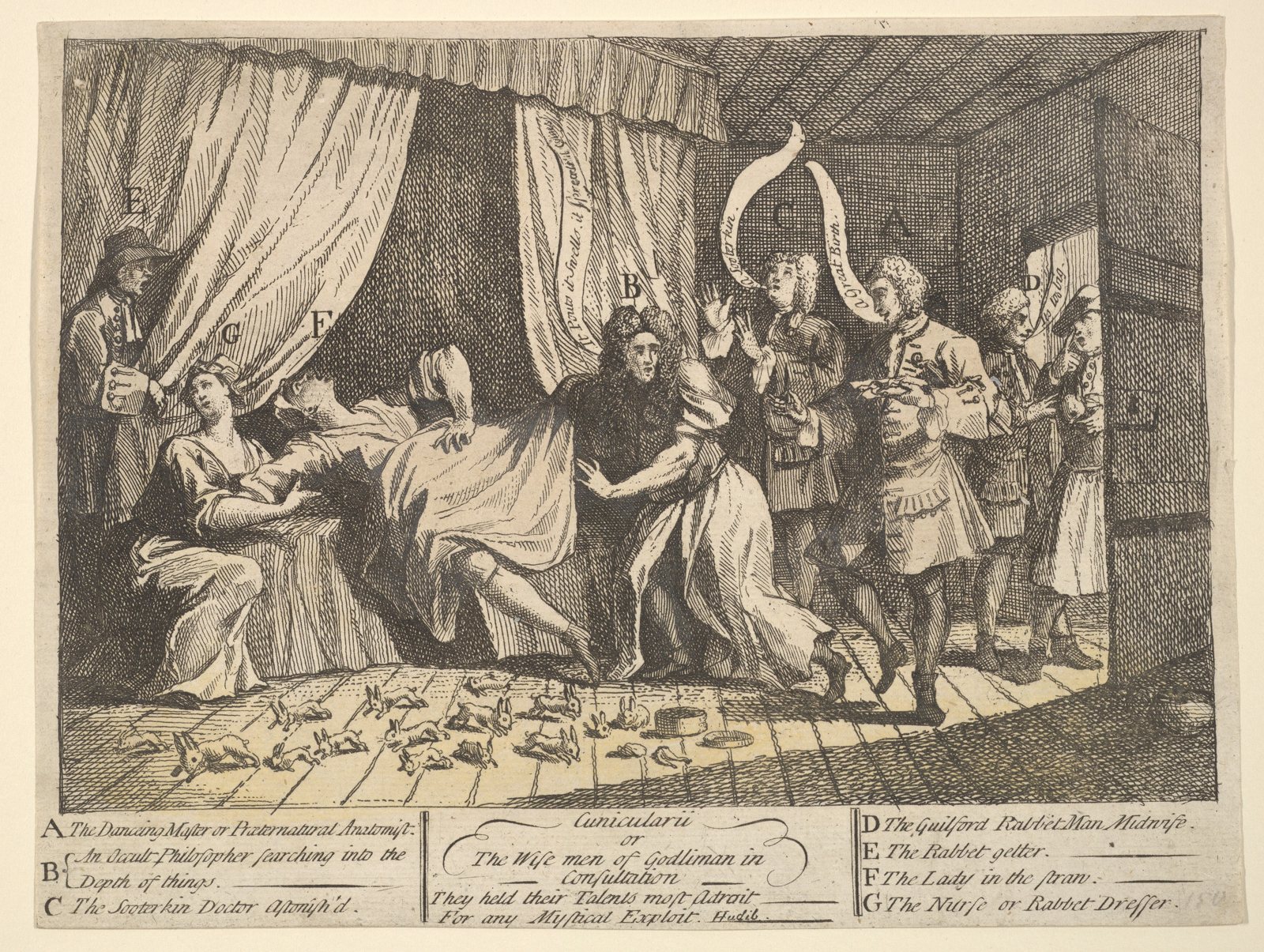
The doctors fared worse. St André lost his place at court and never practised with any success again; he lived into his nineties and, it was said, would not have rabbit served at his table. Manningham, who had at least extracted the confession, was laughed at for having gone to Guildford at all. The affair produced a flood of pamphlets, songs and prints, the best known being William Hogarth's Cunicularii, or The Wise Men of Godliman in Consultation, in which the learned gentlemen stand around the bed while rabbits scamper across the floor. Molyneux, the astronomer, died suddenly in 1728; St André had attended him, and went on to marry his widow, which set off whispers that were never substantiated.
One thing has never been cleared up to my satisfaction. Toft's confession, taken down over several sessions, changes its story more than once about who put her up to it and when. Whether an illiterate woman from Godalming planned the most successful medical hoax of her century, or was pushed through it by people who stood to gain more than she did, is a question the Georgians did not much care to answer, and the documents still do not.
Enjoyed this story?Get a new one every day on social.