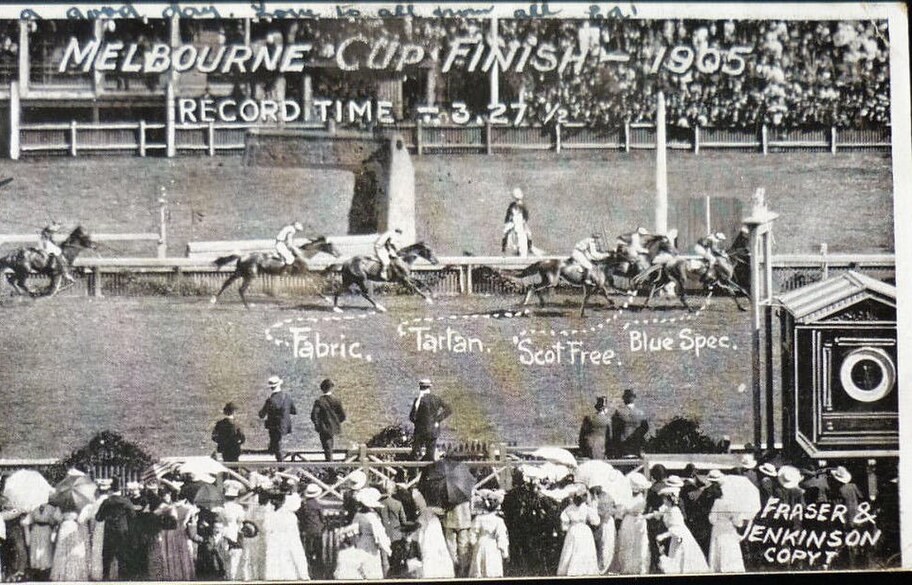
Postcard: Fraser & Jenkinson, 1905, public domain, via Wikimedia Commons
On Tuesday afternoon the state of Victoria will stop work for about three and a half minutes. Melbourne Cup Day has been a public holiday in the city since the 1870s, and it is the one day of the year on which a good share of Australians who never otherwise bet on anything put money on a horse. The 2025 race drew 84,374 people to Flemington and was run for A$10 million. Half Yours won it, with Jamie Melham in the saddle, only the second woman to ride a Cup winner.
The first one was a Thursday in November 1861, and if you had been there you would not have guessed what it would turn into.
Seventeen horses and a man called de Mestre
Flemington racecourse had been laid out beside the Maribyrnong River in 1840, five years after Melbourne itself was founded, and by the early 1860s the gold rush had made the colony rich and restless enough to want a proper race. The Victoria Turf Club put up a prize of 710 gold sovereigns and a gold watch for a two-mile handicap on 7 November 1861. Seventeen horses started. About 4,000 people came, which was a respectable crowd for a town of its size, though it was reported to be smaller than hoped, partly because the news had just reached Melbourne that the explorers Burke and Wills were dead.
The favourite was a Victorian horse called Mormon. The winner was Archer, a big bay stallion from New South Wales, trained by Etienne de Mestre and ridden by John Cutts, who came home six lengths clear. It was a rough race by any standard: one horse bolted before the start, two fell during it, and at least one of those did not get up. Victorian pride was not helped by the fact that an interstate horse had taken the colony's money, and it was not helped the following year either, when Archer came back and won again.
The horse that did not walk to Melbourne
For a very long time, and in a good many books, Archer was said to have walked to Flemington from de Mestre's property at Terara, near Nowra on the New South Wales south coast, a journey of more than 800 kilometres, arriving fit enough to win. It is a lovely story and it even made it into a film in the 1980s.
It is not what happened. The shipping columns of the Sydney newspapers of October 1861 record de Mestre boarding a steamer for Melbourne with three horses, Archer among them. He went by sea, like everybody else with any sense. The walking legend seems to have grown up afterwards, as these things do, from the plain fact that a bush horse from New South Wales had beaten the best of Victoria. (I notice nobody ever claims Mormon walked anywhere.)
Archer's third Cup was the one he never ran. In 1863 de Mestre's telegram accepting the handicap weight arrived in Melbourne after the deadline, because the day it was sent fell on a public holiday in Victoria and the telegraph office there was closed. The Victorian club refused the entry. The New South Wales owners boycotted the race in protest, and the 1863 Cup was run with seven starters, the smallest field in its history. Interstate feeling was at least as strong as anything a modern state-of-origin crowd can manage.
How Thursday became Tuesday and Tuesday became a holiday
The Victoria Racing Club was formed in 1864 and took over the race. The move to the first Tuesday in November came in 1875. By 1873 the Victorian government gazette was already listing Cup Day as a holiday for banks and the public service, and by 1877 it was a gazetted public holiday for metropolitan Melbourne, where it has stayed ever since. The rest of the country does not get the day off, which does not stop the rest of the country from stopping. The phrase "the race that stops a nation" is of uncertain origin and, like most slogans, slightly overstated, but when a betting agency claimed in 2000 that four in five adult Australians had bet on that year's Cup, nobody found the number hard to believe.
The race has produced the stories a 165-year-old event ought to. Phar Lap won it in 1930 at odds of 8 to 11, the only favourite ever to win at odds-on, three days after someone fired a shotgun at him in the street; his trainer hid him at Geelong and brought him to the course an hour before the start. Makybe Diva won three in a row from 2003 to 2005, which nobody else has done. Michelle Payne became the first woman to ride a winner in 2015 and told the people who had said she could not do it, on live television, that they could get stuffed. The distance was cut from two miles to 3,200 metres in 1972 when Australia went metric, which took 19 metres off the race.
Tuesday at Flemington
The 166th running is on 3 November, over 3,200 metres on the grass at Flemington, with a car maker's name in front of it. The field is capped at 24 horses, many of them bred or trained abroad, which would have surprised the gentlemen of the Victoria Turf Club, who thought a horse from New South Wales was foreign enough. The sovereigns and the watch are gone; the trophy is a three-handled gold cup. Archer's share of the 1861 purse would buy you a reasonable seat in the stands next week, and a hat.
Enjoyed this story?Get a new one every day on social.