"If you don't pay, or if you interfere in any way, you will lose your plane."
That sentence is from a typed letter in one of the odder crimes in aviation, and I went back to it this week after at least seven flights and a cruise ship in Europe received bomb threats. A LOT flight from Heathrow with 181 people aboard put down at Warsaw-Modlin. A Ryanair flight from Manchester landed in Murcia. A plane from Israel was searched in Sofia after a threat arrived by email. No devices were found, and as I write nobody has said who sent the threats. Airlines have been getting calls like these for a long time, and one wave of them can be dated to a single evening of American television.
Rod Serling's bad idea
On 13 December 1966 NBC showed The Doomsday Flight, a TV movie written by Rod Serling of The Twilight Zone. A bitter former airline mechanic hides a bomb on a jet bound for New York. It has an altitude switch and will go off if the plane descends below 4,000 feet, so the crew must find somewhere high enough to land. They end up in Denver.
It drew the second-biggest ratings of the season, and the phones started before it finished. An airline got a threat during the premiere. Over the following days TWA, Eastern, American, Pan Am and Northwest all had similar calls, eight in six days by one count. Serling told reporters, "I wish to Christ I had written a stagecoach drama starring John Wayne instead."
The film stayed in syndication anyway. In the summer of 1971 the FAA wrote to 500 television stations asking them to drop it, warning it could have "a highly emotional impact on some unstable individual." Twenty agreed. By then the individual had already seen it.
A man in Townsville goes to the pictures
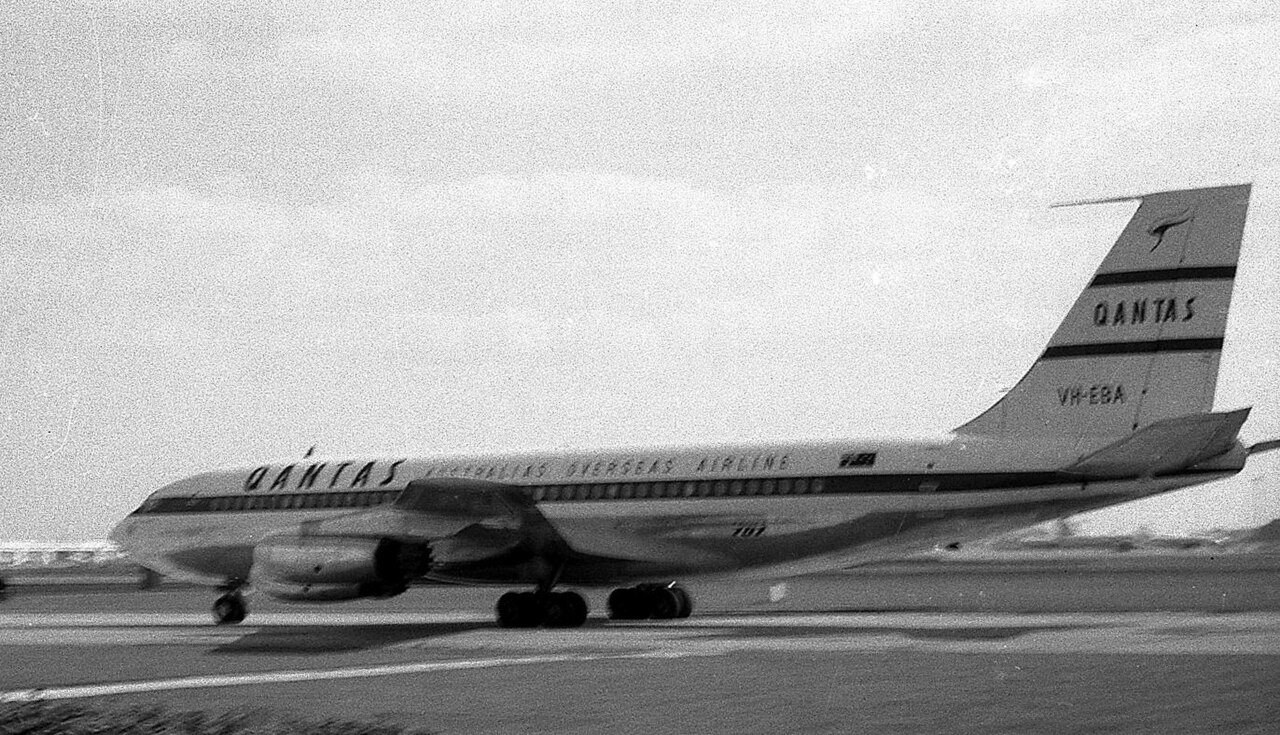
Peter Macari was an English migrant in Australia who watched The Doomsday Flight in Townsville in March 1971. He seems to have treated it as a set of instructions. In April a man in Mount Isa named Francis Sorohan stole gelignite and a dozen detonators for him. On 11 May he bought an altimeter and offered Raymond Poynting $50,000 to help, and Poynting typed three threatening letters. Macari looked at a Pan Am jet and rejected it. He wanted Qantas Flight 755 from Sydney to Hong Kong, because it was the only flight that would stay in the air long enough for him to collect.
What he added to the movie was the clever part, and I find it a bit chilling. He built a real device and left it where it would be found.
Twenty thousand feet
Around midday on 26 May 1971, with the Boeing 707 airborne and 128 people on board, Macari rang the Department of Civil Aviation. He gave his name as Mr Brown, said there was a bomb on Flight 755 that would explode if the plane dropped below 20,000 feet, and said an identical one was in locker 84 at Sydney airport. It was. Police defused it, took out the explosives and fitted a light bulb, then sent it up in a test aircraft. On the way back down, the bulb lit at about 5,000 feet.
Captain William Selwyn learned about all this over Dalby, Queensland, at around 1:30. He was told to hold 35,000 feet. "We did not know what altitude it was set to go off at," he said later. His crew searched the aircraft and found nothing, and the passengers were told there was a technical problem. An RAAF Phantom came up to have a look. For hours the jet circled, burning fuel, which of course was the whole design: a plane cannot circle forever.
Qantas paid. At about 5:45 Captain R. J. Ritchie, one of the airline's general managers, stood at Chifley Square in the middle of Sydney and passed two blue suitcases holding $500,000 in used $20 notes through the window of a yellow Volkswagen Kombi. Police were nearby and were reportedly never given the signal. Some time after six, Mr Brown called back to say there was no bomb on the plane. It landed around 6:45 with everybody safe.
The E-Type
Macari might have got clean away if he had chosen a quieter partner. Poynting took to buying expensive cars, among them a new E-Type Jaguar, and a service station attendant mentioned the free-spending customer to police. Detectives watched him, he confessed, and both men were arrested on 4 August 1971. Police found $138,240 behind a bricked-up fireplace in Annandale. Another $137,000 turned up under the floorboards of a house in Balmain in 1973.
Macari said a third man called Ken had been the brains and had taken most of the money. The judge's reply was short: "this statement I reject." Macari got 15 years, Poynting seven. Macari was paroled after nine and deported to England in 1980, and Australia sent him home on Qantas, which I assume was somebody's idea of a joke, though I have not found anyone who will admit to it.
Only about half the ransom was ever recovered. I have read the theory that the rest is sitting in safes off Bondi Beach, and I have never seen a good source for it.
The second Mr Brown
One more thing, because it is too good to leave out. On 4 July 1997 a man using the name Mr Brown threatened Qantas Flight 27, again Sydney to Hong Kong, and asked for $505,000. Police judged it a hoax. Qantas handed over bags of phone books, and the man was arrested when he collected them. Flight 27 landed in Hong Kong at 8:15 that evening.
Enjoyed this story?Get a new one every day on social.