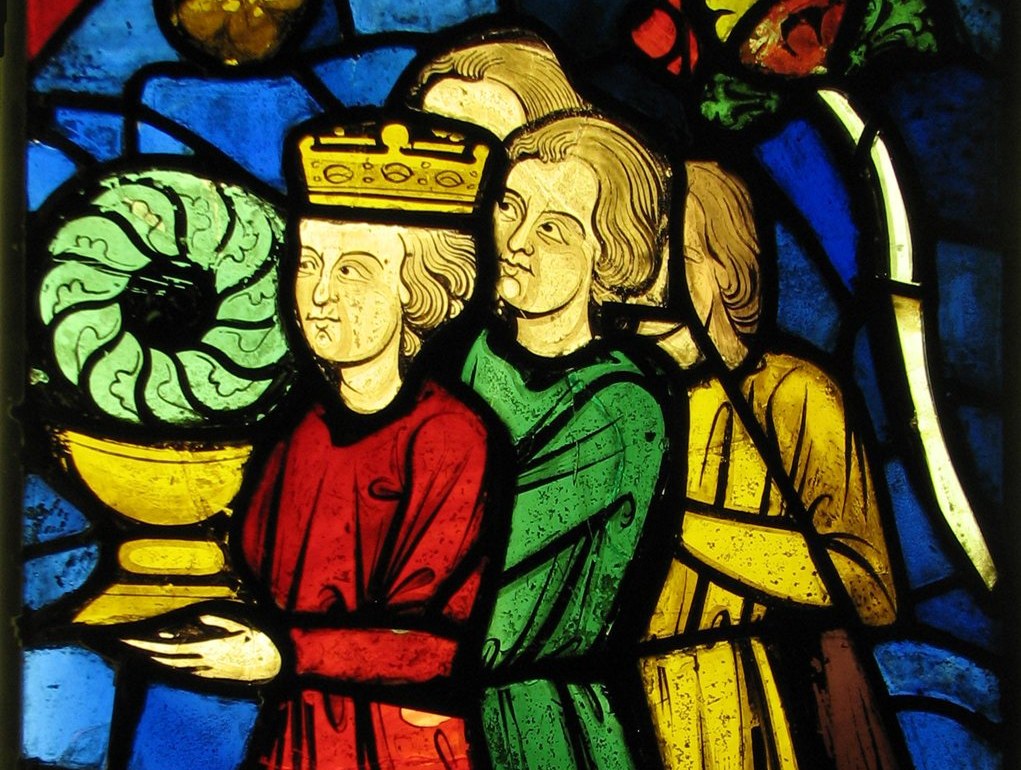
Stained glass: King Louis IX Carrying the Crown of Thorns, Paris, ca. 1245 to 1248, The Metropolitan Museum of Art, CC0
On Shrove Tuesday 1229, which fell at the end of February, a party of students from the University of Paris walked out to the faubourg Saint-Marcel, a village of tanners and tavern-keepers just beyond the city wall on the south bank, to drink the last of the carnival wine before Lent. The wine was good and sweet, says the chronicler Matthew Paris, and when the bill came the students thought it was wrong. The argument became a fight, the tavern-keeper shouted for his neighbours, and the students were beaten and thrown into the street. On Ash Wednesday they came back with clubs, broke the tavern open, beat the owner, smashed the wine jars and worked their way along the neighbouring shops. Paris had seen plenty of student brawls, but this one emptied the university for two years.
I was reading about it this weekend because French students are in the streets again: the interior ministry counted 410,000 marchers on Saturday, 110,000 of them in Paris, in a movement that began last month over unfilled teaching posts at one lycée. Nobody is going to leave Paris for two years over it. But the idea that a university can simply stop, and that stopping is a weapon, was worked out in that same city nearly eight hundred years ago, over a bar tab.
A city inside the city
Paris in 1229 had a few thousand students (estimates run from about 2,500 to 5,000; nobody counted), most of them between fourteen and twenty-five, packed into the streets below the hill of Sainte-Geneviève, where they heard lectures in Latin. That is why it is still the Latin Quarter. They were clerics in the legal sense, tonsured and answerable to the bishop's courts rather than the king's, which put them beyond the reach of the royal provost. Parisians resented that more than anything. A student who stabbed a townsman faced a church court that would not hang him; a townsman who struck a student risked excommunication.
The arrangement went back to 1200, after a worse riot in which the provost had led armed townsmen against a hostel of German students and killed several. King Philip Augustus, who needed the university more than he needed the provost, jailed the provost and gave the scholars a charter putting them under the Church. So in 1229 the students had the law on their side, which is one reason they felt free to go back with clubs.
The queen's sergeants
The king in 1229 was Louis IX, aged fourteen. The kingdom was run by his mother, Blanche of Castile, who had spent three years putting down rebellious barons and had no patience left for students. The complaint reached her, the bishop and the papal legate seem to have agreed that the rioters should be punished, and Blanche told the provost to deal with it. His sergeants went into the faubourg, found students, and killed several of them. The chroniclers are fairly sure these were not the ones who had wrecked the tavern. One account says the men they caught were simply the first scholars they met, out for a walk, and that some of the bodies went into the Seine. (Matthew Paris was writing at St Albans, a long way off and with a standing interest in making the French look bad, so the details deserve some salt. The main facts are not disputed.)
The masters went to the queen and the legate and asked for justice: punish the guilty, not the university. They were refused, so at the end of March they did the one thing a medieval university could do that a city could not, and stopped teaching. The University of Paris owned no buildings worth the name; it rented rooms and borrowed churches. The university was its masters and students, and when they left there was nothing in Paris to point at.
An invitation from the king of England
They scattered to Orléans, Angers and Reims, and a good many went home. Henry III of England saw his chance. In July 1229 he wrote to the masters and scholars of Paris, deploring their treatment, inviting them to England and promising them liberties and whatever lodgings they needed. Enough of them accepted that Oxford's theology school is usually said to have grown up on the strength of the Paris refugees.
Toulouse wanted them too. Its university had been founded that spring under the treaty that ended the Albigensian crusade, and its masters sent out a recruiting circular, written by the grammarian John of Garland, promising the Paris scholars cheap wine, good bread, friendly townsmen, and lectures on the natural philosophy of Aristotle, "which are forbidden at Paris." That last line was true; Paris had banned Aristotle's books on nature in 1210, and Toulouse was advertising the ban as a selling point.
Who stayed behind
The Dominican friars had a house in Paris and no intention of leaving it, and in 1229, with the other theologians gone, one of them, Roland of Cremona, was given a chair of theology, the first a friar had ever held there. By 1231 the Dominicans had two of the twelve chairs. The secular masters never forgave it, and the quarrel over whether friars belonged in a university at all ran for thirty years and pulled in Thomas Aquinas. The empty lecture halls of 1229 changed who taught in them for the rest of the century.
The pope's letter
Pope Gregory IX had studied at Paris himself and did not want the university scattered; it was the Church's best school of theology. After two years of negotiation he issued a bull on 13 April 1231, known from its first words as Parens scientiarum, the mother of sciences, which historians have been calling the university's Magna Carta since the nineteenth century. It gave the masters the right to make their own statutes, to set lecture hours and dress and the rules for funerals, and, the clause that mattered, to suspend lectures whenever a master or student was killed or maimed and no satisfaction came within fifteen days. It also told the bishop's chancellor to stop locking students in his private prison, which tells you something about the chancellor.
The masters and students came back in 1231, and the queen and the young king confirmed the privileges of 1200. The tactic kept working: Paris walked out again in 1253 and 1255, and other universities copied it.
What became of it
The University of Paris lasted, in one form or another, until 1970, when the government broke it into thirteen universities after the occupation of the Sorbonne in May 1968 (the de Gaulle side of that story ran here on Thursday).
The students marching this weekend are not asking for anything a pope could give them: 250,000 more university places and another 200 euros a month in grants, according to the plan their unions published. The lycée where it started was short of teachers; a ministry figure quoted in the coverage says French state schools lost 15.4 million teaching hours last year to absences nobody covered, which is a grievance the bull of 1231 did not anticipate.
Nobody recorded whether the wine bill was ever paid.
Enjoyed this story?Get a new one every day on social.