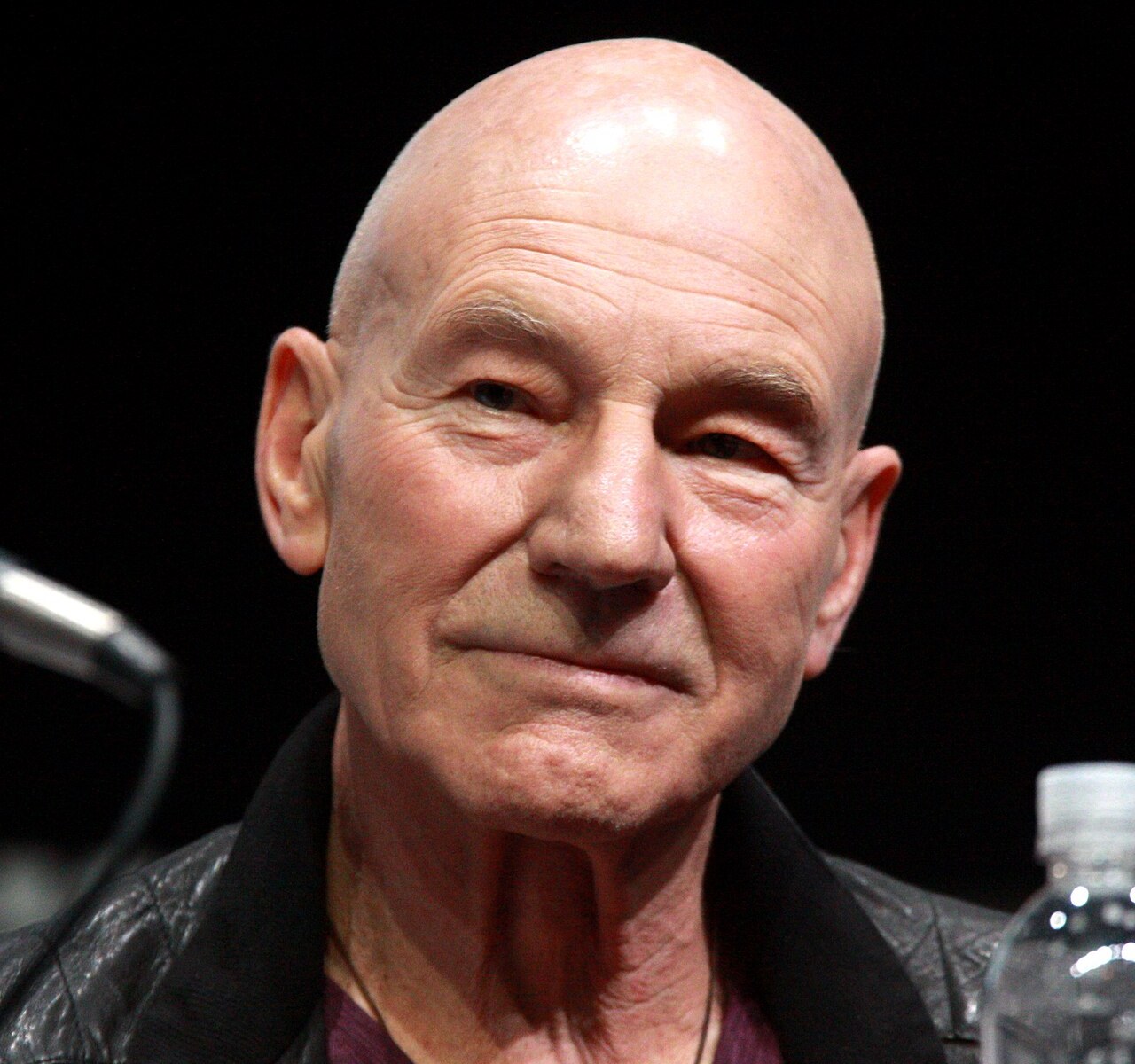
Photo: Gage Skidmore, CC BY-SA 3.0, via Wikimedia Commons
Some time in 1986, a producer named Robert Justman went with his wife to an evening lecture at UCLA. The course was on humour in the arts, and the session that night was a reading by two performers. One of them was a 46-year-old English actor with a shaved head and a voice that could fill the room without trying, who read some Shakespeare and made the audience laugh. Justman had spent the previous twenty years producing the original Star Trek and was now, reluctantly, helping Gene Roddenberry put together a sequel for Paramount. By his own account he turned to his wife during the reading and said he thought he had found their new captain.
Patrick Stewart died on Wednesday at his home in Los Angeles, at 86. His family said he had been living with Alzheimer's disease and Lewy body dementia. The obituaries this week have led, reasonably, with Jean-Luc Picard. What I find more interesting is how close he came to never playing him.
A junior reporter from Mirfield
Stewart was born in 1940 in Mirfield, a mill town in the West Riding of Yorkshire, the youngest of three sons. He left school at 15 and got a job as a junior reporter on a local paper, a job that, he said many times afterwards, he was no good at because he kept inventing details to make stories read better. His editor told him to choose between the paper and the amateur dramatics that were eating his evenings. He chose the stage.
Twenty years at Stratford
He trained at the Bristol Old Vic Theatre School and joined the Royal Shakespeare Company in 1966, becoming an associate artist the following year. He stayed with the company for the better part of twenty years: Snout the tinker in Peter Brook's famous white-box Midsummer Night's Dream in 1970, Enobarbus, Shylock, Leontes, Titus. He had lost his hair at 19 (he once said he had been in mourning for it ever since) and by his forties he was the kind of actor theatre people in Britain knew very well and almost nobody else had heard of. He appeared on television in I, Claudius and in the BBC Smiley adaptations, and he was in David Lynch's Dune, but no one would have called him famous.
"I won't have him"
Justman arranged for Stewart to come to Roddenberry's house in Los Angeles. The three of them talked for about 45 minutes. When Stewart had gone, Roddenberry said, without explanation, that he would not have him.
Justman's theory, which he set out in interviews years later, was that Roddenberry had been picturing a particular kind of Frenchman in the captain's chair: physical, virile, with a good head of hair. Roddenberry was a man who had named the character after the Piccard brothers, the Swiss balloonists and deep-sea explorers, and who had a very definite idea of a dashing adventurer. What had walked into his living room was a bald, courteous Yorkshireman who spoke like a classical actor because he was one.
So Justman kept going. He put Stewart forward again and was told no again. He has described eventually pretending to give up, announcing in a meeting that he never wanted to hear the name again, and then quietly carrying on. Rick Berman, who came on as a producer, backed Stewart, and so did the casting director. Paramount's executives, by Stewart's own telling, asked him to audition in a hairpiece, which he did, and then asked him to take it off, and decided they preferred him without. Other actors were seen for the part. Roddenberry's own preference is usually reported to have been Stephen Macht.
The story Justman told of the last day of auditions is that the final candidate read, the room went quiet, and Roddenberry sighed and said they might as well go with Stewart. That was how it was decided. Stewart himself said in later life that he was never entirely sure Roddenberry had come round to him, even after the show was a hit.
Six weeks, one suitcase
Stewart signed a six-year contract and, he said, assumed the series would be cancelled within the first season. He told the story of flying out with one suitcase and living out of it for weeks, on the grounds that it would be a waste of effort to unpack. (I have heard him tell it at least three ways, with the number of weeks varying, so take the details as an actor's details.)
Star Trek: The Next Generation went on air on 28 September 1987 with a two-hour episode called Encounter at Farpoint. Paramount did something unusual with it: rather than sell the show to one of the three big networks, it sold it directly to local stations across the country, a practice called first-run syndication that was mostly used for game shows and reruns. The studio had tried and failed to get a Star Trek revival onto television in the late 1970s and did not want to be at a network's mercy. It worked. The series ran for seven seasons and 178 episodes, finished in May 1994 with an episode called All Good Things, and was followed by four feature films with the same cast.
Stewart was 47 when the show started and 54 when it ended. He spent the next decade trying to be something other than Picard (and being, for a new generation of children, Professor Xavier in the X-Men films instead), then came back to the character for three seasons of Star Trek: Picard between 2020 and 2023. He was knighted in 2010. He never stopped doing theatre: Macbeth, Claudius, a one-man A Christmas Carol he first performed in the late 1980s and kept coming back to for decades.
The part made the man, and the other way round
The usual way of telling this story is that Hollywood got lucky and a great Shakespearean lent his seriousness to a science fiction show. I think it runs the other way as often as not. Stewart was, in 1987, a very good supporting actor who had never carried a production. Seven years of playing a captain who settles arguments by talking, who is allowed to be wrong, who reads and gardens and is embarrassed by his own emotions, made him into a leading man, and he said as much. The RSC gave him the voice. Picard gave him the authority to use it on his own terms.
Roddenberry died in October 1991, halfway through the run. The two men never became close, and a short piece of screen-test footage of Stewart reading Picard's lines with hair still turns up online every few years as evidence of what the argument was about. I think Roddenberry was simply wrong, and that he had the sense, in the end, to be wrong quietly.
Enjoyed this story?Get a new one every day on social.