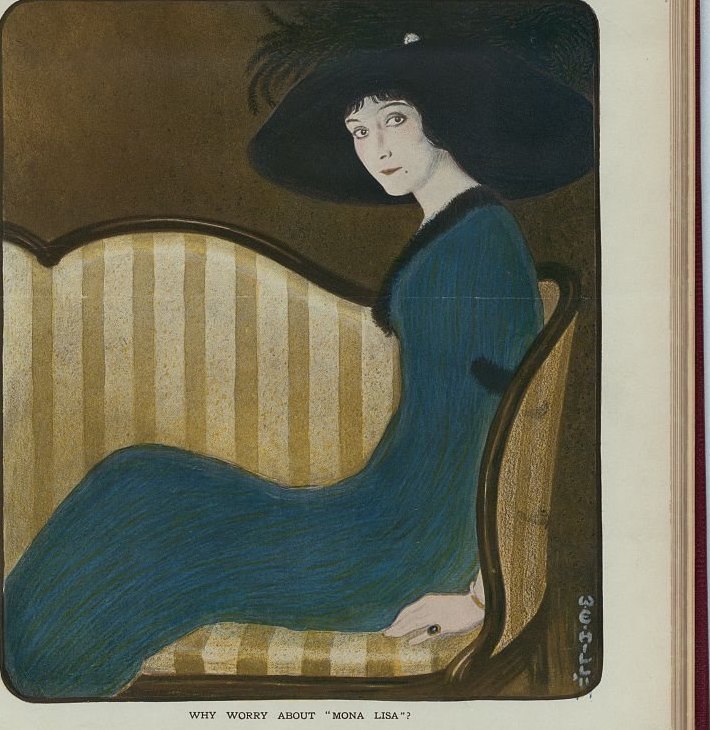
Illustration: W. E. Hill, Puck magazine, 13 September 1911, Library of Congress Prints & Photographs Division, no known restrictions
On the morning of Tuesday 22 August 1911 a painter named Louis Béroud walked into the Salon Carré of the Louvre with his easel to carry on with a picture he was working on, a view of the gallery with the Mona Lisa in it. There were four iron hooks on the wall where the Mona Lisa should have been. Béroud asked a guard, who assumed the painting was upstairs being photographed, which happened often enough. It took until the afternoon for the museum to accept that the most famous painting in the building had been gone since the previous day, when the Louvre was closed to the public and nobody had thought to look.
The police shut the museum for a week, sealed the borders and searched all thousand-odd rooms of the Louvre. Newspapers offered rewards. About a week later the reward money led the investigation to a 29-year-old Spaniard called Pablo Picasso, born in Málaga on this day in 1881, who really did have stolen Louvre property in his flat.
Two stone heads for fifty francs each
The property was not the Mona Lisa. In March 1907 a Belgian drifter named Géry Pieret, who did odd jobs for the poet Guillaume Apollinaire and called himself his secretary, had walked out of the Louvre with two small Iberian stone heads, carved in Spain some centuries before Christ and displayed in a gallery with almost no supervision. He sold them to Picasso, by most accounts for fifty francs apiece. Picasso knew where they came from, or at any rate did not ask, and he put them to use at once: the heavy-lidded, big-eared faces of the Demoiselles d'Avignon, which he was painting that spring and summer, owe a good deal to them. The sculptures sat in his studio, in plain sight of anyone who visited, for four years.
In the spring of 1911 Pieret, broke again, went back to the Louvre and helped himself to a third piece. When the Mona Lisa vanished and the papers began paying for stories, he went to Paris-Journal, handed over the statuette, and sold them an account of how easy it was to steal from the Louvre, including, in passing, the two heads he had sold to a painter in 1907.
A suitcase on the quay at midnight
Picasso and Apollinaire read the papers like everyone else and understood immediately what they had in their possession. According to Fernande Olivier, who was living with Picasso at the time and wrote about it years later, the two men packed the heads into a suitcase and walked down to the Seine around midnight with the intention of dropping them in the river. They walked up and down the quay for some time and could not do it, partly nerves, partly because two of the most noticeable men in Montmartre could not easily pitch a suitcase off a bridge unseen. They went home with the heads and handed them instead to Paris-Journal, anonymously, on the understanding that the paper would return them to the Louvre and keep quiet. The paper returned them and ran the story. On 7 September the police arrested Apollinaire, searched his flat, and took him to the Santé prison, where he spent five days. Apart from the thief, he is the only person who was ever locked up over the Mona Lisa, and he had nothing to do with it.
The painter who did not know the poet
Picasso was summoned before the examining magistrate on 8 September. Olivier says he was so frightened that morning that she had to help him dress. At the Palais de Justice he was brought face to face with Apollinaire, who had spent two nights in a cell and had already told the police everything about Pieret and the heads. Asked whether he knew the man, Picasso, by his own later account, said that he did not.
He told the story against himself for the rest of his life, so it may have improved in the telling (he also said Apollinaire forgave him, which seems true, since the two stayed close until Apollinaire died in 1918). The magistrate, Henri Drioux, decided neither man had anything to do with the Mona Lisa, released Apollinaire on 12 September and let the matter of the heads drop. The case was formally dismissed the following year.
The handyman in the broom cupboard
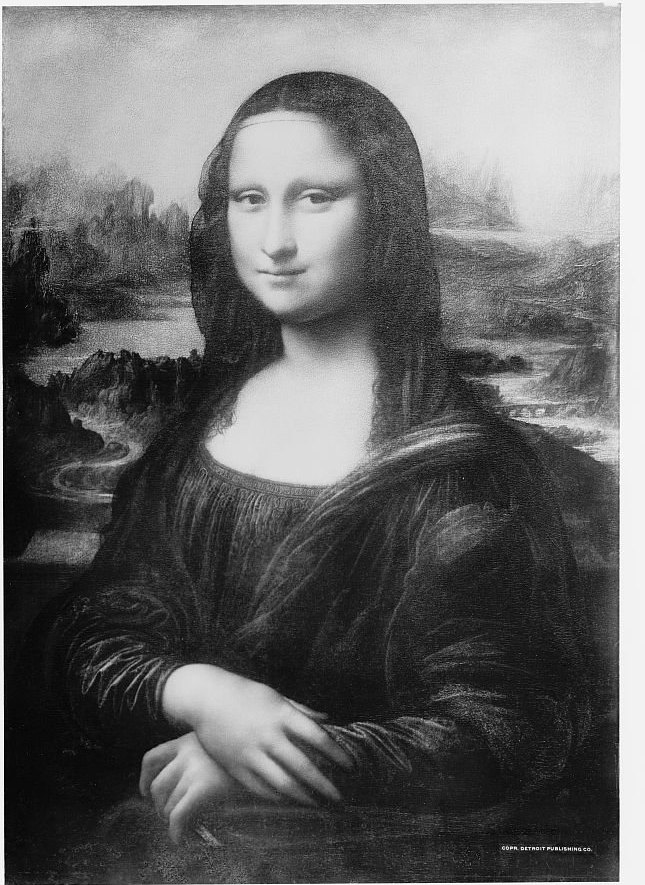
A black-and-white photographic print of the Mona Lisa published by the Detroit Publishing Co. between 1900 and 1912, when the painting was still an ordinary exhibit. Library of Congress Prints & Photographs Division, no known restrictions
The Mona Lisa turned up in December 1913 in Florence, where a Louvre handyman named Vincenzo Peruggia tried to sell it to an art dealer for 500,000 lire and a promise that it would stay in Italy. By the usual account he had hidden in a cupboard on the Sunday night, lifted the painting off its hooks on Monday morning, taken it out of the frame, put it under his smock and walked out of a side door. He served seven months. The painting went back on the wall on 4 January 1914 and has been the most visited object in the building ever since, which it was not before the theft.
The Louvre is still having trouble keeping hold of things. A year ago this month, four men with a furniture lift and an angle grinder took eight pieces of the French crown jewels out of the Apollo Gallery in under eight minutes, and as of the summer none of the jewels had been found. The museum's director resigned in February. The Mona Lisa, meanwhile, is to get a room of its own under a rebuilding plan the museum expects to finish around 2031. It will have its own entrance, which, going by 1911, is also an exit.
Enjoyed this story?Get a new one every day on social.