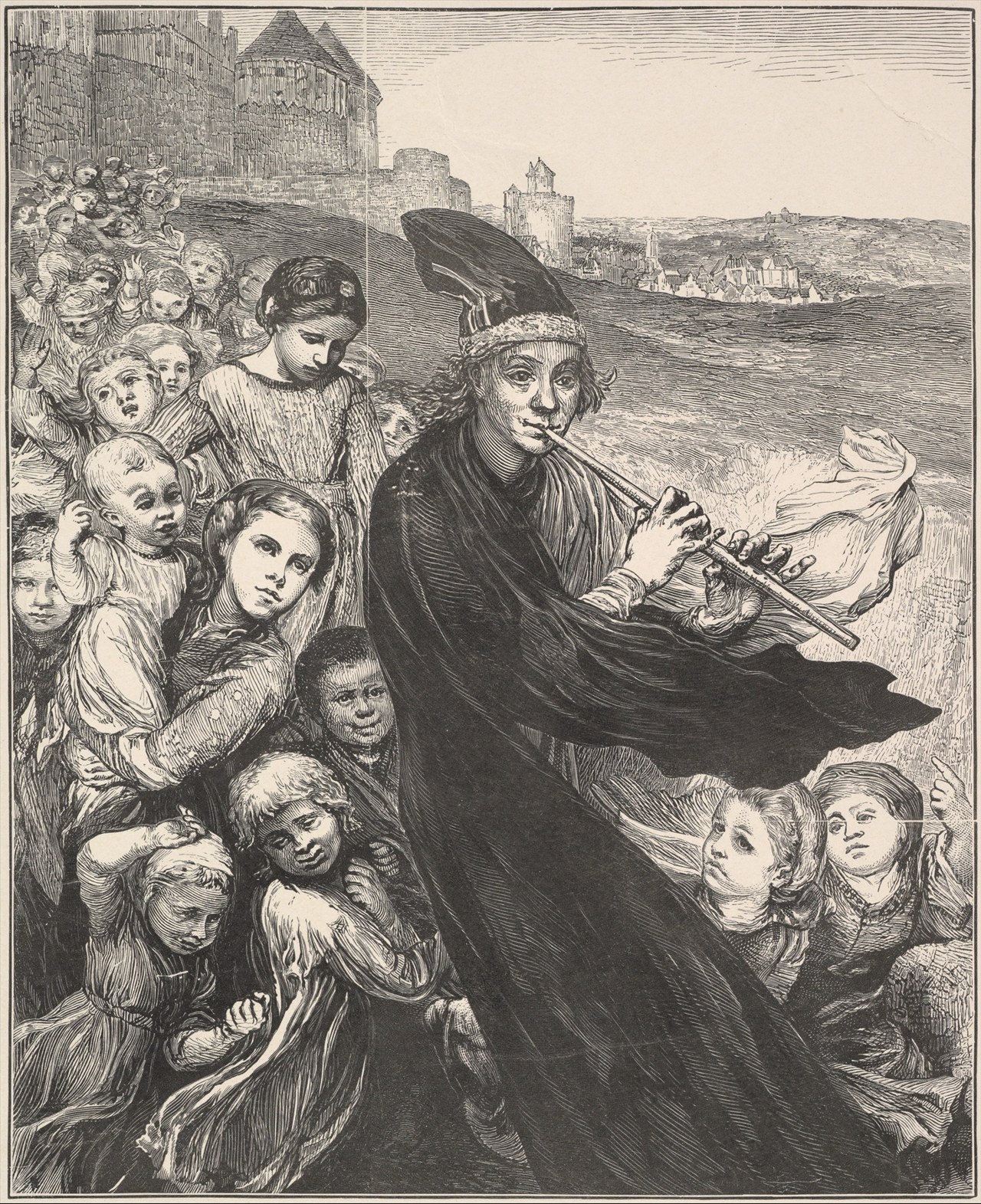
Wood engraving: Henry Marsh after John La Farge, The Pied Piper of Hamelin, 1868, The Metropolitan Museum of Art, public domain (CC0)
"In the year 1284, on the day of John and Paul, 26 June, 130 children born in Hamelin were led away by a piper clothed in many colours to Calvary near the Koppen, and lost."
That is the oldest surviving written account of the Pied Piper, and it is not a story. It is an entry, copied in the Low German of the time into a manuscript in Lüneburg around 1440 to 1450 from an older Hamelin source, and it reads like what it is: a town recording something terrible that happened to it. There is no rat in it, no unpaid fee and no magic, just a date, a number, a man in coloured clothes, a place outside the walls and the word "lost".
Most of what people know about the Pied Piper was added later, by writers who never went near Hamelin. The children are the part nobody added, and nobody has explained them.
What Hamelin wrote down
Hamelin is a river town on the Weser in Lower Saxony, and in the thirteenth century it already had a market church, a council and a habit of keeping records. Around the year 1300 the council had a stained-glass window made for the Market Church showing a piper and a crowd of children in white. The window was destroyed in 1660, but it was described and sketched over the centuries, and the earliest surviving picture of it, a watercolour copy made in 1592, is the oldest image we have of the Piper.
The town's own chronicle marks time from the event. An entry from 1384 reads simply: "It is 100 years since our children left." A chronicle compiled by the Dominican Heinrich of Herford around 1370 also records the loss of the children in 1284. The date, the Feast of Saints John and Paul, 26 June, is the same in every early source. So is the number, 130.
One more detail. The street running east from the market, down which the children were said to have gone, is called Bungelosenstrasse, which translates roughly as "the street without drums". Local custom holds that no music may be played and no dancing done on it, and the town still observes this; by tradition even wedding processions fall silent as they pass. Nobody can say reliably how old the rule is.
The rats arrive, three hundred years late
The rat-catcher is a sixteenth-century addition. The earliest known version with rats is in the chronicle of Count Froben Christoph von Zimmern, written in the 1560s, and from there the story spread to Richard Verstegan's English retelling of 1605, which Robert Browning used as the basis for his poem of 1842, the one most English readers know. Browning got the year wrong, giving 22 July 1376, which he had from Verstegan, and nobody minded.
The Brothers Grimm included the tale in their Deutsche Sagen in 1816, adding a version in which two children were left behind, one blind and one lame, and in which the rest were believed to have founded settlements far away in Transylvania. That detail, as it happens, is closer to what the historians now think than the rats are.
Why rats? Every river town with grain warehouses had them, and rat-catchers were real travelling tradesmen. A town that lost its children for no reason is an unbearable story; a town that cheated a workman and paid for it has a shape and a moral, and at some point somebody gave Hamelin that shape.
The house that remembers
In 1602 and 1603 a wealthy councillor built a tall stone house on Osterstrasse, at the corner of Bungelosenstrasse. On the side wall facing the forbidden street he had an inscription carved, in German, repeating the record: in the year 1284 on the day of John and Paul, 26 June, 130 children born in Hamelin were led away by a piper in many colours past the Calvary by the Koppen and were lost.
The building is called the Rattenfängerhaus, the Rat-Catcher's House, though it has nothing to do with the rat-catcher and was built three centuries after the children left. It belongs to the town now and houses a restaurant with Piper decor. People eat lunch there, under a sentence about 130 missing children, and most of them do not read it.
What became of them
The explanations fall into a few families. The oldest, which the Grimms' Transylvania version preserves in garbled form, is emigration. The thirteenth century was the great age of German settlement eastward, into Brandenburg, Pomerania, Prussia and beyond, and recruiters, called locators, went through the towns of Lower Saxony signing up young people with promises of land. "Children" in the chronicle (kinder, those born in Hamelin) may simply mean the town's young, not infants. The linguist Jürgen Udolph has spent decades on this, and has shown that surnames typical of Hamelin turn up in clusters in the Uckermark and Prignitz regions of Brandenburg, and that place names there echo places around Hamelin. A piper in coloured clothes would be a very good description of a locator making himself conspicuous in a market square.
Other candidates have been a children's crusade or pilgrimage, which is awkward because the famous one was in 1212; an outbreak of the dancing mania that did hit German towns in the period (a documented case in 1237 had children dancing from Erfurt to Arnstadt); a landslide or drowning in the Weser; and plague, though 1284 is early for that. There is a theory that a sect lured the children to the Koppen hills near Coppenbrügge, and another that the piper is Death and the window a memorial to an epidemic. There is also the dull possibility that the town lost its young men in a battle and recorded it in the only way it could bear.
I lean towards emigration, mainly because of the surnames, but I notice that it does not explain the Piper. Every early source has him. Something about the way the children left involved a man who was not from Hamelin and who was dressed to be looked at.
Hamelin now
The town has made its peace with the story, which is to say it sells it. The open-air Pied Piper play, performed by local people in costume on the terrace of the Hochzeitshaus beside the Market Church, is seventy years old this year; the 2026 season ran every Sunday at lunchtime from 17 May to 20 September, free, half an hour long, rats included. Bakeries sell bread rolls shaped like rats. The town observes 26 June as Rat Catcher's Day. A new Piper window was installed in the Market Church to replace the one lost in 1660.
The children remain where the chronicle left them, somewhere past the Calvary near the Koppen, on 26 June 1284. If Udolph is right, their descendants have been living in Brandenburg for 740 years under Hamelin surnames, with no idea why. If he is wrong, I do not know what happened to them, and neither does anyone else.
Enjoyed this story?Get a new one every day on social.