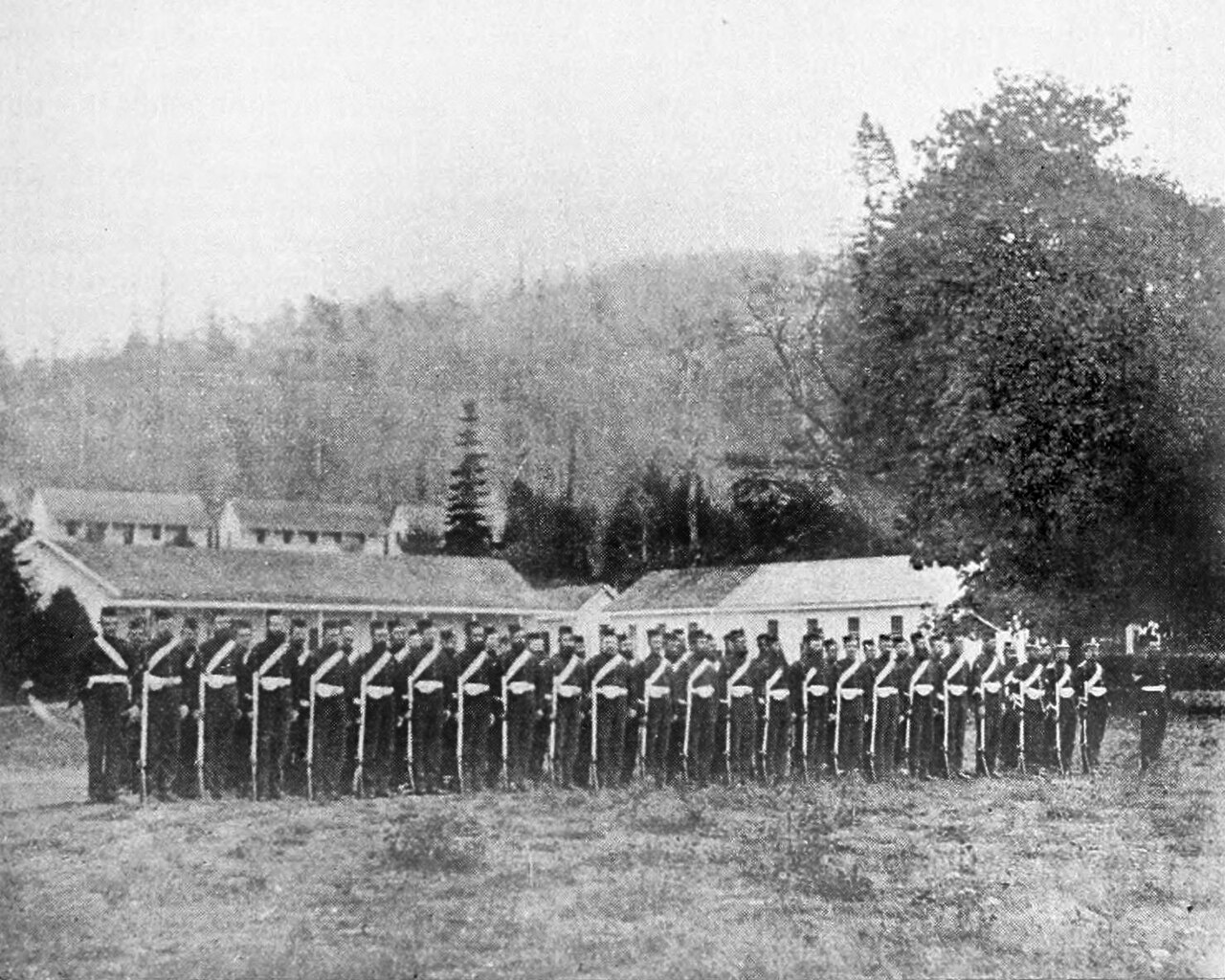
Photo: unknown photographer, 1872, public domain, via Wikimedia Commons
The only casualty of the war was a pig, and it was shot before the war began.
Everything else about the San Juan Island dispute of 1859 was real enough. Two governments sent troops. Warships anchored within range of an earthwork with field guns in it. A general who would later be remembered for one of the bloodiest charges of the American Civil War commanded the American side, and a Royal Navy admiral refused a colonial governor's direct instruction to land marines. Then the two armies settled in, a hundred men each, and stayed on the island for twelve years, holding joint dinners and the occasional athletics meeting, while the diplomats took their time.
A treaty with a hole in it
The Oregon Treaty of 1846 drew the border between British North America and the United States along the 49th parallel from the Rockies to the Pacific coast, then bent it south around Vancouver Island so that the island stayed British. The line was to run through "the middle of the channel which separates the continent from Vancouver's Island". The trouble was that there are two channels. Haro Strait runs close to Vancouver Island; Rosario Strait runs close to the mainland. Between them lie the San Juan Islands, and the treaty did not say which strait it meant.
Both sides noticed. The British read the treaty as Rosario, which put the islands in their territory. The Americans read it as Haro, which put the islands in theirs. In 1853 the Hudson's Bay Company set up a sheep station on San Juan Island, Belle Vue Farm, under a manager named Charles Griffin, partly to have facts on the ground. By 1859 some two dozen American settlers had arrived to make facts of their own, and the local American tax collector had already tried, without success, to collect duty on the Company's sheep.
The pig in the potatoes
On 15 June 1859 an American settler named Lyman Cutlar found a large black pig rooting in his potato patch. It was not the first time, and this time he shot it. The pig belonged to Griffin. Cutlar offered ten dollars in compensation; Griffin wanted a hundred. The exchange that followed is usually reported as Cutlar saying the pig had been eating his potatoes and Griffin replying that it was up to Cutlar to keep his potatoes out of the pig. I would not swear to the wording, but it is in character for both men.
The British authorities on Vancouver Island threatened to arrest Cutlar. The American settlers petitioned for military protection. The petition reached Brigadier General William Harney, commanding the Department of Oregon, a man with a long record of acting first and explaining afterwards, and he sent a company of the 9th Infantry under Captain George Pickett. Pickett landed on 27 July with 66 men and posted a notice declaring the island United States territory. Four years later he would lead the charge at Gettysburg that carries his name.
Five warships and a governor who wanted a fight
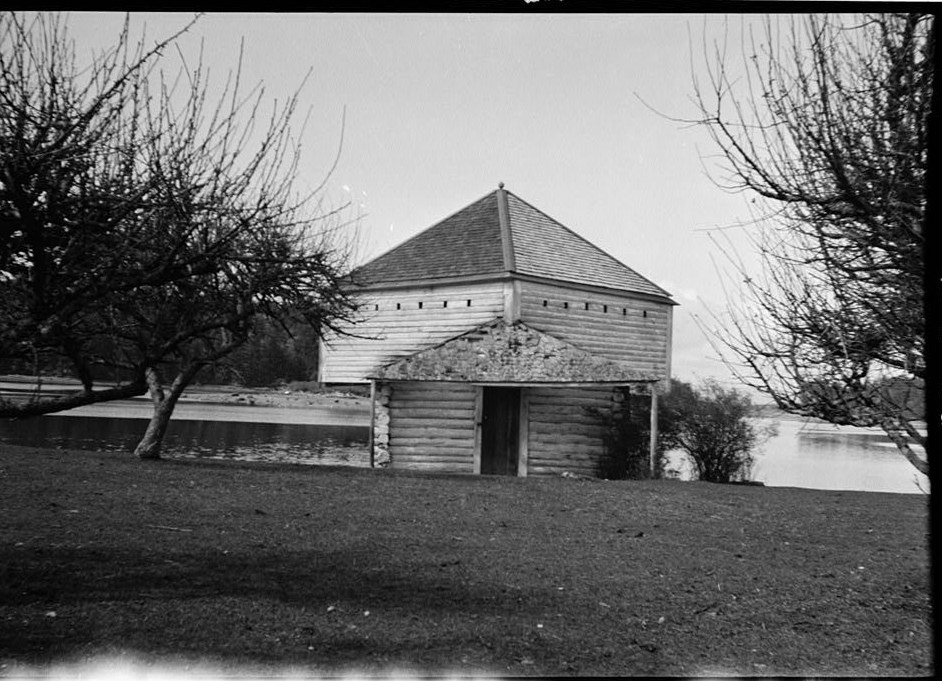
Photo: the Royal Marines' blockhouse at English Camp on Garrison Bay, Historic American Buildings Survey, Library of Congress Prints & Photographs Division, no known restrictions
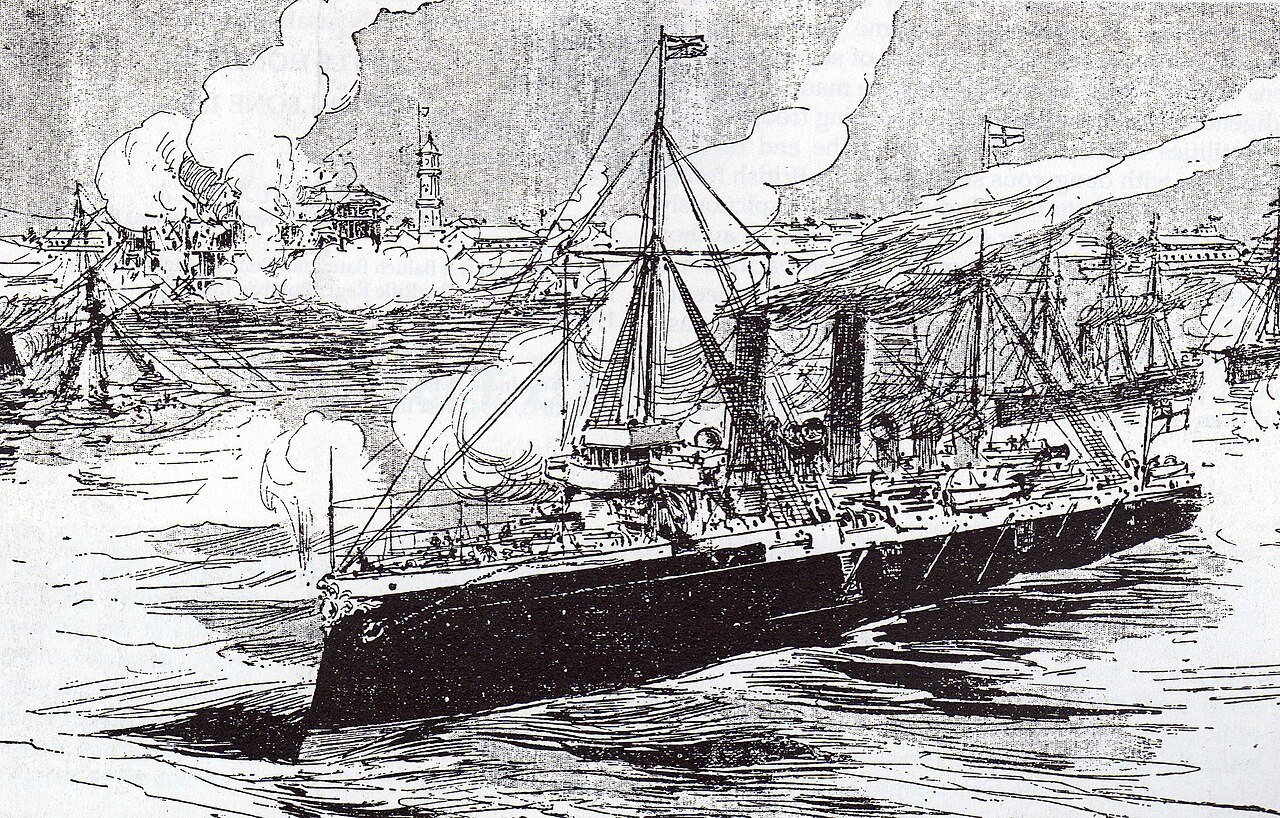
James Douglas, the governor of the colony of Vancouver Island, was not a man to let 66 American infantrymen settle a boundary question. He sent HMS Satellite, then HMS Tribune and HMS Plumper, and instructed the naval commander to land Royal Marines and remove Pickett's men. Harney responded with reinforcements. By the end of August the Americans had 461 soldiers and 14 field guns dug in on the southern end of the island, and the British had five warships offshore carrying 70 guns and 2,140 men.
What stopped it was Rear Admiral Robert Baynes, who arrived from Chile to take command of the Pacific Station and read his instructions. He declined to carry them out. He is reported to have said that he would not involve two great nations in a war over a squabble about a pig. Douglas was furious. Baynes was right, and in the end London backed him.
The orders on both sides, meanwhile, were to hold position and under no circumstances fire first. Soldiers on each side spent the late summer trying to goad the other into it, by most accounts without much enthusiasm.
General Scott arrives and everyone calms down
When news of the standoff reached Washington, which took weeks, President Buchanan's government was appalled. It sent General Winfield Scott, the commanding general of the US Army and a man who had negotiated his way out of two earlier border crises with Britain, to the Pacific coast to sort it out. Scott arrived in October 1859, removed most of Harney's troops, and reached an agreement with Douglas: each side would keep a token force of about a hundred men on the island until the boundary was settled properly.
The Americans stayed at what became American Camp on the southern tip, in the wind, beside the old sheep farm. The Royal Marines arrived in March 1860 and built a tidier post on Garrison Bay on the north-west shore, with a parade ground, a blockhouse, a formal garden and, eventually, officers' quarters up the hill. The two garrisons visited each other's camps on their respective national holidays. One of the young American officers who served there was Henry Martyn Robert, who later wrote Robert's Rules of Order, the standard manual for running an orderly meeting, which seems about right.
Twelve years, then a German emperor
The boundary question sat in a drawer through the Civil War. It came out again in 1871, when Britain and the United States signed the Treaty of Washington to settle a bundle of grievances left over from that war, and agreed to refer the San Juan question to a neutral arbitrator: Kaiser Wilhelm I of the newly united Germany. The Kaiser handed it to a commission of three experts, who met in Geneva and, on 21 October 1872, found for the Americans. The border ran through Haro Strait. The Royal Marines took down their flag and left the island in November 1872. The American garrison followed in 1874.
Both camps are now part of San Juan Island National Historical Park, established by Congress in 1966, about 2,100 acres of prairie, shoreline and forest at either end of the island. The blockhouse at English Camp still stands by the water. Every morning a park ranger, who is an employee of the United States government, raises a Union Jack over the old parade ground, and every evening takes it down again.
Enjoyed this story?Get a new one every day on social.