Photo: Jamie Heath, CC BY-SA 2.0, via Wikimedia Commons
A man walks up to a counter on a street corner a little before midday, puts a coin down, and points at one of the big jars set into the top. The woman behind the counter ladles something hot into a bowl for him: lentils, probably, or a stew with bits of goat in it, with a chunk of coarse bread and a cup of wine cut with warm water. He eats standing up, with his elbow on the painted marble, looking at the picture of a rooster on the front of the counter. Then he goes back to work.
That was lunch in Pompeii for most of the people who lived there, and it happened at about eighty places like it across a town of perhaps 12,000. The one I have in mind is in the north of the city, in the district archaeologists call Regio V, and it was dug out of the ash in 2019 and 2020 with its jars still full. It is the only one of Pompeii's fast-food counters to have been excavated completely and in one go, and it has told us more about what ordinary Romans ate than any amount of Apicius.
A town without kitchens
The thing to understand about Pompeii is that most of its inhabitants could not cook at home. The grand houses had kitchens, slaves and storerooms. Everyone else lived in rooms above shops or in small apartments with no hearth, no chimney and no safe place for a fire. Wood was expensive, water had to be carried, and a brazier in a wooden upper room was how whole blocks burned down. So people bought their hot food, and the trade that fed them has left its mark on nearly every street.
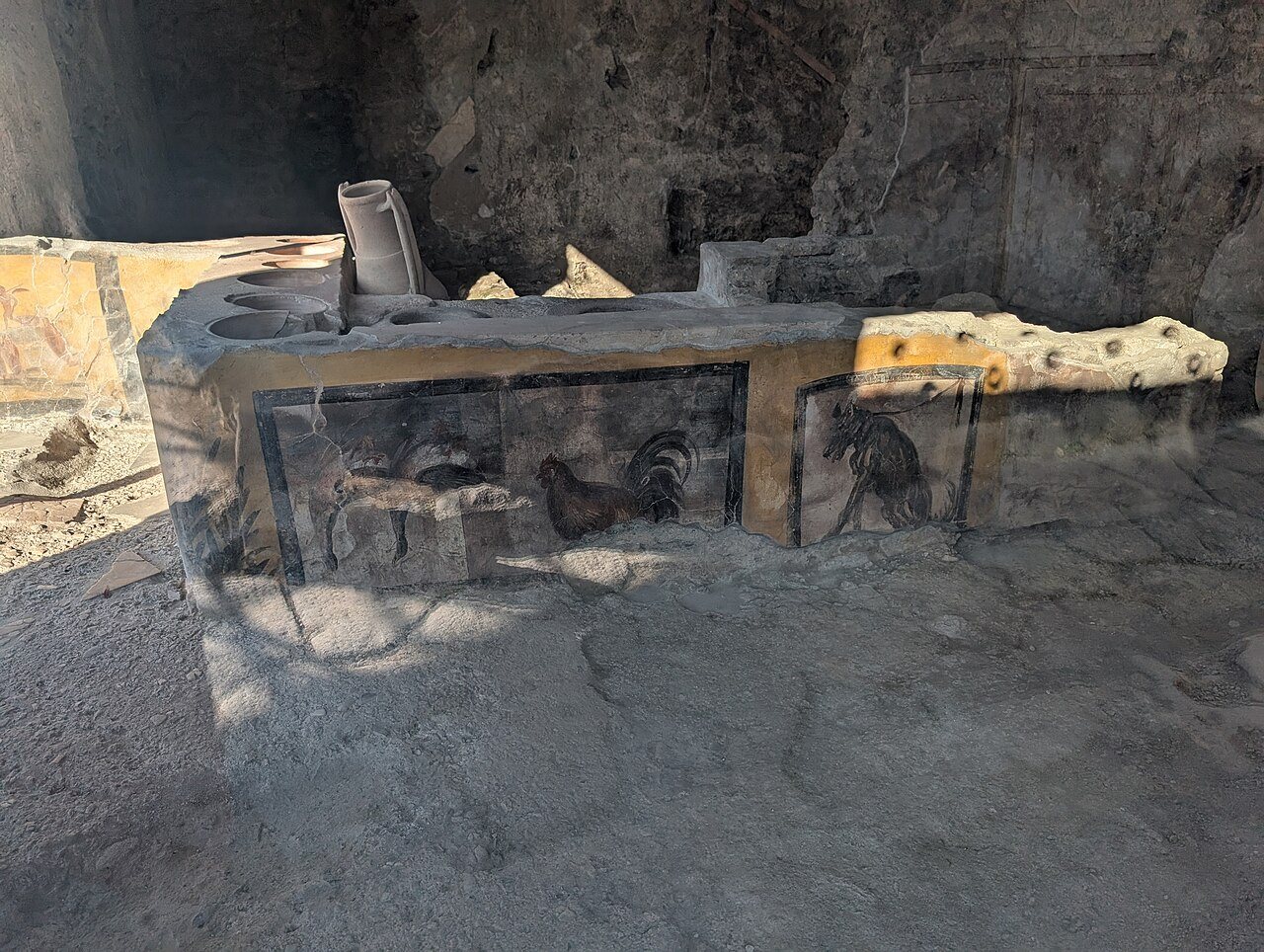
The Romans had several words for these places and used them loosely: popina, taberna, caupona. The modern term, thermopolium, is a Greek word meaning roughly "a place that sells hot things", and it appears in Plautus, though it is not clear the Pompeians themselves used it. What they looked like is not in doubt, because the city is full of them. A masonry counter, usually L-shaped, faces the street. Set into its top are the mouths of large earthenware jars, dolia, in which food and drink were kept and sometimes kept warm. Behind it there is often a small back room, and above it, up a staircase, rooms to rent.
What was in the jars
The Regio V counter came to light at the junction of two lanes, the Vicolo delle Nozze d'Argento and the Vicolo dei Balconi, during work to stabilise the edge of the unexcavated part of the city. The first corner of it appeared in 2019; the full excavation ran through 2020 and the results were announced the day after Christmas that year.
The counter is painted. On its front, in bright colours, is a sea nymph riding a seahorse, a cock, two mallards hanging upside down by their feet, and, on the short side, a black dog on a leash with its teeth showing, which I take to be the ancient equivalent of a sign on the gate. The ducks and the cock were the menu as much as the decoration. When the contents of the dolia were sampled, the archaeologists found fragments of duck bone in one, and in another a mixture of pig, goat, bird, fish and land snail, all cooked together in something a modern Neapolitan might recognise as a stew or a paella. At the bottom of a wine jar were crushed fava beans, which Roman writers recommend for lightening the colour and flavour of cheap wine. There was a bronze ladle, nine amphorae, flasks, and a two-handled ceramic pot of the sort you serve from.
Scratched into the painted frame around the dog, in untidy capitals, somebody had left an insult aimed at a man named Nicia, who was presumably the owner or a regular, and whose sexual habits the writer had views on. It is the kind of thing that turns up on Pompeian walls everywhere, and it is a useful reminder that these counters were social places as much as kitchens, where men drank, played dice and quarrelled.
The bones
There were also people. In the back room the team found the skeleton of a man of about fifty, lying on what seems to have been a bed, who did not get out when the ash came. Bones of a second person turned up inside one of the dolia, which the excavators read as the work of tunnelling treasure-hunters in the seventeenth or eighteenth century, who disturbed a body and pushed what was left into the nearest hole. And there was a dog, a small one, about twenty centimetres at the shoulder, fully grown, found near the counter. A dog that size in the first century was a pet, not a guard, and I think it belonged to whoever ran the place, rather than to the snarling animal painted on the front.
Four emperors against lunch
What the men who ran Rome thought about all this is on record, and they did not approve. Suetonius says Tiberius had the market inspectors restrict the cook-shops and forbade them even to sell pastries. Dio tells us Claudius shut the taverns where people gathered to drink and ordered that no boiled meat or hot water be sold in them. Under Nero, Suetonius writes, the taverns were forbidden to sell any cooked food except pulses and vegetables, where before they had offered every kind of dish. Vespasian, a generation later, repeated the ban on anything but beans.
Four emperors in sixty years passed what amounts to the same law against hot lunch, and the only sensible conclusion is that it never worked. Rich Romans regarded the popina as a sink of drink, gambling and bad company, and emperors regarded any place where working men gathered as a political problem. The Pompeii counters, with their painted ducks and their stews of five meats, were operating in open defiance of at least the spirit of those rules in 79, and nobody seems to have minded.
The one that was dug out in 2020 was fitted with a new wooden roof over the counter to protect the paintings, and on 12 August 2021 it opened to the public, which can come up the lane and look at the counter from about where the customers stood, through a sheet of glass, and not eat. The jars are empty; the duck and the goat and the snails went to the laboratory. The paint on the ducks and the dog is still bright enough that you can see them from the far side of the lane, which is more than can be said for most of what was on the walls of the grand houses up the hill.
Enjoyed this story?Get a new one every day on social.