Photo: US Department of Defense, Defense Visual Information Center, public domain, via Wikimedia Commons
The head of US Central Command, Admiral Brad Cooper, was in the Strait of Hormuz last week to say that the shipping lanes had been cleared of Iranian mines and that commercial traffic would keep moving. The president has said he has "a decision to make" about Iran, between a deal and resuming the strikes that began in February, and that he will not make it before next Tuesday's midterm elections. A third aircraft carrier group is on its way to the region. Eight months into the war, there is a feeling of nothing new under the Gulf sun, and in one respect that is right. Mines, tankers, a blockade, oil platforms and a short, sharp naval battle: the United States and Iran did all of this once before, in 1987 and 1988, and nobody involved would have called it a war.
The Tanker War
The background was somebody else's war. Iraq had invaded Iran in September 1980, and by 1984 the fighting on land had stalled into trenches and poison gas, so both sides took it to sea. Iraq's planes attacked tankers loading at Iran's Kharg Island terminal; Iran, which could not reach Iraq's oil because Iraq exported it by pipeline, attacked the ships of the Gulf states that were lending Iraq money, Kuwait above all. By one count more than 500 merchant vessels were hit over the course of the war, and several hundred sailors were killed.
In late 1986 Kuwait asked both superpowers for help. The Reagan administration put eleven Kuwaiti tankers under the American flag, which made attacking them an attack on the United States. The operation was called Earnest Will, and it began badly: on 24 July 1987 the first convoy was steaming towards Kuwait when the supertanker Bridgeton struck a mine. The tanker shrugged off a hole the size of a house. The three warships escorting it, which would not have, fell into line behind the tanker and let it lead them through the minefield. Nobody at the Pentagon enjoyed the photographs.
Mines with serial numbers
Two months earlier, on 17 May, an Iraqi jet had put two Exocet missiles into the frigate USS Stark and killed 37 American sailors. Iraq said it was a mistake and apologised. The deadliest single blow to the US Navy in those waters, in other words, came from the side Washington was quietly helping.
Iran's weapon of choice was older and cheaper. On 21 September 1987 American helicopters flying at night caught an Iranian landing ship, the Iran Ajr, dropping mines into the shipping lane. They shot it up, and a boarding party found ten more mines on deck, each with a serial number. In October an Iranian missile hit one of the reflagged tankers in Kuwaiti waters, and the US Navy replied by shelling two Iranian oil platforms it said were being used as lookout posts. A pattern had been set: Iran did something deniable, the Americans hit a platform.
14 April 1988: the Samuel B. Roberts
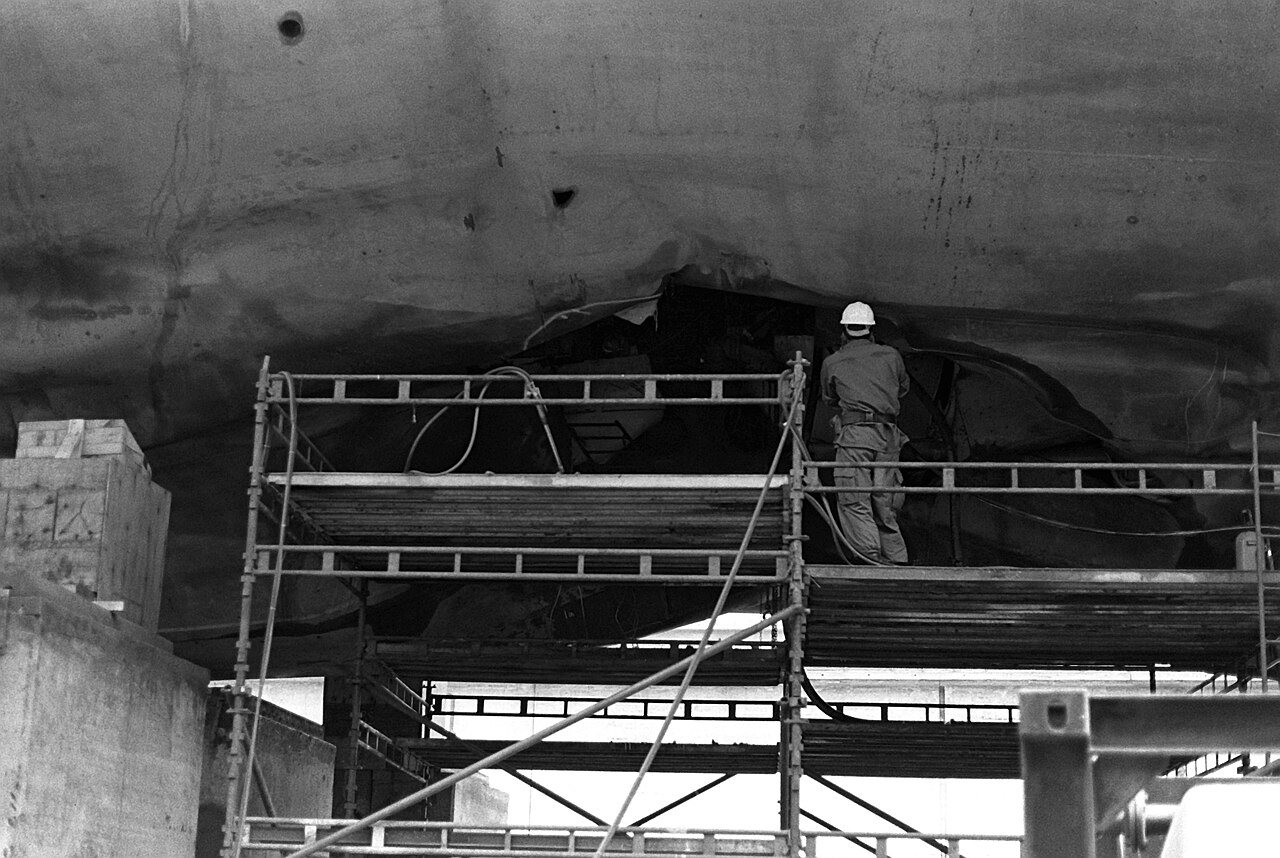
The pattern broke on the afternoon of 14 April 1988. The frigate USS Samuel B. Roberts was returning from escorting a convoy when a lookout saw mines in the water ahead. The captain, Paul Rinn, stopped the ship and tried to back out along his own track. The frigate struck a mine anyway, under the stern. The blast lifted the ship, broke its keel, tore a hole some 15 feet across and set the engine room on fire. Ten men were injured and none died, which was mostly down to the crew, who spent five hours fighting fire and flooding in a ship that could have broken in two. The Roberts was towed to Dubai. Divers who went back to the minefield found more mines, and the serial numbers matched the batch found on the Iran Ajr seven months earlier.
18 April: Praying Mantis
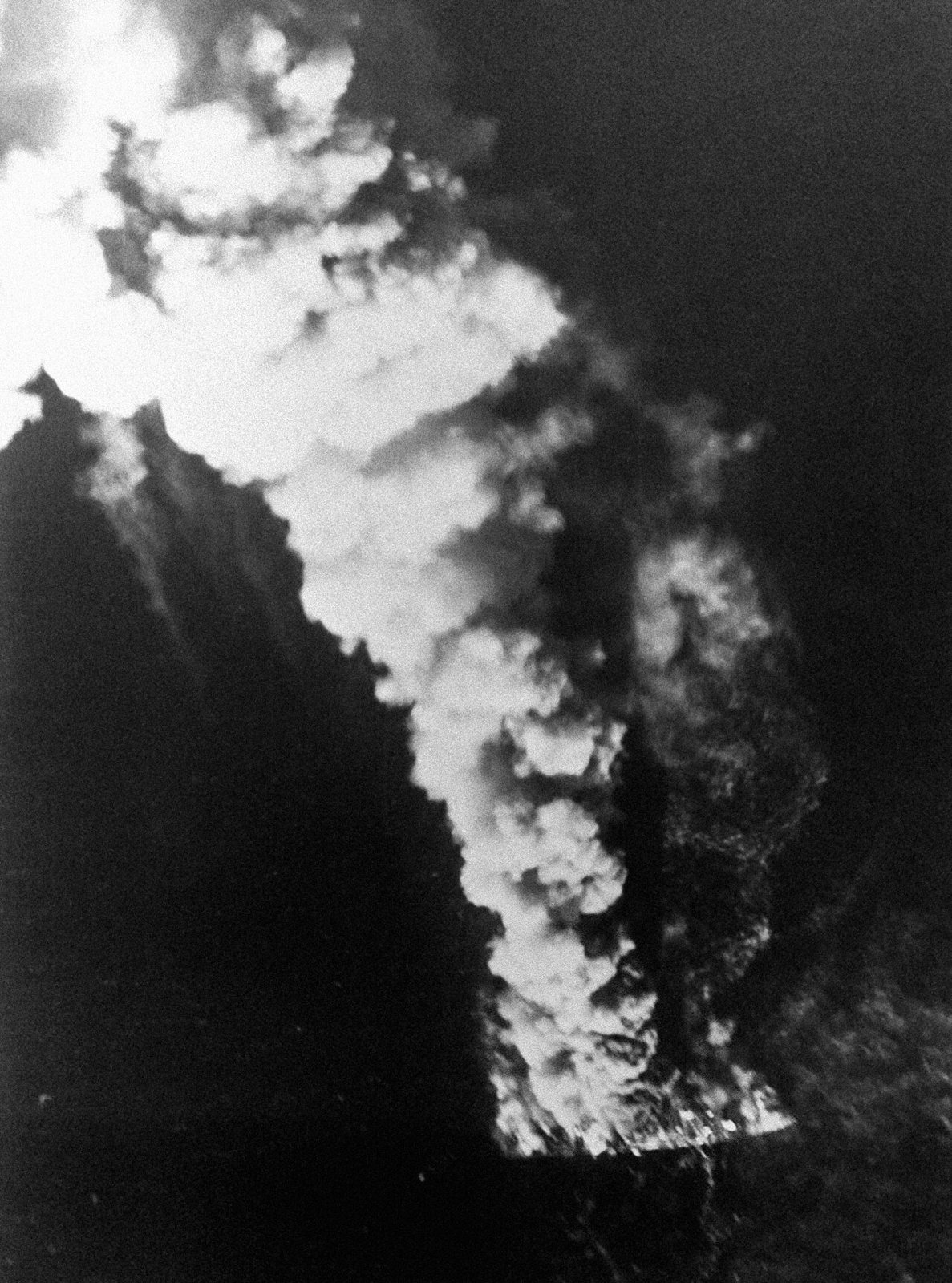
Aerial photograph of a column of black smoke rising from the Iranian frigate Sahand after the US air attack of 18 April 1988. US Navy photo, public domain, via Wikimedia Commons
The reply came four days later and lasted a day. Operation Praying Mantis, on 18 April 1988, was the biggest surface action the US Navy had fought since 1945, and it went roughly to plan.
Three groups of warships sailed at dawn. Two went for Iranian oil platforms, Sassan and Sirri, that were being used as military posts; the crews were warned by radio to leave, most did, and the platforms were shelled and then blown up by Marines who boarded them. The Iranian response was the part the planners had not scripted. A small missile boat, the Joshan, came out to fight, was warned off five times, and fired a Harpoon anti-ship missile at the cruiser Wainwright. The missile missed (the Americans had fired chaff, and the Joshan's missile may have been faulty), and the Joshan was sunk by a volley of missiles and gunfire.
Then, in the afternoon, Iran's navy sent out its frigates. The Sahand fired at American aircraft and was hit by bombs and missiles from the planes and from the destroyer Joseph Strauss; it burned for hours and sank that night. Its sister ship, the Sabalan, came out after it and took a single laser-guided bomb down the funnel that left it dead in the water. The pilots were lined up to finish it off when the order came from Defense Secretary Frank Carlucci to let it go. It was towed home to Bandar Abbas and repaired. The Americans lost one helicopter, a Marine Cobra that crashed in the dark with its two crew; the navy's finding was that it was not shot down.
The same day, by no coincidence, Iraq's army retook the Faw peninsula. Three months later Iran accepted the United Nations ceasefire resolution it had refused for a year, and the Iran-Iraq War ended in August 1988. Historians disagree about how much the day at sea had to do with it, but Iranian leaders at the time plainly believed the Americans had entered the war on Iraq's side.
The worst day came after
The story does not end on 18 April, and it is dishonest to tell it as if it did. On 3 July 1988 the cruiser USS Vincennes, in a confused engagement with Iranian speedboats inside Iranian waters, fired two missiles at a radar contact its crew believed was an attacking F-14. It was Iran Air flight 655, an Airbus on its scheduled run from Bandar Abbas to Dubai, and all 290 people on board were killed. The United States expressed regret but never apologised, and in 1996 paid about 62 million dollars to the families in a settlement that admitted no liability. In Iran, that day is remembered far more than Praying Mantis is remembered in America.
Eleven years in The Hague
Iran also went to court. In 1992 it sued the United States at the International Court of Justice over the destroyed platforms, under a 1955 treaty of friendship signed when the Shah was in power that neither side had got round to cancelling. In November 2003 the court ruled that the American attacks could not be justified as self-defence, since the United States had not shown that the platforms were the source of the attacks on its ships, and then declined to award Iran any damages, because the platforms were not exporting oil to the United States at the time. Both sides claimed a win. Washington tore up the treaty in 2018.
That earlier confrontation was fought in the same water, over the same tankers, around the same platforms, with mines from the same navy, and it ended with a ceasefire in somebody else's war, a shot-down airliner and a court case nobody won. What the 2026 version ends with is still being decided, and the people deciding it have said they will not say until after 3 November.
Enjoyed this story?Get a new one every day on social.